
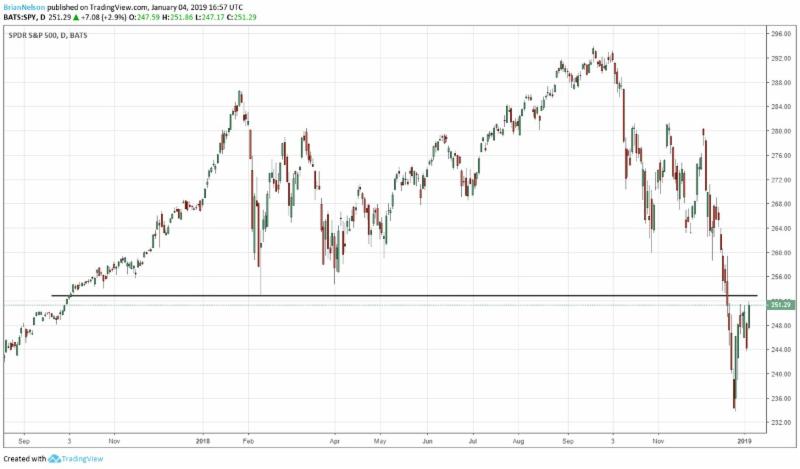
Image shown: The S&P 500 ETF (SPY) since August 2017. The index has broken through support and is now bouncing back to resistance.
By Brian Nelson, CFA
Good morning everyone,
Are you watching these markets? This is incredible. The Dow finished down 660 points yesterday (briefly dropping 700 points), and today, the Dow is currently trading up 600 points at the time of this writing. Granted, there was Apple’s (AAPL) poor first-quarter 2019 guidance yesterday and the strong jobs report today, but this volatility is not “normal,” no matter what others are saying.
A couple announcements up front. For those that already ordered our book Value Trap, I will send you the pdf download to your email address just to make sure you have it. You only have a certain amount of time to download the file after purchase, but I want to make sure you have it. Let me know if you don’t get that email today. Also, please review the book on Amazon here. It would mean so much to me.
I’ll also be setting up a walk-through of the website and the stock and dividend reports in the coming days, so please stay tuned. The date will be in January, and once I have it, I’ll send out an invite to everyone! This will be one of the first times it will be an open invite. Hope you’ll join! But please — read Value Trap before the call (purchase a digital pdf copy here).
There’s a lot to worry about with the structure of this market, something we talk extensively about in our new book Value Trap. The Dow had the worst trading session for a Christmas Eve ever. The day after Christmas was the biggest one-day point rise in the Dow ever, and the Thursday of that holiday week experienced the biggest intraday swing for the Dow since 2011.
It’s the intra-day swings that are the most unusual. For example, according to data from SentimenTrader, there has only been one other day since 1984 (35 years ago!), where the S&P 500 was lower by 2% at 2:30ET and surged to finish up more than 0.5%. I think this is where many that are measuring volatility are missing the mark.
For example, earlier this week, January 2, we opened nearly 400 points lower on the Dow, surged mid-day, dropped again, and then finished roughly flat, up 0.08%. Those measuring volatility in the traditional sense (prior close versus prior close data) would not have picked up the large intra-day swing, and this is the type of volatility that is very unusual. Treasury Secretary Steve Mnuchin has said market structure is a cause for concern, but many are taking this to be “computers,” “machines,” “algorithms,” or “high-frequency trading.”
I believe it is much more than this. I believe it is all price-agnostic trading, meaning traders that are willing to pay just about anything for stocks, irrespective of their absolute enterprise value, whether it’s a quantitative trader or an indexer saving for retirement. The market structure is vastly different that even a few years ago.
Though Apple’s news yesterday and the jobs report today are two fundamental and economic data points we can point to that would cause some volatility, respectively, that the markets cratered yesterday and are now surging today is only being exacerbated by this price-agnostic trading. This market is simply whipsawing, and we think levels of volatility may only get worse.
We recently moved to being “fully invested” in the simulated Best Ideas Newsletter portfolio and simulated Dividend Growth Newsletter portfolio, and this seems somewhat counter-intuitive given our concerns about market structure. However, the very idea that this market could spin uncontrollably upward is not a scenario we want to sit out. Not all volatility is bad to returns. Today, we’re experiencing significant upside volatility (vol).
Just a quick note on a few things. It was great to see one of the highest-rated ideas on the Valuentum Buying Index, Celgene (CELG), surge yesterday. Our process is working. 2018 included some savvy moves in the simulated Best Ideas Newsletter and simulated Dividend Growth Newsletter portfolio by capturing “alpha” due to our outsize cash weighing. The very top-weighted idea at the end of 2017 in the simulated Best Ideas Newsletter portfolio, Visa (V), was a standout performer, too.
But there is something else I want to mention. I think Valuentum faced one of its biggest challenges during 2018. At our core is a drive to help investors make better decisions. Putting investors first is all we know how to do. We’re completely independent, and in late 2017, we made the decision to help investors in the high-yield dividend space. We knew it wouldn’t be easy, and we let our members know how challenging it was.
But we did well. As our high-yield dividend benchmark swooned during the year, the average return of our ideas came in better than expected, and most importantly, not one idea cut its dividend or distribution. As you know, we cover a lot of ground at Valuentum, and what I’m really aiming for is to have a rich conversation with you, a genuine conversation about intrinsic values and how momentum fits into the picture.
I think reading Value Trap will get us to a common language, but we’re always available for any questions you may have, too. When you subscribe to Valuentum, you partner with us! One last thing: I am so grateful for you and your interest. Seeing our members’ response to Value Trap had me tearing up. It’s a book about my personal journey, and the feedback that many of you have provided thus far has been truly wonderful.
Thank you for being here!
—–
Valuentum members have access to our 16-page stock reports, Valuentum Buying Index ratings, Dividend Cushion ratios, fair value estimates and ranges, dividend reports and more. Not a member? Subscribe today. The first 14 days are free.
Brian Nelson does not own shares in any of the securities mentioned above. Some of the companies written about in this article may be included in Valuentum’s simulated newsletter portfolios. Contact Valuentum for more information about its editorial policies.