
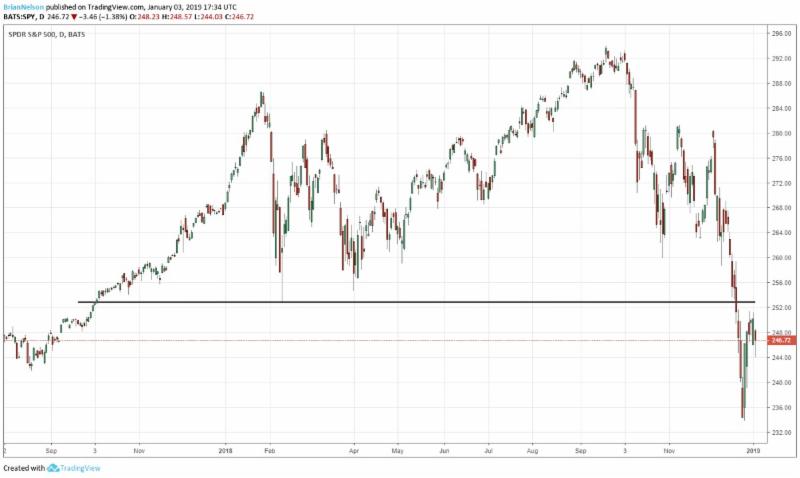
Image shown: The S&P 500 ETF (SPY) since August of last year. The markets have broken through key support levels, and now support has become resistance. Volatility remains heightened since the low-vol ETN blew up in February.
This article is the introduction to both the Dividend Growth Newsletter and High Yield Dividend Newsletter, both of which will be released today due to the holiday January 1.
By Brian Nelson, CFA
Markets are facing big pressure on the trading session January 3.
There’s more to the story than rising interest rates. There’s more to the story than the US-China trade war. There’s more to the story than concerns about the political environment. Price-agnostic (indexing and quant) trading, as I outline in Value Trap, could really take this market on a wild spin. The Dow is trading off aggressively in part due to Apple’s poor first-quarter 2019 guidance, which we believe is the warning shot across the bow for more to come. As I’ve been saying for some time, fasten your seatbelts.
Right now, we played this market well during its multi-year upswing, and we capitalized on the large cash “weightings” in the simulate newsletter portfolios once the markets swooned in unprecedented fashion in December. Regardless of what you may have heard, the month’s trading activity was not “normal.” Now, we’re playing with all of our chips on the table in the simulated newsletter portfolios. That means, we’re watching this market like a hawk. We were expecting heightened volatility, and we know you were expecting heightened volatility. At this point, however, it is all about how to play it “correctly,” without taking on too much premium risk, which erodes with time.
A lot of members have been asking about put options. To put it simply, put options are a speculative bet (and they are a bet) on the price decline of a given security, whether it is a stock or ETF. For example, if I wanted to bet on the price decline of the S&P 500 ETF (SPY) over a certain time period, I would buy put options at a specific strike price for a specific premium (in the money or out of the money or at the money). The longer time duration of the option, the more expected volatility of the asset, and how far away the strike price is away from the trading price are major factors in the price of a put option.
If the security price goes down, the price of the put option goes up, all else equal. If the security price goes up, the price of the put option goes down, all else equal. However, the eroding time value of options and the uncertainty of how volatility is factored into the pricing coupled with large bid/ask spreads make any options trading quite risky. Most options expire worthless, meaning most that buy options often lose their entire premium, so they are dangerous vehicles. We don’t dabble in these derivatives much at all, and at most, we’d only risk about 1-3% of the simulated newsletter portfolios at any time. You can lose a bundle in options. Please be careful. Always talk to your personal financial advisor if any of these risk-mitigation techniques may be right for you.
That said, I believe the markets could have a long way to go downward, particularly if price-agnostic trading accelerates the fall, but while we have our fingers on the put-option trigger, we’re not rushing to add protection yet. Markets tend to ebb and flow, and if we’re going to add protection to the simulated newsletter portfolios, it will be on a strong series of up days and when the markets calm down, not on what is shaping up to be one of the worst days on Wall Street for some time after a heightened period of volatility. If we acted today, we’d be paying up the nose for put-option protection, and it’s very likely most will not end up in the money as a result. At this juncture, we’re going to feel some pain in both the simulated Best Ideas Newsletter portfolio and simulated Dividend Growth Newsletter portfolio, but we’re not going to make it worse by overreacting.
As for the simulated High Yield Dividend Newsletter portfolio, it is important to remind you that high yield dividend investing is synonymous with high risk. Remember: these are companies that, almost by default, do not generally cover their dividends/distributions with internally-generated free cash flow (cash flow from operations less all capital spending) and are dependent on a healthy credit and equity market to keep paying such dividends/distributions. The size of their yields can turn a lot of heads sometimes, but you have to understand that, while the market is inefficient, in my view, it is not that inefficient where it would misprice risk so terribly to allow a 10%+ yielding equity when the 10-year is yielding under 3%. That 10%+ yield simply means tremendous risk. Here’s what we said in the inaugural January 2018 edition (pdf) of the High Yield Dividend Newsletter, from 12 months ago:
It couldn’t have been 15 years ago, for example, that investors could get a 6%+ yield on a 1-year certificate of deposit (CD) from the local bank. I know because I had one. Now, look at the risks investors have to take to get that kind of yield. Please always work with your personal financial adviser or seek professional help to determine if any idea or strategy may be right for you.
Said bluntly, the ideas in the High Yield Dividend Newsletter may not be your cup of tea. It sounds so silly for us to feel the need to say this, but stock prices can go down, and equities with high yields often have an investor base solely focused on the yield. In the event that a high-yield equity comes under suspicion of a dividend cut, its price may experience a considerable decline in advance of the dividend cut, resulting in not only capital impairment but also reduced income if the dividend cut happens.
We’ve seen this too many times before to count, but we’ve always cautioned about the risk of high yielders, avoiding them whenever possible–now, in this (High Yield Dividend) newsletter, we’ll be steering through the universe. We are playing in a mine-field with respect to navigating the high-yield space. Frankly, it’s like “no-man’s” land during World War I, and most of our efforts will be spent hunkering down in the trenches, trying to avoid stepping on what could be called high-yield landmines. We think success in the simulated High Yield Dividend Newsletter portfolio will come from avoiding “unforced errors,” and avoiding mistakes, rather than simply chasing the highest yields. If we venture out too far into “no-man’s” land, we could get burned.
We’re also worried about the general make-up of the equity markets today. With the proliferation of index investors and quantitative investors, many of whom are using backward-looking information, not many market participants are paying attention to the price-to-estimated fair value consideration. This has considerable implications on the traditional underpinnings of equity valuation and the thousands of books written on “value investing” in decades past. If, for example, very few are paying attention to the price-to-estimated fair value equation, will stocks ever be bid toward their fair values again? We think so, of course, but with estimates suggesting only 10% of trading on the markets today is coming from traditional, fundamental investors, we’re taking note of the risks.
I love our subscribers, and I can never thank you enough. I genuinely care about you. Sometimes, I catch a lot of flak for focusing too much on the risks and the negatives, but you have to understand: the good stuff takes care of itself. You know this. Your efforts should be mostly spent on protecting the downside. I want you to continue to be skeptical of the high-yield dividend space, and always diversify, diversify, diversify–between asset classes, too. In the second edition of the High Yield Dividend Newsletter (pdf), I pounded the table on what we were up against (last February).
Let’s talk a little about the stock market now. The bull market we are currently in can be viewed about average when compared to other bull markets in history as it relates to duration and total return, but that is what concerns me. If we’re talking about average bull markets, then we need to talk about average bear markets, too. The average bear market is fast and cuts deep, with total losses to the tune of 40%, on average. If you’re not one to believe in valuation, then you’re one to believe in bull markets. And if you believe in bull markets, then you must also believe in bear markets, and bear markets are very, very painful…
I think it is important that we continue to emphasize that high yield dividend investing is very risky. I spent a lot of time in the inaugural edition on the topic of risk, but it is worth emphasizing yet again. For starters, even if we identify solid, high-yielding companies and their fundamentals hold up under adverse market conditions, you can’t forget that a market is made up of buyers and sellers that are focused on achieving goals. If yields on fixed-income instruments continue to shoot up, then investors will start to anticipate a continuation of that trend–and start to prepare to reallocate capital to better risk-adjusted opportunities, long before any perceived tipping point actually occurs with yields. This means that they may start selling the very ideas in the simulated High Yield Dividend Newsletter portfolio, pressuring their shares.
…
I care. I want you to think about your goals and risk tolerances. Can you tolerate a 40% drop in wealth as in an average bear market? If not, should you be in stocks? If you can’t handle the tremendous risks of a rising interest-rate environment on the prices of high-yield dividend-paying equities, is this an area that you should be involved with? As yields on certificates of deposits start to reflect rising near-term rates, what might be a better fit for you and your retirement goals? Only you and your financial advisor know the answer to these questions. What I am worried about is that there may be investors that aren’t aware of the tremendous risks, and as a result of this multi-year bull market, are taking on risks that they don’t know enough about. The stock market doesn’t go up in a straight line.
Remember folks: the value of a research publisher is to get the risks in front of you, right away. Our customers come from all over, from Seeking Alpha, YahooFinance, Barron’s, and social media and beyond, but I see a lot of content that is often very one-sided in the blogosphere, and a lot of authors on these blogs may not be independent. As I talk in my book, Value Trap, many these days are conflating ownership of a stock with expertise. You know better: Just because someone owns a stock does not make them an expert on investment analysis. I believe Valuentum’s independent opinion is so very important in bull markets and in bear markets. We don’t get everything right, but you know we’re telling you how we think it is.
As I wrap up, I can’t begin to tell you just how happy I am to be back in full swing after finalizing the book, Value Trap. I have priced the book in such a way where I hope that everyone will read it. It is a jam-packed 350 pages of content with tons of footnotes that I think will truly create an environment where we can have a genuine conversation about investing, price versus estimated intrinsic value. It’s a book that I believe sorts through a lot of topics and helps frame them in a different perspective. I truly hope you read it. It will make our interactions much richer, and you’ll get a ton more out of our website.
The paperback is now available on Amazon here. If you want to read the book immediately, it’s available for pdf download at the Valuentum store here. Let’s keep watching these markets.
Tickerized for holdings in the SDY, WDIV, and IDV.
—–
Valuentum members have access to our 16-page stock reports, Valuentum Buying Index ratings, Dividend Cushion ratios, fair value estimates and ranges, dividend reports and more. Not a member? Subscribe today. The first 14 days are free.
Brian Nelson does not own shares in any of the securities mentioned above. Some of the companies written about in this article may be included in Valuentum’s simulated newsletter portfolios. Contact Valuentum for more information about its editorial policies.