
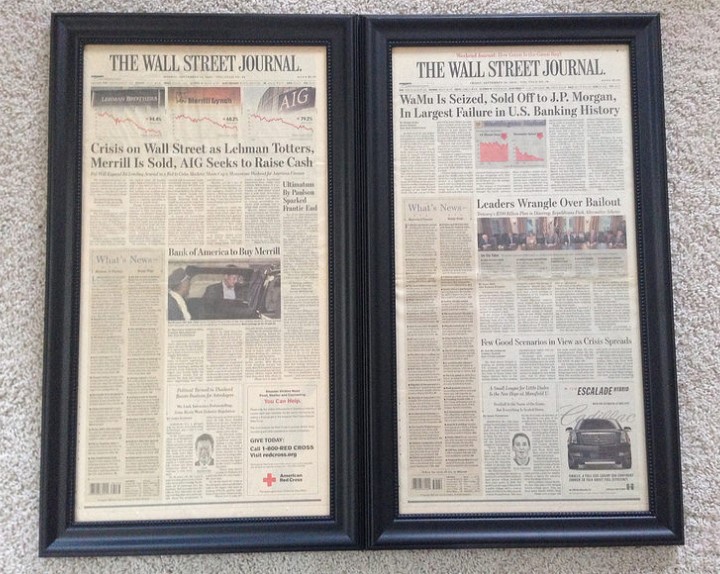
Image shown: Wall Street Journal front pages from the Financial Crisis — a reminder that an investor cannot control the markets.
By Brian Nelson, CFA
I think there may exist a group of investors that believe they can control the market.
For example, investors seek to achieve goals. Let’s say an income investor bought a stock today and it doubled in price tomorrow, meaning that it generated 100% in income-equivalent in just one day–or let’s say at a hefty 10% annual required yield-equivalent, 10 years’ worth of income. The investor can sell the stock and lock in 10 years’ worth of income, or he or she can let it ride. Some may choose to let it ride, but what if that same stock’s price is cut in half tomorrow and those 10 years’ worth of income are completely wiped out? Would there be regrets, even if the income idea is still a strong dividend payer? I think so–10 years’ worth of income-equivalent was completely wiped out.
Each investor has different goals and risk tolerances, but it’s important investors understand that a dollar is a dollar. Forcing one’s returns to be generated strictly via income over the long haul is trying to tell the market what to do, which could end badly. Not even Warren Buffett can control the market and the distribution of returns. If the market hands you lemons, make lemonade. Said in another example, if an income idea jumps 30% in a few months, handing you the equivalent of 5-10 years’ worth of income in the form of capital appreciation (a dollar is a dollar), why not consider taking it, even if you may have been planning to hold the stock for longer than 5 years? Surely, one can’t be disappointed by taking profits?
But some investors might be. How? Because achieving the goal didn’t take years, and the return didn’t come in the form of a dividend payment. It seems these investors want to tell the market what to do. This seems so silly to me. The last 8 years in the stock market have been phenomenal, but I think such success has done nothing more but to provide a false sense of security. What the market gives, the market can taketh away–markets don’t always go up! If you’re disappointed because income ideas are providing you with significant income through alternative means such as in the form of capital appreciation, strive to be flexible and open your mind on ways you might be able to convert that capital appreciation to income to achieve goals.
Remember – you can’t control what the market does and in what forms returns are provided, or how long it may take for goals to be achieved. If the market hands you a winning ticket in a short time, it may be okay at times to cash it in (converting capital appreciation to income), instead of letting it ride, only to potentially set yourself up for disappointment later. Every situation is different, of course, but markets will be markets. It’s important to use common sense. Capital appreciation can be converted to income quite easily.
Now read, the ’13 Most Important Steps to Understand the Stock Market.”