
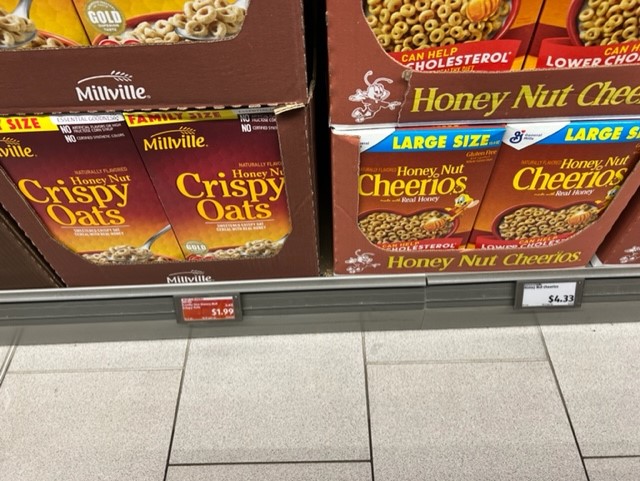
Image: Prices for private label brands at Aldi are considerably lower than those of branded products. The consumer staples sector, however, remains fully-priced with a 21+ forward earnings multiple, and many constituents hold large net debt positions. We believe the sticking point for the Fed is not groceries or gasoline prices, but rather the labor markets, which remain very strong, despite layoffs. Image Source: Valuentum
By Brian Nelson, CFA
We’ve yet to see the worst of job cuts, in our view. The rapid shift in the global economy mid-2022 was profound, as many companies were still building in anticipation of increased demand during the first half of the year to the point where demand growth started to dry up, almost stopping on a dime. In the past 24 hours alone, Amazon (AMZN) announced that it will lay off 18,000, while Salesforce (CRM) announced that it would trim about 10% of its workforce.
The news follows a year when there have already been more job cuts in tech than during the worst of the dot-com bust. It’s estimated that more than 153,000 tech workers lost their job last year. Among the needle-movers were Meta Platforms (META), which announced it would shed 11,000 employees last year. Twitter’s job cuts were deep as new CEO Elon Musk optimizes the entity, while other companies including Carvana (CVNA), DoorDash, Inc. (DASH), Stripe, Redfin (RDFN), and Lyft (LYFT) noted they would eliminate positions.
The labor market, in our view, is the last domino that needs to fall before the Fed begins what we expect to be a period of stabilization with respect to the federal funds rate, which now stands at 4.25%-4.5%. Our latest channel checks indicate that consumers are finding ways to trade down to more affordable groceries, so inflation is not biting in the same way it was a few months ago. Same-store sales at discount grocer Aldi, for example, are estimated to be expanding at a double-digit pace in the U.S. as even wealthy consumers look for bargains there amid the huge reset higher in grocery prices that happened over the past 12-18 months.
Right now, other discount players such as Dollar General (DG), Dollar Tree (DLTR), and Five Below (FIVE) may be faring better in this market environment, but we think Aldi has been the big winner. Unfortunately, for investors, Aldi is a closely-held private entity, so they can’t get in on what looks to be a structural change in consumer behavior. Quite simply, the market share that Aldi has gained is now its to lose. Walmart (WMT) is still working to get back on track given its consumer discretionary exposure, and Target (TGT) has even more work to do.
Though the cult followings are large at the warehouse membership clubs, Sam’s Club and Costco (COST), may not offer consumers as much bang for their buck, in our view, as prices for private labels at Aldi are still a much better deal than buying brand names in bulk. We’re not talking about a few percentage points here and there with respect to savings at Aldi, but savings could be as much as 50% or more on certain items, at least based on our price checks.
Private label Crispy Oats at Aldi, for example, cost $1.99, while General Mills (GIS) Honey Nut Cheerios cost $4.33 at the same location [the individual unit cost for a box of Cheerios at Sam’s Club is $3.79]. It’s clear how much shoppers are saving at Aldi. Looking at the Aldi receipt even brings back a feeling of nostalgia from the 1990s. Branded consumer staples equities continue to be resilient, however, despite their trading at 21.4x forward 12-month earnings with most having large net debt positions. Price elasticities are in branded staples’ favor at the moment, but we don’t think shoppers that have switched to Aldi will ever completely go back to branded items.
Gas prices at the pump have also come in. The week before Christmas, national gas prices fell to an 18-month low, giving consumers a bit of a break. Though energy resource prices are largely out of government control given OPEC influence, the application of strategic petroleum reserve releases is, at least, a signal that the White House will do what it can to help consumers at the pump. As of January 2, 2023, U.S. regular gasoline conventional retail prices were $3.12 per gallon, which is down considerably from the June 2022 spike of $4.84 per gallon. Consumers may be feeling a bit better than they did during the June 2022 swoon in the markets, but until labor markets really start to show more pain, the Fed can’t be certain inflation won’t come back in full force.
Employers did whatever they could to keep employees happy during the COVID-19 meltdown, and many continue to struggle to return to normalcy years after the first case of COVID-19 hit the shores of the U.S. Having gone through so much the past few years, employers have seemingly become somewhat resistant and slow to the type of layoffs needed for the Fed to get the data it wants. This is understandable. Employers fought to keep jobs and their businesses up and running during COVID-19, and they don’t want to potentially make a mistake if the global economy doesn’t sink. That is the hope, but it may be false hope.
Nonetheless, the seasonally adjusted unemployment rate stood at 3.7% in November 2022, and jobs data just isn’t poor enough to convince the Fed that inflation will not surge back in 2024 after likely slowing in 2023, in our view. The December ADP (ADP) jobs report showed that 235,000 jobs were added in the month, far better than consensus. The latest reading for initial jobless claims also fell for the week ending December 24, 2022, coming in lower than expectations. The labor markets are far too strong and don’t yet match what’s going on in the real economy given employer reluctance to face the new economic realities. We expect more drastic job cuts to come.
Concluding Thoughts
We maintain our view that markets will remain challenged for at least the first quarter of 2023, and we expect the S&P 500 to bottom around 3,400 based purely on a technical evaluation of the ongoing downtrend. The labor market remains too strong for the Fed to stop rate hikes as the primary concern for the Fed is not what inflation will do this year, but rather whether it will spike again in 2024.
To truly stomp out inflation, the Fed needs to witness further weakening in the labor markets, as consumers have found ways to trade down to offset grocery inflation and as gas prices at the pump ease. We’re never happy to hear of layoffs, but an unemployment rate of 4.5%-5% may be the range required for the Fed to stop hiking, in our view.
The last thing the Fed wants is to stop hiking too early, only for inflation to come roaring back in the quarters that follow the pause. The Fed is not thinking about year-over-year inflation numbers for 2023, in our view, but rather policies that will ensure that inflation rates of the past 12-18 months do not return in 2024-2025. They are playing the long-term game.
Also tickerized for KR, CVS, RAD, WBA, ACI, BJ, CALM, CASY, HRL, PPC, SFM, SYY, TSN, XLP, XLE, XLF, SPY, QQQ, SCHG, DIA
———————————————
Brian Nelson owns shares in SPY, SCHG, QQQ, DIA, VOT, BITO, RSP, and IWM. Valuentum owns SPY, SCHG, QQQ, VOO, and DIA. Brian Nelson’s household owns shares in HON, DIS, HAS, NKE, DIA, and RSP. Some of the other securities written about in this article may be included in Valuentum’s simulated newsletter portfolios. Contact Valuentum for more information about its editorial policies.
Be Careful With Celebrity Endorsement of Investment Products >>
Valuentum members have access to our 16-page stock reports, Valuentum Buying Index ratings, Dividend Cushion ratios, fair value estimates and ranges, dividend reports and more. Not a member? Subscribe today. The first 14 days are free.