
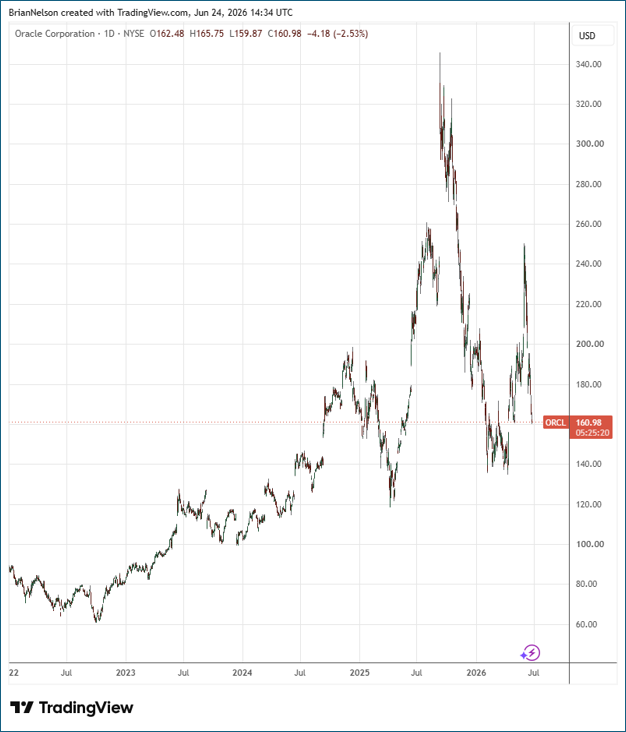
Image Source: TradingView
By Brian Nelson, CFA
Oracle (ORCL) recently reported fourth quarter fiscal 2026 results where both revenue and non-GAAP earnings per share came in better than expectations. The company set a number of new records in the quarter: record total revenue of $19.2 billion, up 21% in USD and better than consensus of $19.09 billion; record total cloud revenue of $9.9 billion, up 47% in USD, record non-GAAP earnings per share of $2.11, up 24% in USD and better than the $1.97 consensus mark; and record remaining performance obligations of $638 billion, up $85 billion sequentially.
Management included the following in the press release:
The large increases in Oracle’s RPO and revenue are driven by the growing demand for cloud infrastructure for AI training and inferencing. Oracle is building datacenters that are intended to use clean energy from natural gas fuel cells to generate electricity with minimal emissions. Other innovations in the areas of high-performance networking, advanced security and autonomous software have made Oracle the world’s fastest growing provider of cloud datacenters.
Our database and applications businesses are both benefiting from Oracle’s early adoption of AI. The Oracle Multicloud AI Database grew 404% in Q4—making it our fastest growing business ever. The Oracle Health application suite will soon include a completely new AI version of the Cerner hospital and clinic patient care management system. We expect this new AI patient care management system to push the growth rate of the overall Oracle Health business to double-digits in fiscal year 2027. And this is just the beginning of the expansion of the Oracle Health business.
We believe AI is about to completely revolutionize healthcare. Improvements in patient care are expected to yield much better patient outcomes, while dramatically lowering the cost of healthcare throughout the world. Oracle Health AI systems will allow doctors to spend less time with computers and more time with patients. AI molecular design models are expected to enable researchers to accelerate the development of life-saving drugs. Oracle’s new AI clinical trial system is designed to enable regulators to rapidly review and approve clinical trial test results enabling patients to get access to new drugs sooner. AI will make healthcare better, more accessible, and less expensive.
Oracle is guiding first quarter fiscal 2027 revenue to grow from 27%-29% in both constant currency and USD, wrapping the consensus estimate. Total cloud revenue is anticipated to grow between 57%-63% in constant currency and 58%-64% in USD. Oracle expects non-GAAP earnings per share to grow between 16%-19% in constant currency, to $1.71-$1.75 (above the $1.68 per share consensus estimate) and between 17%-20% in USD, to $1.72-$1.76. For fiscal 2027, Oracle confirmed its prior revenue guidance of $90 billion and raised its non-GAAP earnings per share guidance, to $8.05, above the $8.02 consensus forecast.
The big problem with Oracle stems from two places: its net debt position and its capital spending. Cash and cash equivalents were $31.3 billion at the end of the quarter, while notes payable and other borrowings ballooned to $129.5 billion, creating a huge net debt position. Oracle was also free cash flow negative for fiscal 2026, as $55.7 billion in capital expenditures overwhelmed operating cash flow of $32 billion. In fiscal year 2027, Oracle expects to raise roughly $40 billion in new capital, including the $20 billion at-the-market equity issuance it previously announced.
We like Oracle’s top-line growth and non-GAAP earnings per share, but a deeper look shows a leveraged firm that is burning through cash to meet its lofty backlog. For fiscal 2027, Oracle expects capital expenditures of up to $95 billion, which would be greater than its expected revenue for the year. Further, gross margins are expected to step down due to timing for the ramp-up of its data center projects. Oracle declared a quarterly cash dividend of $0.50 per share of common stock, but we would not be surprised to see the dividend on the chopping block, if current trends persist. For now, however, Oracle remains a speculative idea in the newsletter portfolios. Shares yield 1.2% at the time of this writing.
—–
Brian Nelson owns shares in SPY, SCHG, QQQ, QQQM, DIA, VOT, RSP, and IWM. Valuentum owns SPY, SCHG, QQQ, QQQM, VOO, and DIA. Brian Nelson’s household owns shares in HON, DIS, HAS, NKE, DIA, RSP, SCHG, QQQ, QQQM, and VOO. Some of the other securities written about in this article may be included in Valuentum’s simulated newsletter portfolios. Contact Valuentum for more information about its editorial policies.
Valuentum members have access to our 16-page stock reports, Valuentum Buying Index ratings, Dividend Cushion ratios, fair value estimates and ranges, dividend reports and more. Not a member? Subscribe today. The first 14 days are free.