

By Callum Turcan
Early Friday (Arabian Standard Time) on January 3 (the strike was carried out late Thursday evening Eastern Standard Time), under the orders of President Trump, the US took out major general Qasem Soleimani who was the leader of Iran’s Quds military group within the Islamic Revolutionary Guard Corps (‘IRGC’). Please note the US designated the IRGC as a Foreign Terrorist Organization in April 2019, and that the justification for the strike was due to there being an immediate threat to US lives (namely soldiers and contractors stationed in the Middle East), according to the Pentagon. It’s important to note that the strike occurred on Iraqi soil.
The Quds force is known to be Iran’s extraterritorial military outfit, an elite group thought to be deeply involved in ongoing wars in Syria (undergoing a civil war), Yemen (undergoing a civil war), and Iraq (ostensibly fighting the remnants of the ISIS terror group). Qasem Soleimani was in Iraq when the US took him out with an airstrike, along with others such as Abu Mahdi al-Muhandis, who was the deputy chief of the Popular Mobilization Units (‘PMF’) which is an umbrella group for various militias active in Iraq that have extensive ties with Iran. Abu Mahdi al-Muhandis was thought to be an adviser of Qasem Soleimani.
The Situation
The major general had long worked to thwart Western interests, and was responsible for the deaths of many US soldiers and others (often by way of proxy) according to the US Department of Defense. Here’s what the Pentagon had to say on January 2, 2019:
“At the direction of the President, the U.S. military has taken decisive defensive action to protect U.S. personnel abroad by killing Qasem Soleimani, the head of the Islamic Revolutionary Guard Corps-Quds Force, a U.S.-designated Foreign Terrorist Organization.
General Soleimani was actively developing plans to attack American diplomats and service members in Iraq and throughout the region. General Soleimani and his Quds Force were responsible for the deaths of hundreds of American and coalition service members and the wounding of thousands more. He had orchestrated attacks on coalition bases in Iraq over the last several months – including the attack on December 27th – culminating in the death and wounding of additional American and Iraqi personnel. General Soleimani also approved the attacks on the U.S. Embassy in Baghdad that took place this week.
This strike was aimed at deterring future Iranian attack plans. The United States will continue to take all necessary action to protect our people and our interests wherever they are around the world.”
This news shocked markets as the US effectively took out one of the leading political and military figures in Iran. Mourners and supporters of Qasem Soleimani, namely in southern Iraq and Iran, protested the move by the US. Iraq’s parliament voted on a non-binding resolution that asks Iraqi Prime Minister Adel Abdul-Mahdi (who is leading a caretaker government after resigning from his post last year following mass protests in Iraq) to rescind the nation’s invitation to US troops (not all parliamentarians voted as many protested the vote by not showing up). President Trump responded by threatening to impose sanctions on Iraq after the backlash, along with threatening Iran with additional attacks if Iran attempts to retaliate in any way.
However, the US sent mixed signals concerning some of these issues on January 6 as a memo was floated which seemed to indicate that the US was getting ready to have its troops exit Iraq in short order. That was quickly denied by US Defense Secretary Mark Esper and others, but given the gravity of the situation, many are wondering why the memo was floated in the first place.
Iran has now declared that it won’t abide by the 2015 deal reached with Western powers concerning its nuclear program, a policy shift that’s long been in the works. Please note the US had already withdrawn from the deal in 2018, and has been applying a policy of maximum pressure on Iran (sanctions to cut down on its oil exports and ultimately revenues, revenues that could be used to fund extraterritorial endeavors along with general government activities) to cripple its economy. In some form or another, the goal of the US is (apparently) to get Iran to agree to a new nuclear deal with even stricter oversight of its nuclear program, along with getting Iran to end its extraterritorial endeavors and missile tests.
Market Impact
Oil and other commodity markets (such as gold and other “safe haven” assets, a term we find a tad silly given gold has limited intrinsic value beyond the ability to sell gold to another buyer, but we digress) experienced some powerful reactions to these events, with West Texas Intermediate (USO) and Brent (BNO) both shooting upwards initially on the news as shown in the graphic below.
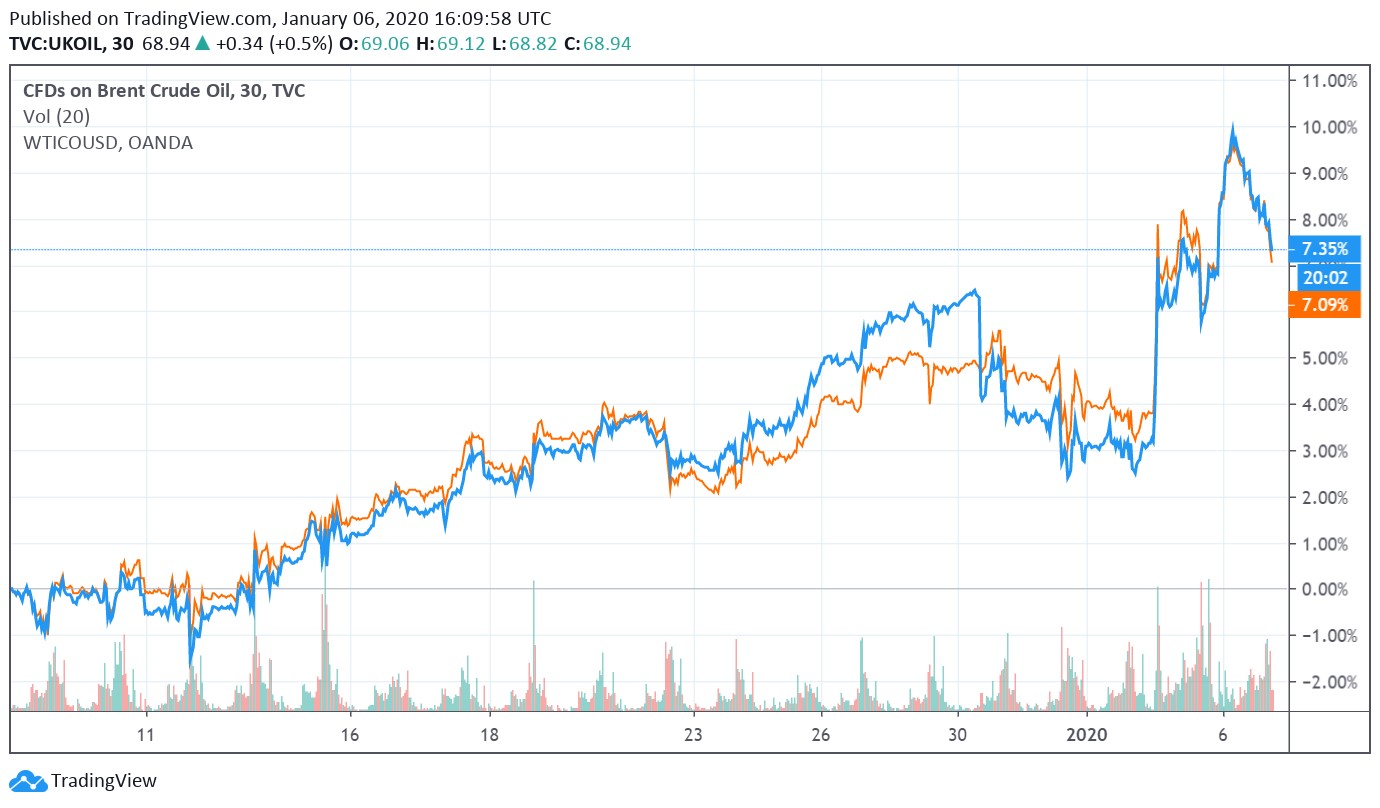
Image Shown: Near-term oil prices shot up on the news that the US had killed a leading political and military figure in Iran who was responsible for a large portion of Iran’s foreign policy and numerous deaths of US soldiers.
Here, we would like to stress that while near-term oil prices rose on the news initially, what matters most is what happens at the back end of the curve and more broadly, whether oil prices are shifting towards a dynamic where the structural price should shift upwards (meaning on a forward-looking basis, oil prices could justify trading at a higher valuation for a sustained period of time). Please keep in mind that the WTI futures contract for December 2020 deliveries sits near $58 per barrel as of this writing, far below ~$63 per barrel for February 2020 deliveries. The price for December 2021 deliveries is just ~$54 per barrel, and as the futures curve is downward sloping, we are looking at an oil market in backwardation (near-term prices are higher than medium-term prices).
For oil and gas equities (XLE), particularly smaller upstream producers (XOP) of oil and other liquid raw energy resources (natural gas liquids and condensate), rising geopolitical tensions in the Middle East (and ever-growing US-Iran tensions) saw shares of almost all names surge upwards on the news. However, as the oil price gains appear short-lived given the muted action at the back end of the futures curve, that exuberance seems misplaced. Short of an escalation of tensions in the Middle East that leads to actual supply losses, instead of just fears over supply losses, the bump in oil prices will have just a negligible impact on the future free cash flows of upstream producers and thus the intrinsic value of those companies. We caution that this could see shares of upstream producers, particularly those that rallied the hardest initially on the news, shift lower. Refineries sold off heavily on the news as the industry’s expected future input costs rose, a situation that could reverse itself if oil prices shift lower.
Defense names (ITA) also rose on this news, and this is a space where the price gains are more justified given that rising geopolitical tensions tie directly into greater defense spending at the national level in both the US and elsewhere (such as various Middle Eastern countries including Iran). Even though oil supplies might not have been impacted directly, at least not yet (as of this writing), geopolitical fears could see greater demand for anti-missile defense systems, airplanes, drones, and much more.
Concluding Thoughts
We will continue to monitor these events as they unfold, and we caution that things could quickly spiral out of control. While many are calling for restraint, emotions are running high. Should things escalate, that may change the supply situation as it concerns oil and liquified natural gas (‘LNG’), but for now refined product and raw energy resource supplies out of the Middle East have apparently not been impacted (as compared to the attack on Saudi Arabia’s oil facilities last year, which saw a lot of the world’s oil supply knocked offline temporarily, a situation we covered in this article here). Defense budgets should be monitored, as should the potential for retaliation (some missiles were fired into the Green Zone in Baghdad, Iraq, in recent days). We will provide our members with relevant updates going forward as new information comes to light.
Oil & Gas (Majors Industry) – BP CVX COP XOM RDS.A RDS.B TOT
Independent Oil & Gas Industry – APA COG CLR DVN EOG MRO OXY PXD
Refining Industry – HES HFC MPC PSX VLO
Oil & Gas Pipeline Industry – ENB ET EPD KMI MMP
Aerospace & Defense Industry – BA FLIR GD LLL LMT NOC RTN
Related: ARMCO, USO, OIL, XLE, XOP, BNO, VDE, AMLP, AMZA, ITA, SPY, DIA
—
—–
Valuentum members have access to our 16-page stock reports, Valuentum Buying Index ratings, Dividend Cushion ratios, fair value estimates and ranges, dividend reports and more. Not a member? Subscribe today. The first 14 days are free.
Callum Turcan does not own shares in any of the securities mentioned above. Callum Turcan is long Whiting Petroleum Corporation (WLL) $9 put options expiring January 31, 2019. Kinder Morgan Inc (KMI) is included in Valuentum’s simulated Dividend Growth Newsletter portfolio. BP plc (BP), Enterprise Products Partners L.P. (EPD), and Magellan Midstream Partners L.P. (MMP) are all included in Valuentum’s simulated High Yield Dividend Newsletter portfolio. Some of the other companies written about in this article may be included in Valuentum’s simulated newsletter portfolios. Contact Valuentum for more information about its editorial policies.