
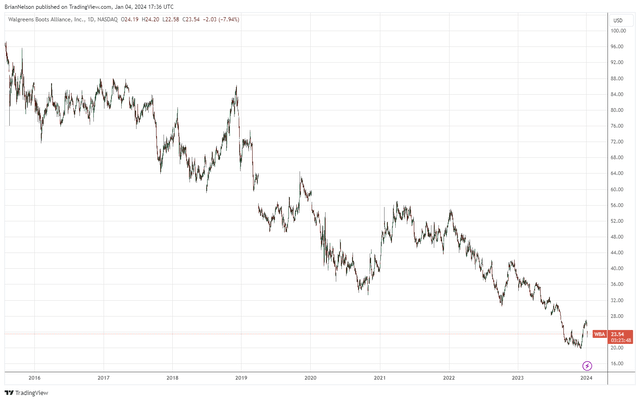
Image: Walgreens’ shares have been under consistent pressure for years, and a turnaround is not guaranteed.
By Brian Nelson, CFA
Back in early December, we said the following about Walgreens (WBA):
Walgreens is a household name, but its wheeling and dealing over the past few years has created a convoluted situation that can best be observed by the company’s deteriorating operating cash flow. As shown in the company’s cash flow statement…capital expenditures are eating up a high percentage of operating cash, and its fiscal 2023 free cash flow — as measured by cash flow from operations less all capital spending — is now materially below that of cash dividends paid. The firm also issued guidance recently that came in below expectations, which leads us to believe that there may be further deterioration to come; and the company has a large net debt position to boot. Walgreens’ dividend health is risky, in our view, and the market seems to agree, with shares yielding ~9.2% at this time. A dividend cut seems likely.
Today, January 4, Walgreens announced that it would slash its quarterly dividend payment to $0.25 per share, a 48% decrease. This should not be surprising to members. Walgreens’ Dividend Cushion ratio stood at -0.3 (negative 0.3), and we hope members have avoided this catastrophe of a Dividend Aristocrat. A Dividend Cushion ratio below 1 signals increased long-term risk to the payout, while a firmly negative Dividend Cushion ratio signals heightened risk.
Our cash-based dividend growth process has led to outperformance in the Dividend Growth Newsletter portfolio the past couple years, while other areas have suffered, and it has also shown to be useful in predicting dividend cuts. Walgreens is now one of more than 50 companies across our coverage universe in recent years where the Dividend Cushion ratio has warned of significant risk to the sustainability of the dividend in advance of the cut, “Efficacy of the Dividend Cushion Ratio.”
As for Walgreens, we think there may be further trouble on the horizon. From our perspective, its operations are growing more and more redundant as value-conscious consumers grow in number, and the firm faces heightened competition in the pharmacy arena. In its first-quarter fiscal 2024 results, adjusted earnings fell 43.1% on a constant currency basis, and the challenging retail market trends management speaks of may be closer to permanent in Walgreens’ case.
We’re concerned about Walgreens’ long-term story, and we won’t be adding it to any newsletter portfolio anytime soon.
———-
NOW READ: A Note on Valuation – Low P/E Stocks with High Dividend Yields
———-
Brian Nelson owns shares in SPY, SCHG, QQQ, DIA, VOT, BITO, RSP, and IWM. Valuentum owns SPY, SCHG, QQQ, VOO, and DIA. Brian Nelson’s household owns shares in HON, DIS, HAS, NKE, DIA, RSP, SCHG, QQQ, and VOO. Some of the other securities written about in this article may be included in Valuentum’s simulated newsletter portfolios. Contact Valuentum for more information about its editorial policies.
Valuentum members have access to our 16-page stock reports, Valuentum Buying Index ratings, Dividend Cushion ratios, fair value estimates and ranges, dividend reports and more. Not a member? Subscribe today. The first 14 days are free.