
Understanding some of our recent moves in the Dividend Growth Newsletter portfolio and the context of the Hasbro-Hanesbrands alpha-generating trade-off…how can this be, right?
By Brian Nelson, CFA
Every reader is different with a different perspective, time horizon, and goals, and I try to provide as much context and background as possible in my writings for those reasons and more. We won’t always get everything right every time (nobody does), but I think your knowing how and why we do things (and being the judge) is par for the course with any membership. Gaining your trust is very important to me, and our team works hard each and every day to do so.
Shortly before the release of the Dividend Growth Newsletter, we added a 3% position in Hanesbrands (HBI) in light of many things, but we also did so in the context of the construction of the newsletter portfolio, and our wishes to allocate more cash to a market that we think will continue to “inflate” in 2017. The challenge is that some readers and some investors may view our ideas in isolation, rather than a portfolio targeted to achieve the respective newsletter goals. The Nelson Exclusive is where we provide three new ideas each month (considerations for income, capital appreciation, and a short idea) on a standalone basis outside the Dividend Growth Newsletter portfolio and Best Ideas Newsletter portfolio context.
I often worry if readers sometimes view each incremental newsletter portfolio idea by itself and over a short period of time, instead of on a collective, portfolio basis over a multi-year period. If you recall, I added Step 10 in the “13 Most Important Steps to Understand the Stock Market,” for this very reason, to help explain the trade-offs in stock selection, that there will be winners and losers. (If you haven’t read those 13 steps, it’s an absolute must.) The past week or so provided a good example on how “alpha” and/or a positive return in the Dividend Growth Newsletter portfolio can be attained, despite what we believe to be a temporary setback with respect to newly-added Hanesbrands’ equity, “Hanesbrands Now Even Cheaper; FCF Yield: ~7%; PE Ratio: ~10x.” It helps shed some light on how we continue to put up strong performance in the newsletter portfolios, despite when sometimes every new idea that is added doesn’t work out immediately.
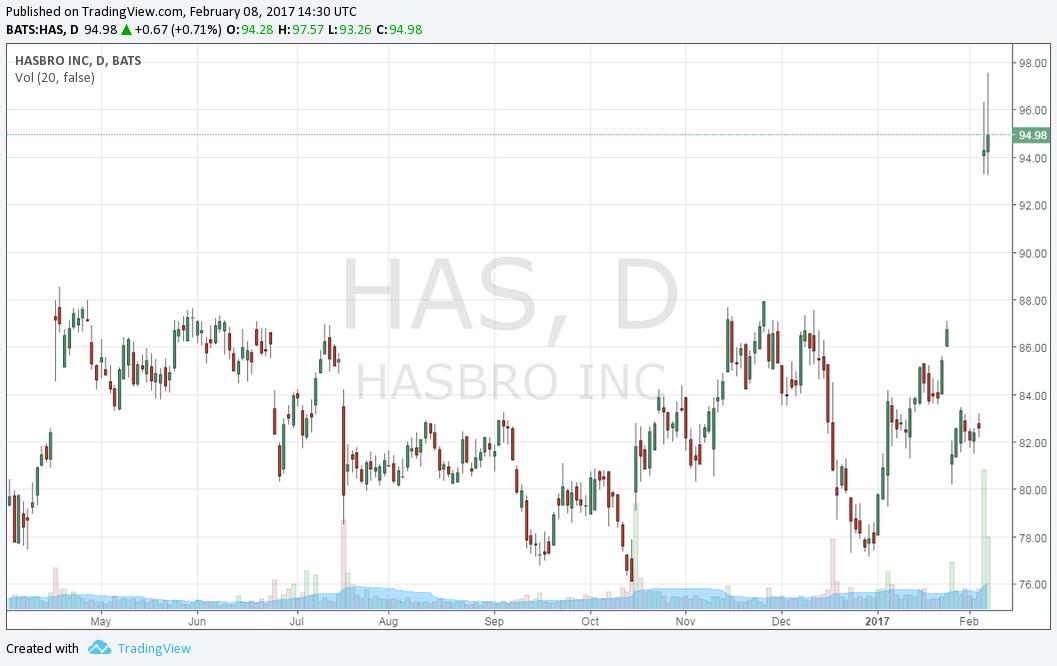
As you know, Hanesbrands had just been added to the Dividend Growth Newsletter portfolio at $23.77 per share, and now is trading just under $20, a bit of poor timing on our part right before the quarterly release, to say the least, but we’re being patient on the position (and its shares look mighty cheap, even cheaper). But here’s why portfolio context is so important: One of the largest weightings in the Dividend Growth Newsletter portfolio, toy and licensing giant Hasbro (HAS), a position that was weighted at 5% (nearly 67% more than Hanesbrands’ weighting) put up a quarterly report February 6 that has sent its shares surging from $82 to ~$95, a roughly offsetting percentage move, but one that was on a higher-weighted stock in the Dividend Growth Newsletter portfolio. The higher the weighting, the more impactful its moves on portfolio returns.
Hasbro’s average cost is ~$32 in the Dividend Growth Newsletter portfolio, and the stock has been a big winner for those that follow our best ideas (housed in the Best Ideas Newsletter portfolio and Dividend Growth Newsletter portfolio). In fact, my colleague Kris Rosemann pounded the table on Hasbro in our October 25, 2016, podcast, “EVERYTHING DIVIDENDS + 3 TOP IDEAS,” explaining how we’re letting this winner “run” in the spirit of the Valuentum methodology, despite a rather “frothy” valuation. Importantly, our ideas in the newsletter portfolios are our best ideas at any given time, and while some readers may like our incremental ideas that we add, they should be considered our next best ideas, of course. Said differently, with each passing day, we make a conscious decision to continue to hold the ideas in the newsletter portfolios, and if we had to reestablish the newsletter portfolios each day, we would be sending out email alerts on these stocks. Because they are already in the newsletter portfolios, however, there’s no need for us to send out alerts.
While in some cases, the newsletter portfolio add/remove decisions are made in the context of existing newsletter constituents and how they fit together within the portfolio construct to achieve portfolio goals, in other cases, new ideas are considered with respect to the conditions of the broader market environment. Today, the broader market, for example, continues to be “overpriced” relative to historical valuations, so some of the best companies’ valuations are getting stretched (some of them are very stretched). At last check, for example, the S&P 500 (SPY) is trading at 17+ times forward earnings. While methodological, our process in the newsletter portfolios also has to be flexible to achieve goals in this overheated environment, which we expect to get even frothier. These are trying times for stock pickers, but we are still working to achieve targeted newsletter goals.
This is why it may seem somewhat counter-intuitive why we may continue to hold Hasbro, despite its valuation, or why we added Boeing (BA) more recently, given that their respective valuations aren’t considerably attractive, or why we may place a trade on the Alerian MLP (AMLP), despite us being very cautious on the business models of MLPs. In Boeing’s case, shares aren’t considerably cheap, but the company was not added to the Best Ideas Newsletter portfolio, but the Dividend Growth Newsletter portfolio, which emphasizes dividend growth potential. In some cases in the Dividend Growth Newsletter portfolio and particularly in this market environment, we relax some non-dividend related criteria to identify dividend growth ideas that fit the bill to achieve newsletter goals. Boeing was not added to the Best Ideas Newsletter portfolio, which emphasizes valuation and the Valuentum Buying Index more so than capital allocation policies set by the board.
If you may recall, late last year, we decided to increase our allocation to equities in the Dividend Growth Newsletter portfolio given our views on the market for 2017, “5 Shocking…,” and in light of the under-weighting of equities in the Dividend Growth Newsletter portfolio at the time (and our overweighting of cash). Given frothy conditions and overpriced equities in general, we have been looking to bolster the Dividend Growth Newsletter portfolio with fundamentally strong ideas that have solid income growth potential, and we’ve had to be a little more flexible with valuation considerations. Though there are always risks, Boeing made the cut when it came to the dividend, even though shares are trading at the high end of our fair value estimate range.
As it relates to the newsletters, we strive every day to achieve newsletter portfolio goals, and that may mean that we seek certain exposures to certain sectors or industries, too. In the Dividend Growth Newsletter portfolio, we had been lacking exposure to the aerospace industry, one of our very favorites, “Boeing’s Lift Off, Lockheed’s Caution, and United Tech’s Outlook,” so Boeing fit very well as an idea in this regard, too. We very much like the visibility that the aerospace industry provides as it relates to the airframe makers’ backlogs. Oftentimes, achieving sector allocations in newsletter portfolios means that we have to relax certain firm-specific criteria, too.
All of this said, ideally, of course, we would prefer to add undervalued, strong dividend growth companies, but those are becoming scarcer in today’s frothy market–and importantly, many undervalued, strong dividend growth companies are already included in the Dividend Growth Newsletter portfolio. I hope this helps further explain our rationale for some of the more recent moves in the Dividend Growth Newsletter portfolio. Please let us know if you have any questions. Don’t forget to watch the podcast on Hasbro!