
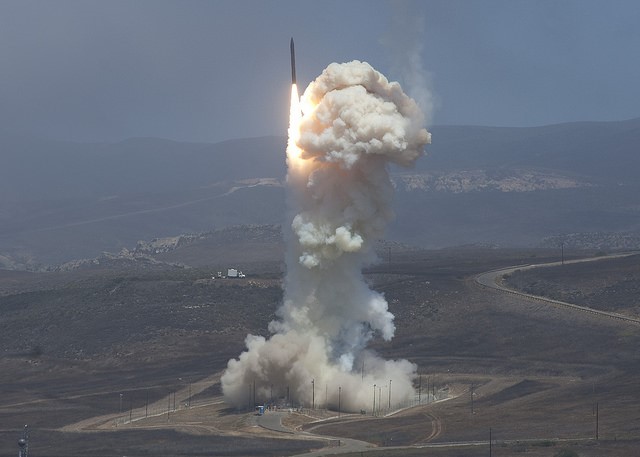
Image Source: US Missile Defense Agency. June 22, 2014 – The Missile Defense Agency’s Flight Test 06b Ground-Based Interceptor launches from Vandenberg Air Force Base, Calif. on June 22, 2014.
The markets have finally been getting the volatility that we’ve all been waiting for, and we don’t like the idea that the market is now trading more like a cryptocurrency. Granted, it’s important to stay focused over a long-term time horizon, which irons out the ups and downs, but there’s just something about 1,000+ daily swings on the Dow Jones Industrial Average that really doesn’t sit well with us, regardless of what that implies with respect to the percentage change. Can you imagine — All of this over just a couple basis point increase in the 10-year and one very, very small ETF losing most of its value? What if something truly material happens? This market is fragile.
By Kris Rosemann and Brian Nelson, CFA
Investors continue to take inventory of the drivers of the recent stock market (SPY, QQQ, DIA) volatility, which include concerns over rising interest rates (and implications on valuations across equities), poorly structured and leveraged exchange traded products (and potential systemic risk, though we don’t think there should be worry of contagion), and automated trading, likely a result of the explosion of assets under management at quantitative traders. We think many are also starting to look at implications of the new tax policy on the economy, especially whether the US is truly prepared in the event of the next downturn, the timing the only uncertainty.
What concerns us the most (and we’re really not too concerned)–and maybe investors with long-enough time horizons can ignore it–is that the stock market seems to be trading more like cryptocurrency the past few days than anything else, or at least it feels that way. The wild swing in the Dow Jones Industrial Average from down 500+ to up 500+ in a single trading session February 6 was peculiar. Maybe it just seems large given how steadily-rising the US stock market has been the past many months with almost little volatility, but it does “feel” rather strange. For one, is the market truly this fragile where a small basis-point increase in risk-free rates and the collapse of one very, very small ETF can cause such a dislocation? It may matter little whether the moves in the stock market in early February are significant over than long haul, and more about what those moves imply about the structure of the marketplace itself. Is Carl Icahn correct? Are index funds to blame?
Let’s cover some news. China (FXI, KWEB) has filed challenges to the Trump Administration’s decision to impose tariffs on solar panels (TAN) and washing machines at the World Trade Organization amid mounting trade pressure between the two leading economies. The Chinese Commerce Ministry recently announced an investigation into American exporters of sorghum that are allegedly selling the grain below cost in the Chinese market. Tensions remain elevated on the Korean peninsula as we head towards the Winter Olympic Games in Pyeongchang, South Korea (EWY). Vice President Pence stated that the US will soon impose “the toughest and most aggressive round of economic sanctions on North Korea ever.” US equities appear to remain unfazed by geopolitical issues, and we point to this as an incremental risk beyond that which caused market volatility the past few days.
In earnings-related news, Dividend Growth Newsletter idea Hasbro (HAS) rallied following its fourth quarter earnings report before the open February 7. Hasbro Franchise Brand revenue advanced 11% in the quarter on a year-over-year basis, but management points to slower consumer demand for both the company and its industry in November and December as a key factor in net revenue falling 2% from the year-ago period. Operating margin in the quarter expanded to 17% from 15.7% in the fourth quarter of 2016. Management is confident that its innovative lines that are supported by storytelling and digital initiatives have the company well-positioned for 2018 and beyond. Despite free cash flow falling to ~$590 million in the full-year 2017 from ~$662 in 2016, management announced a quarterly dividend hike of more than 10%; the new annualized payout yields ~2.8% as of this writing. Seeking Alpha is also reporting that chatter surrounding a Hasbro-Mattel deal has started to pick up again.
Shares of global fashion luxury group Michael Kors (KORS) rose after its fiscal third quarter report before the open February 7. Total revenue climbed 6.5% from the year-ago period to $1.44 billion thanks in part to the acquisition of Jimmy Choo, and adjusted earnings per diluted share came in at $1.77, up 7.9% on a year-over-year basis. Highlights of the quarter were the integration of Jimmy Choo and progress on its Michael Kors Runway 2020 plan, a core tenet of which is elevating its brand position via innovative offerings. For full-year fiscal 2018, the company expects total revenue to be ~$4.66 billion with comparable sales declining in the mid-single digits. Operating margin is projected to be 18%, and diluted earnings per share guidance has been issued in a range of $4.40-$4.45. Michael Kors registered a 9 on the Valuentum Buying Index in early August 2017 when shares were changing hands at ~$45, and shares have since surged to the upper $60s.
Snap (SNAP) rallied in a big way after its fourth quarter report after the close February 6 revealed a better-than-expected loss and 72% year-over-year revenue growth. Though the net loss was not as bad as expected, it widened to ~$350 million in the quarter from ~$170 million a year earlier, and the company burned through nearly $820 million in free cash flow in 2017, figure that also deepened from the year-ago period (free cash flow was negative $678 million in 2016). Nevertheless, Mr. Market loved Snap’s 18% year-over-year daily active user growth, as well as the 46% increase in average revenue per user from the fourth quarter of 2016. Shares are still down meaningfully since it started trading in early 2017, but the rally in its equity February 7 was remarkable.
In other news, defense-related stocks, including one of our favorites Boeing (BA), caught a bid as it was reported that Senate leaders might raise budget caps by $300 billion over the next couple years. Congressional outcomes are difficult to handicap, but if tax reform is any indication, the odds are in favor that more spending on defense is likely going to happen. Not only does the sitting President know increased defense spending will stimulate the economy, but greater nuclear defense capability may be required given concerns over North Korea (and concerns over the growing threat of cybersecurity (HACK) have not gone away either). We like the news for Lockheed (LMT), Northrop Grumman (NOC), Raytheon (RTN), and General Dynamics (GD), among others in the aerospace and defense supply chain.
As we wrap up the note, it’s probably worth another reminder about cryptocurrency (XBT, GBTC): cryptocurrencies in aggregate are not scarce as they continue to proliferate. We tend to agree with Goldman’s global head of investment research that “investors should prepare for coins to lose all of their value as they’re replaced by a small set of future competitors.” Just like only a few dot-coms survived, including behemoths Amazon (AMZN) and eBay (EBAY), only a few cryptocurrencies will survive, too. The rest may very well go bust.
Related: MCHI, MAT
—–
Valuentum members have access to our 16-page stock reports, Valuentum Buying Index ratings, Dividend Cushion ratios, fair value estimates and ranges, dividend reports and more. Not a member? Subscribe today. The first 14 days are free.
Kris Rosemann and Brian Nelson do not own shares in any of the securities mentioned above. Some of the companies written about in this article may be included in Valuentum’s simulated newsletter portfolios. Contact Valuentum for more information about its editorial policies.