
Image Source: Phillip Pessar
Let’s take a look at some of the biggest restaurant operators in the fast food and coffee space. Established players continue to refranchise their massive global chains, and innovation in the digital channel may ultimately separate some from the pack.
By Kris Rosemann
Starbucks Comps Grow Nicely; Reiterates Fiscal 2019 Guidance
Starbucks’ (SBUX) fiscal 2019 first quarter report, released January 24, revealed top-line strength in the form of 9% year-over-year net revenue growth as global comparable store sales grew 4%. A 3% increase in average ticket on a global basis was key to the increase in comparable store sales, and US comparable store sales growth came in at 4% from the year-ago period despite transactions being flat. Comparable store sales in the increasingly important Chinese market advanced 1% from the first quarter of fiscal 2018 despite transactions falling 2%. Management attributed the sequential improvement in its US comparable store transactions to its digital initiatives and an improving in-store experience, and it remains focused on accelerating growth in the US and China, which will require ongoing effective execution in the digital channel.
Partner investments were tabbed as a key player in Starbucks’ poor margin performance in its fiscal first quarter as non-GAAP operating margin declined 180 basis points from the year-ago period. Non-GAAP earnings per share jumped 15% on a year-over-year basis to $0.75 after including a $0.07 benefit from one-time income tax items. Management reiterated its fiscal 2019 guidance in its quarterly update, and it expects global comparable store sales growth of 3%-4% to help drive consolidated revenue growth of 5%-7%. Consolidated operating margin is expected to contract moderately, and non-GAAP earnings per share guidance comes in a range of $2.68-$2.73 compared to $2.42 in fiscal 2018.
Shares of Starbucks are currently trading in the upper half of our fair value range, but its Dividend Cushion ratio of 2 and dividend yield of ~2.1% make for an intriguing combination for a restaurant operator. Nevertheless, we’re not interested in adding exposure at this time.
Dunkin’ Brands Delivers Inconsistent Traffic in 2018; Introduces Long-Term Targets
Shares of Dunkin’ Brands (DNKN) faced selling pressure following the release of its fourth quarter report February 7 as flat US comparable store sales at the Dunkin’ chain fell short of expectations, and management noted its disappointment in failing to drive consistent traffic momentum (traffic declined in the fourth quarter) over the course of the year. Strategic pricing increases and beneficial mix shift benefited comparable results in the fourth quarter. Baskin-Robbins US comparable store sales fell 3.7% from the year-ago period, but the opening of 148 net new Dunkin’ and Baskin-Robbins stores around the globe helped drive global systemwide sales growth of 2.8% on a year-over-year basis. Management remains optimistic that it is executing its plan to evolve Dunkin’ US into a beverage-led, on-the-go brand.
Adjusted operating income in the fourth quarter at Dunkin’ Brands expanded to 32% from 30.3% in the comparable period of 2017 as growth in royalty income and rental margin and lower G&A spending more than offset a decrease in franchise fees. One-time tax items impacted comparability of the company’s bottom-line results, but diluted adjusted earnings per share advanced ~42% from the year-ago period to $0.68.
Dunkin’ Brands faced material pressure in its free cash flow generation in the full year 2018 as a ~5% decline in cash flow from operations was augmented by capital spending more than doubling due to ongoing growth investments, but the measure came in at $217 million in the year, which was more than enough to cover cash dividends paid of $115 million. The company’s net debt position grew to more than $2.4 billion at the end of 2018 from under $2 billion a year earlier, which may very well provide pressure to its already poor Dividend Cushion ratio of 0.1 at last check. Shares yield ~2.1% as of this writing, but management placed significant emphasis on buybacks in 2018 as it repurchased $680 million of its shares.
Dunkin’ Brands introduced a number of targets for both 2019 and the long term in conjunction with its fourth quarter report. In 2019, it expects low-single digit comparable store sales growth for both of its chains in the US, and revenue growth is targeted in the low-to-mid single digit range. Adjusted operating income growth is expected to be in the mid-to-high single digit range, suggesting margin expansion should be expected, and adjusted operating earnings per share guidance comes in a range of $2.94-$2.99. Capital spending is expected to take a notable step back from 2018 levels, but guidance of $40 million is nearly double that of 2017, indicating ongoing aggressive growth in its store base.
Over the long haul, management expects low-single digit comparable store sales growth for Dunkin’ US, and this combined with Dunkin’ US franchisees opening 200-250 net new units per year is expected to drive low-to-mid single digit revenue growth. Expectations for mid-to-high single digit adjusted operating income growth implies ongoing margin expansion is anticipated. Our fair value estimate for Dunkin’ Brands currently sits at $56 per share, and we’re not anticipating a material increase in our fair value estimate upon rolling the model forward. We’re comfortable on the sidelines.
Yum! Brands Delivers on Franchising Target
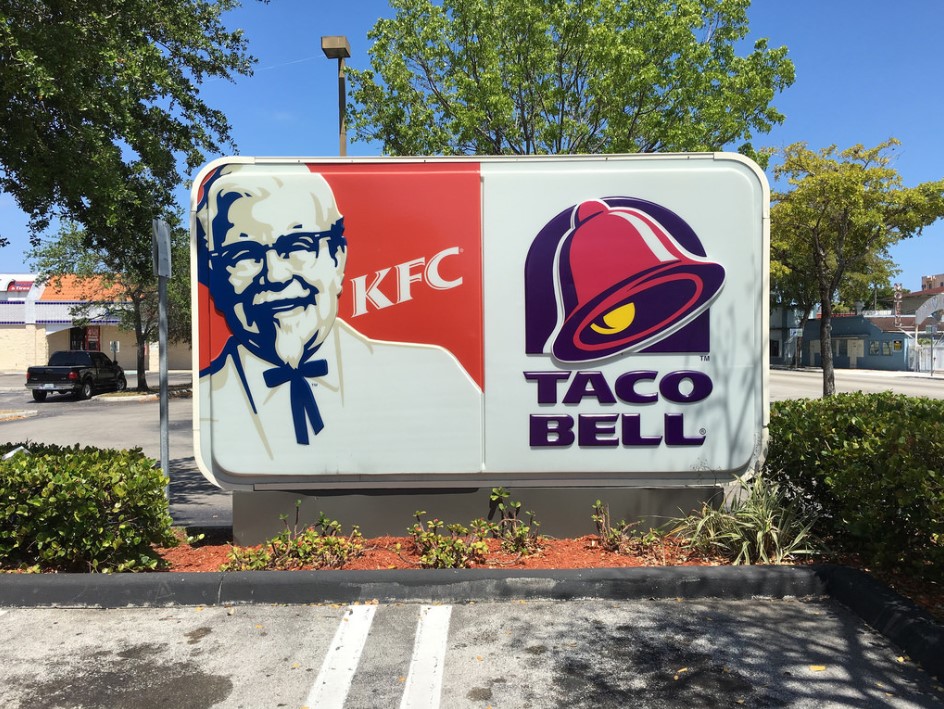
Yum! Brands (YUM) ended 2018 on a strong note while achieving its goal of its restaurant base becoming 98% franchised in the year, and its fourth quarter report, released February 7, revealed a 6% increase in worldwide system sales in constant currency from the year-ago period. The top-line strength was driven by a 9% year-over-year advance at Taco Bell, while its KFC brand trailed that mark slightly with 7% growth. Same-store sales at Taco Bell came in 6% higher than the year-ago period, KFC’s same-store sales growth checked in at 3%, and Pizza Hut’s same-store sales were roughly flat.
Pizza Hut also provided a drag on Yum! Brands’ operating profit performance in the fourth quarter due to headwinds related to franchise advertising other service expenses more than offsetting the tailwind of refranchising (lower company restaurant expenses), but worldwide core operating profit was able to advance 5% on a year-over-year basis. GAAP earnings per share fell 17% from the year-ago period to $1.07 as special items impacted comparability of results. The company’s free cash flow generation in 2018 jumped 32% to $942 million from 2017 levels thanks to both growth in operating cash flow and lower capital spending. Cash dividends paid in the year were just $462 million, but a net debt position of ~$9.8 billion at the end of 2018 provides pressure to its Dividend Cushion ratio, which sits at 0.3 at last check. The company bought back ~$2.4 billion of its shares in 2018.
In 2019, Yum! Expects adjusted earnings per share to be at least $3.75, which is roughly in-line with our current projections. Shares are changing hands above the upper bound of our fair value range, and management’s earnings floor guidance implies shares are trading at ~25x 2019 earnings. We’re not interested in adding exposure to what appears to be overvalued franchised restaurant chains with a sizable debt load. Shares yield ~1.8% as of this writing.
McDonald’s Comps Impress; Long-Term Targets Solid
This earnings recap first appeared in “Earnings Roundup: Big Name Dividend Payers (January 2019).”
McDonald’s (MCD) turned in its fourteenth consecutive quarter of positive global comparable sales in its fourth quarter report January 30, and 2018 marked a second consecutive year of growth in its global guest count for the first time since 2012. In the fourth quarter, global comparable sales advanced 4.4% from the year-ago period with positive comps across all segments, but its franchising efforts led to consolidated revenues falling 3% from the year-ago period on an as-reported basis. Operating income declined 7% from the fourth quarter of 2017 due in large part to non-cash impairment charges, and diluted earnings per share came in at $1.82, more than double the measure in the year-ago period.
Cash flow from operations at McDonald’s in the full year 2018 advanced an impressive ~25%, which helped free cash flow grow by 14%+ to $4.2 billion as capital spending rose materially in the year. Cash dividends paid in 2018 came in at nearly $3.3 billion, and the company repurchased ~$5.2 billion of its own shares. At the end of 2018, the company held $866 million in cash and equivalents and nearly $31.1 billion in long-term debt, and this debt load provides material pressure to its Dividend Cushion ratio, which sat at 0.4 at last check. Shares yield ~2.55% as of this writing.
Now that it has largely completed its franchising strategy, McDonald’s is expecting annual systemwide sales of 3%-5% over the long haul, annual earnings per share growth rates in the high-single-digits, and return on invested capital in the mid-20% range. These are attractive targets but are roughly in-line with our mid-cycle assumptions that drive our fair value estimate of $145 per share for the company. We’re not interested in shares of McDonald’s due to its rich valuation — shares are trading near the upper bound of our fair value range — and we prefer companies with far less debt for long-term dividend growth considerations, even as we applaud management for some of its recent strategic moves in refreshing the image of the iconic American brand in the minds of investors.
Comparable Transaction Growth Returns for Chipotle!
Restaurants – Fast Food & Coffee/Snack: ARCO, DPZ, DNKN, JACK, MCD, PZZA, SONC, SBUX, WEN, YUM
—–
Valuentum members have access to our 16-page stock reports, Valuentum Buying Index ratings, Dividend Cushion ratios, fair value estimates and ranges, dividend reports and more. Not a member? Subscribe today. The first 14 days are free.
Kris Rosemann does not own shares in any of the securities mentioned above. Some of the companies written about in this article may be included in Valuentum’s simulated newsletter portfolios. Contact Valuentum for more information about its editorial policies.