
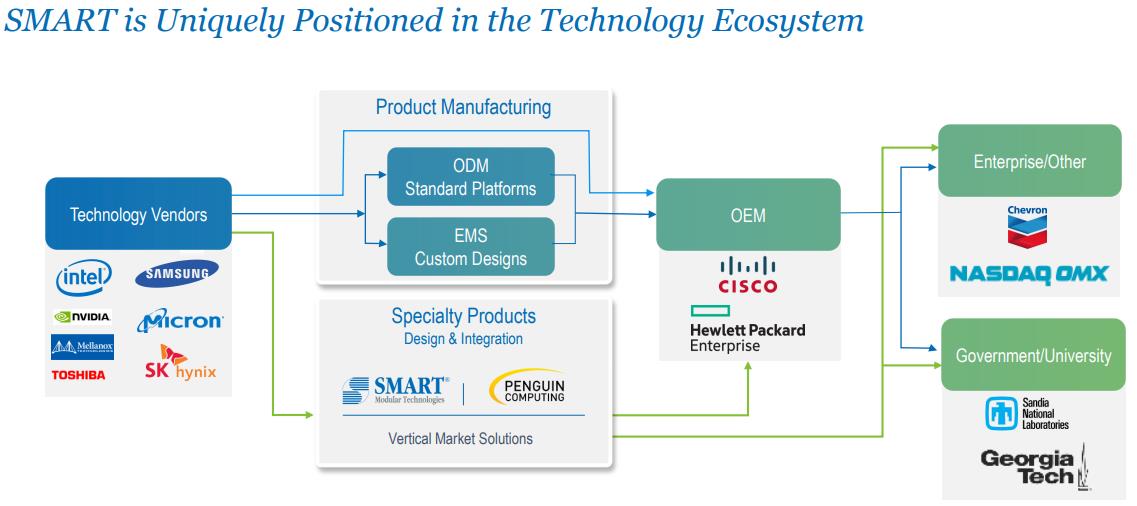
Image source: SMART Global investor presentation
Shares of data and storage firm SMART Global dropped precipitously following its fiscal 2019 first quarter report. A change in Brazil’s local content rules and higher levels of seasonality have impacted its top-line and gross margin expectations and reduced visibility in its business. Potentially volatile gross margin performance is a key risk of the memory space.
By Kris Rosemann
Shares of SMART Global Holdings (SGH), a leader in data compute and storage products and solutions, faced significant selling pressure following its fiscal 2019 first quarter report, results released January 8, as a result of expectations for lower top-line performance in its Brazilian operations, which accounted for just over half of fiscal 2019 first quarter revenue via its subsidiaries. Investors should note that we have never been high on the memory space, and here’s our take on the industry structure, which can found here or in the industry constituents’ individual 16-page reports, as a whole:
Firms in the computers and peripherals industry primarily make storage solutions, while others may offer custom-designed computer/mobile interface solutions or other ancillary computer/mobile products. The industry is characterized by rapid technological change, which has not only increased the adoption of technologies for use in a variety of devices but also has put significant pricing/gross-margin pressure on industry constituents. Competition is fierce, threats of over-supply are continuous, and the prospects for generating long-term competitive advantages are negligible. We don’t like the structure of the group.
Brazil has adjusted its local content rules for the mobile memory sector, which stipulates the amount of industry content that must come from domestic supplier such as SMART’s subsidiaries, down to 50% for calendar 2019 from the previously expected 60%. The move was made in reaction to shortages in calendar 2018, but supply has since improved. The combination of lower local content requirements and increased overall supply is expected to impact SMART’s near-term top-line performance and has reduced visibility in the business. Though management does not expect a material impact of the rule change in its fiscal second quarter (ends late February 2019), the change will weigh on its results through the course of calendar 2019.
It’s no secret that gross margins can be volatile in the memory space, and SMART Global’s near-term outlook is a great example of this as the company expects gross margin to fall to the 18%-20% range in the second quarter of fiscal 2019 from 23.3% in the comparable period of fiscal 2018. Management does not expect to be able to cover its fixed costs in Brazil in the near term, and demand pressures in the mobile memory market are also impacting expectations. Rising levels of seasonality in the Brazilian market resulting from delayed orders around the holiday season are also impacting top-line expectations, and the operating leverage the company often enjoys in times of rising unit volume is expected to provide a headwind as volumes face pressure.
In addition to lower gross margin expectations, SMART projects fiscal second quarter revenue to be in a range of $310-$325 million compared to $314 million in the year-ago period, and non-GAAP earnings per share are expected to fall to a range of $0.73-$0.77 from $1.73 in the second quarter of fiscal 2018. Though management remains optimistic regarding the long-term potential of the Brazilian memory market, we’ve lowered our fair value estimate for shares due to $30 each to the significant change in near-term expectations and reduced visibility in the business. Exposure to the memory space, with our without a presence in the Brazilian market, is not something we’re looking to add to either simulated newsletter portfolio. Both simulated portfolios have been fully invested since December 26.
Computers & Peripherals: MU, NTAP, SGH, SYNA, STX, TECD, WDC, ZBRA
—–
Valuentum members have access to our 16-page stock reports, Valuentum Buying Index ratings, Dividend Cushion ratios, fair value estimates and ranges, dividend reports and more. Not a member? Subscribe today. The first 14 days are free.
Kris Rosemann does not own shares in any of the securities mentioned above. Some of the companies written about in this article may be included in Valuentum’s simulated newsletter portfolios. Contact Valuentum for more information about its editorial policies.