
By Brian Nelson, CFA
On August 24, Enbridge (ENB) announced that it would enter into a definitive agreement under which the entity would buy Spectra Energy Partners (SEP) at an exchange ratio of 1.111 common shares of Enbridge for each common unit of SEP, a near-10% increase from the exchange ratio announced a few months ago. As we have outlined in the past, most recently with respect to the following discussion on the Energy Transfer Equity (ETE) and Energy Transfer Partners (ETP) tie up, “ETE-ETP Rollup and Implied Distribution Cut,” consolidations are slowly eliminating the MLP model via simplification efforts and many combinations are coming with implied distribution/dividend cuts, something that couldn’t have been imagined in years prior.
The story of the demise of the MLP model is rather simple. From where we stand, the MLP model was used primarily as a financing mechanism that could raise equity for the corporate umbrella at a price that was reflective of a yield-based valuation, or one that is effectively priced on the concept of distributable cash flow, an industry specific term that ignores growth capital spending, but includes the net income within the measure that is driven by growth capital spending, “MLP Speak: A Critique of Distributable Cash Flow.” This imbalance translated into equity unit prices for MLPs of bubble proportions that eventually popped as the energy resource markets began to swoon in late 2015 and early 2016, and funding dried up.
It is equally important to understand that part of our thesis in mid-2015 on the MLP space had to do with the idea that the group was not immune to falling energy resource pricing. Many industry experts had argued that midstream equity MLPs–due to their pricing arrangements–would not be impacted by the swoon in energy resource prices. Said differently, the idea that MLPs collapsed because energy resource pricing collapsed was a relationship that we were warning about, while others cried to the contrary. That MLPs collapsed alongside energy resource pricing only reinforces our original thesis given prevaling industry opinion at the time.
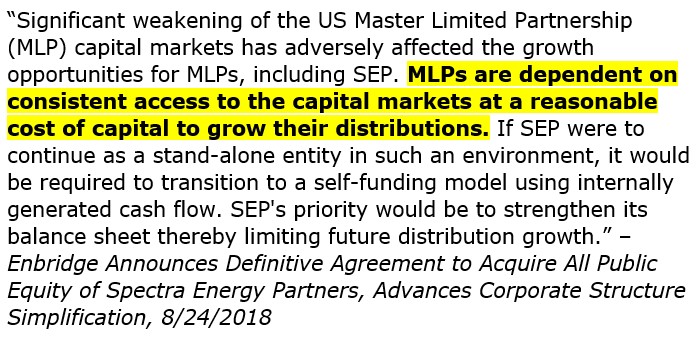
What we find to be most important in the Enbridge-Spectra announcement today is the language in the press release, and we applaud the entity for being so transparent. One sentence stands out, in particular, and represents the core of our thesis that we presented years ago. From the ENB/SEP press release August 24: “MLPs are dependent on consistent access to the capital markets at a reasonable cost of capital to grow their distributions.” If there is any further doubt that MLPs are funding their distributions from the external capital markets, the naysayers are in denial. We’ve pounded the table on this concept time and time again.
There seems to be some confusion with respect to the timeline on our calls with respect to MLPs. In our first piece highlighted in Barron’s in June 2015, “The Bear Case Against Kinder Morgan,” we said the following with respect to MLPs:
Most, if not all, MLPs report distributable cash flow (DCF), which does not in the calculation consider growth capex, an important driver behind the generation of increased cash flow from operations in the future. When MLPs report distribution coverage ratios, this particular calculation also backs out growth capex from the equation, instead using only ‘sustaining capital expenditures.’
There are a number of contractual reasons why the data is presented in such a way, but from a valuation standpoint, we’ve always taken an issue with the MLP universe being implicitly valued on a future distributable cash flow stream that “covers” the distribution than on future free operating cash flow, which is a better measure of the free operating cash flow that a business generates.
The reason why free operating cash flow is more informative is quite straightforward. Distributable cash flow does not deduct the investment associated with driving future growth in an MLP’s cash flow from operations. Said differently, it’s like getting a free pass on all of the future growth spending that is required to drive incremental cash flow from operations, a severe imbalance in the valuation equation.
In valuing MLPs, we’ve circumvented the valuation imbalance by making the universal assumption that MLPs will continue to have access to the capital markets and that they will be able to issue equity and/or debt in such a way that is not value-destructive. Said differently, in our valuation models, we give MLPs credit for the future growth in cash flow from operations without deducting the growth capex that is required to drive it. We disclose this dynamic in every one of our 16-page reports within the MLP space.
We followed up our thesis, “Why The MLP Business Model May Be a Goner,” in September 2015, and we generally went neutral on the MLP space in January 2016 as we noted that Kinder Morgan’s (KMI) equity simply had fallen too far relative to our intrinsic value estimate at the time “Is Kinder Morgan on the Road to Recovery.” For each midstream equity in our coverage universe, we calculate an intrinsic value estimate, and we use that to inform our opinion of the investment opportunity of each idea. MLPs, in early 2016, had fallen to better reflect enterprise free cash flow analysis, eliminating the systematic bubble of the MLP model that had been embedded in yield-based pricing, which we believed and still believe is an imbalanced way to approach equity valuation.
Needless to say, those that heeded our warning on MLPs in mid-2015 did incredibly well as much of their capital was saved. An index tracking the share prices of MLP business models (AMLP), for example, has collapsed since mid-2015, while the broader S&P 500 (SPY) has surged. Furthermore, there have been nearly 60 distribution cuts since we outlined our thesis in mid-2015, and the list of MLP consolidations and roll-ups is long and growing since then. The number of newly-announced MLPs has been practically nil during the past few years, too, another sign that the MLP business model is on its way out. We maintain our view: The Days of the MLP Model Are Numbered.
But that may be okay. Much of the froth has already been removed from MLP midstream valuations as most have systematically reverted to enterprise discounted cash flow valuations, in our view, and the idea that there could be premiums issued within consolidation scenarios is bringing new capital into the sector. This is, in part, why we may see the MLP midstream group advance as a whole as speculative premiums are built into subsidiary unit prices. Though rollups may eventually cause the demise of the MLP business model, on the way out investors may have an opportunty to reap some final gains. Until the next MLP rollup announcement…stay tuned!
Pipelines – Oil & Gas: BPL, BWP, DCP, ENB, EPD, ETP, GMLP, HEP, KMI, MMP, NS, PAA, SEP, WES
Related: AMZA, TGE, APU, TRP
—–
Valuentum members have access to our 16-page stock reports, Valuentum Buying Index ratings, Dividend Cushion ratios, fair value estimates and ranges, dividend reports and more. Not a member? Subscribe today. The first 14 days are free.
Brian Nelson does not own shares in any of the securities mentioned above. Some of the companies written about in this article may be included in Valuentum’s simulated newsletter portfolios. Contact Valuentum for more information about its editorial policies.