
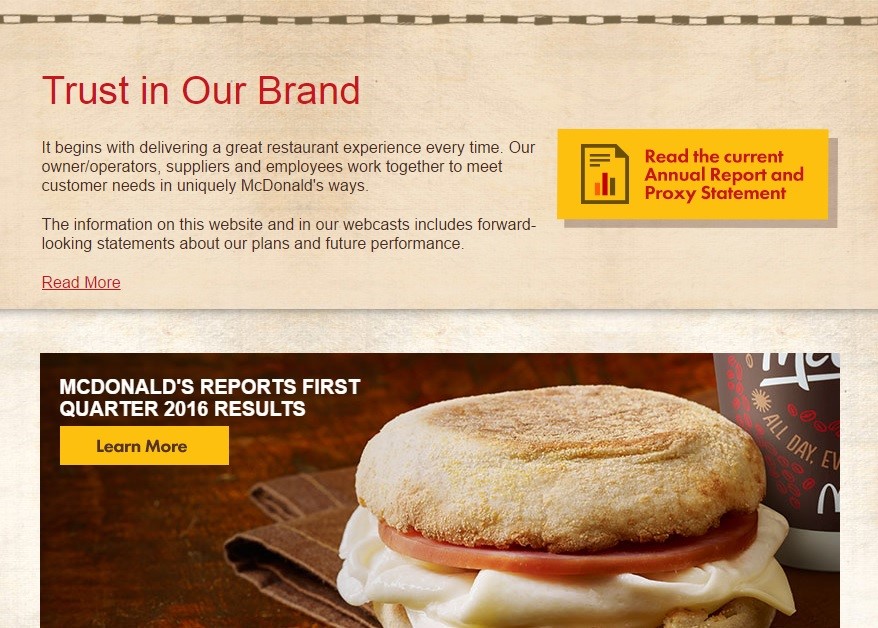
Image source: McDonald’s Investor Relations page
By Kris Rosemann
McDonald’s Comps Still Expanding
McDonald’s (MCD) continues to believe in the turnaround strategy it implemented about a year ago, and the market appears to be on board as well. The company’s biggest appeal remains its brand recognition, and the above screen grab of its ‘Investor Relations’ page on the corporate site hints that it is well aware of this.
Nevertheless, the burger giant has had a solid string of quarters as of late. Global comparable sales in the first quarter of 2016 increased more than 6% from the year-ago period, and US comparable sales grew 5.4% thanks to the broad acceptance of its All Day Breakfast strategy. We were skeptical of the initiative–the long-term viability of it as a growth strategy remains to be seen–but it appears to have accomplished exactly what management had hoped it would do. People are talking highly of McDonald’s again.
The solid comps growth in the first quarter of 2016 came despite the company’s “High Growth Markets” growing comparable sales by 3.6% due to challenging macroeconomic factors. The firm’s “Fundamental Markets” advanced comparable sales by an impressive 11% thanks in part to positive results from Japan, where weakness in the comparable period provided a tailwind.
Operating income in the first quarter of the year expanded at an impressive 28% pace on a year-over-year basis, though this growth rate drops to the mid-teens after accounting for the $195 million strategic charge the firm incurred in the comparable period of 2015. Diluted earnings per share growth was strong in the quarter as well, jumping 46% from the year-ago period. However, this growth was boosted by the aforementioned strategic charge and share repurchases of more than $4.3 billion. This type of bottom line growth is not sustainable, and therein lays the issue with McDonald’s.
If McDonald’s is to grow into its current share-price trajectory and valuation, it will need to continue to put up impressive comps growth and execute flawlessly to continue its bottom line strength. The ongoing refranchising will certainly help expand margins, but will the improvement be enough? We don’t have enough confidence to make that call at the moment. The sustainability of the fundamental drivers behind McDonald’s performance over the past year is not likely replicable over the long haul, and eventually investors will realize the biggest draw to the firm remains its brand name, not the “growth potential” behind egg sandwiches now being available all day.
Yum Stays On Track to Separate China Division
Yum! Brands (YUM) reported a solid quarter to start the year April 20, as worldwide system sales grew 5% from the year-ago period, and worldwide same-store sales edged higher by 2%. The firm’s bottom line performed even better in the quarter. Core operating profit leapt 21%, and earnings per share excluding special items advanced 19% on a year-over-year basis. Operating profit growth was driven by a 42% increase in the firm’s China business operating profit. As a result of the strong quarter, management raised its full-year core operating profit growth guidance to 12% from previous guidance of 10%.
Yum! Brands remains on track to separate its China business by the end of 2016, which is in part a sign of the degree of difficulty foreign corporations have found in operating in the country. It will also offer investors more options to play the restaurant “conglomerate,” if they so choose. Yum! Brands will continue to have material exposure to its China operations through the royalties it will receive in exchange for the rights to the KFC, Pizza Hut, and Taco Bell brands. The Taco Bell brand has yet to enter the Chinese market.
Growth outside of Yum’s China division remained steady as each of the KFC, Pizza Hut, and Taco Bell divisions reported system sales growth in the low-to-mid single digits, and core operating profit advanced in the mid-to-high single digit range during the first quarter of the year on a year-over-year basis. Though the brands may not have the same recognition of McDonald’s, the strength of the three cannot be denied. Similar to McDonald’s, however, is the lack of valuation opportunity we see present at Yum! Brands at the moment. Our fair value estimate remains $65 per share.
Same-Store Sales Growth Streaks Remain Intact at Domino’s Pizza
Domino’s Pizza (DPZ), the self-titled world leader in pizza delivery, reported yet another quarter of strong same-store sales growth in both its US and International operations April 28. The first quarter of the year marked the 20th consecutive quarter of positive same-store sales growth in its US business and the 89th such quarter in its International operations; domestic same-store sales advanced 6.4%, and international same-store sales increased 7.9% from the year-ago period. The strong performance in same-store sales growth drove growth of 7.4% in total revenue on a year-over-year basis.
However, net income felt pressure in the quarter as a result of higher interest expense from the firm’s recapitalization in 2015. Despite the 1.8% decline from the year-ago period in net income, Domino’s reported diluted earnings per share growth of nearly 10% due to lower diluted share counts as a result of the company’s accelerated share repurchase program. We’re not particularly fond of this use of capital as shares aren’t exactly cheap.
Long-term guidance for Domino’s Pizza remains unchanged after the quarter. The company continues to expect domestic same-store sales growth in the range of 2%-5%, and international same-store sales growth in the range of 3%-6%. The firm fully expects its impressive streaks to continue for the foreseeable future. Though we remain in awe of its ability to generate economic value for shareholders, shares are a little too hot for our taste. Our fair value estimate currently sits at $92 per share.
Chipotle’s Woes Continue
Chipotle’s (CMG) struggles over the past several months have been well noted in the media, and the company continued to feel the effects of drama surrounding the safety of its food. The food safety scares have effectively thrown a monkey wrench in the company’s mission of changing the way people think about and eat fast food. In the first quarter of 2016, revenue fell more than 23% from the year-ago period, driven downward by comparable restaurant sales plummeting nearly 30%. Comparable restaurant transactions dropped by just over 21% in the quarter.
The company saw major deterioration in its restaurant level operating margin in the quarter as well, which fell to 6.8% from 27.5% in the first quarter of 2015. The margin contraction was due to unfavorable sales leverage, higher marketing and promotional costs to combat negativity, and food testing and waste costs. Chipotle recorded a loss per diluted share of $0.88 in the quarter, compared to diluted earnings per share of $3.88 in the comparable period of 2015. The firm did not issue earnings or sales guidance after the quarter, a positive publicity move in our view due to the fact that an explicit disappointment may have created even more investor unrest.
There is no question that Chipotle could right the ship very soon and get back on the track it was on only a year ago, but we are having trouble getting behind the firm, even at such relatively suppressed price levels, with such uncertainty surrounding it. Management failing to issue same-store guidance as it typically would points to both the lack of visibility into the business on a near-term basis and the absolute “carnage” that has taken place at the firm in recent quarters.
Panera Stealing Traffic from Chipotle?
Panera Bread (PNRA) reported a strong first quarter of the year, as the firm’s company-owned comparable net bakery-café sales growth of 6.2% in the quarter was the best it has recorded in four years. The company has been accelerating its clean food movement as of late, and the strategy appears to be paying off and is more than likely directly related to the developments at Chipotle. Management has seen an opportunity to increase market share among healthier alternatives to fast food and has done a prudent job in driving traffic increases.
Earnings per share jumped 21% in the first quarter of the year, but advanced “only” 11% on a year-over-year basis when excluding one-time items. After the strong quarter, management raised its full-year 2016 comparable net bakery-café sales target to 4%-5% compared to a previous range of 3.5%-4.5%. It also raised its full-year 2016 earnings per share guidance to a range of $6.50-$6.70, representing growth of 5%-8% compared to the previous growth guidance of 2%-5%.
The performances of Chipotle and Panera in the first quarter of 2016 were nearly complete opposites of one another. Panera’s version of Chipotle’s “Food with Integrity” mission continues to gain steam and has never been stronger and Panera increased its full-year guidance ranges, while Chipotle shied away from issuing guidance at all. One common thread remains, however, as neither company is particularly attractive from a valuation standpoint at the moment. Panera shares are trading well above the upper bound of our fair value range of $127-$191.
Noodles & Company Reports Noodle-like Comparable Restaurant Traffic
Noodles & Company (NDLS) reported revenue growth of nearly 8% in the first quarter of 2016 May 3, driven mostly by new restaurant openings. System-wide comparable restaurant sales fell 0.1% from the year-ago period, and comparable traffic at company-owned restaurants fell nearly 1% on a year-over-year basis.
Restaurant contribution margin in the quarter fell to 13.3% from 16.2% in the year-ago period due to rising labor costs, decreasing operating leverage on lower average unit volumes, and investments in marketing and operational initiatives. As a result of the margin deterioration, the company recorded an adjusted net loss of $2.4 million, which is a sharp drop off from adjusted net income of $0.9 million in the first quarter of 2015.
Noodles & Company’s lackluster quarter was accompanied by lackluster guidance. There seems to be very little excitement around the stock compared to this time last year, and for good reason. The company is no longer riding the wave of speculation that had surrounded fast-casual restaurants in years past, and its fundamentals at the moment are not enticing enough to generate buzz on its own. We’re comfortable on the sidelines on this one.