
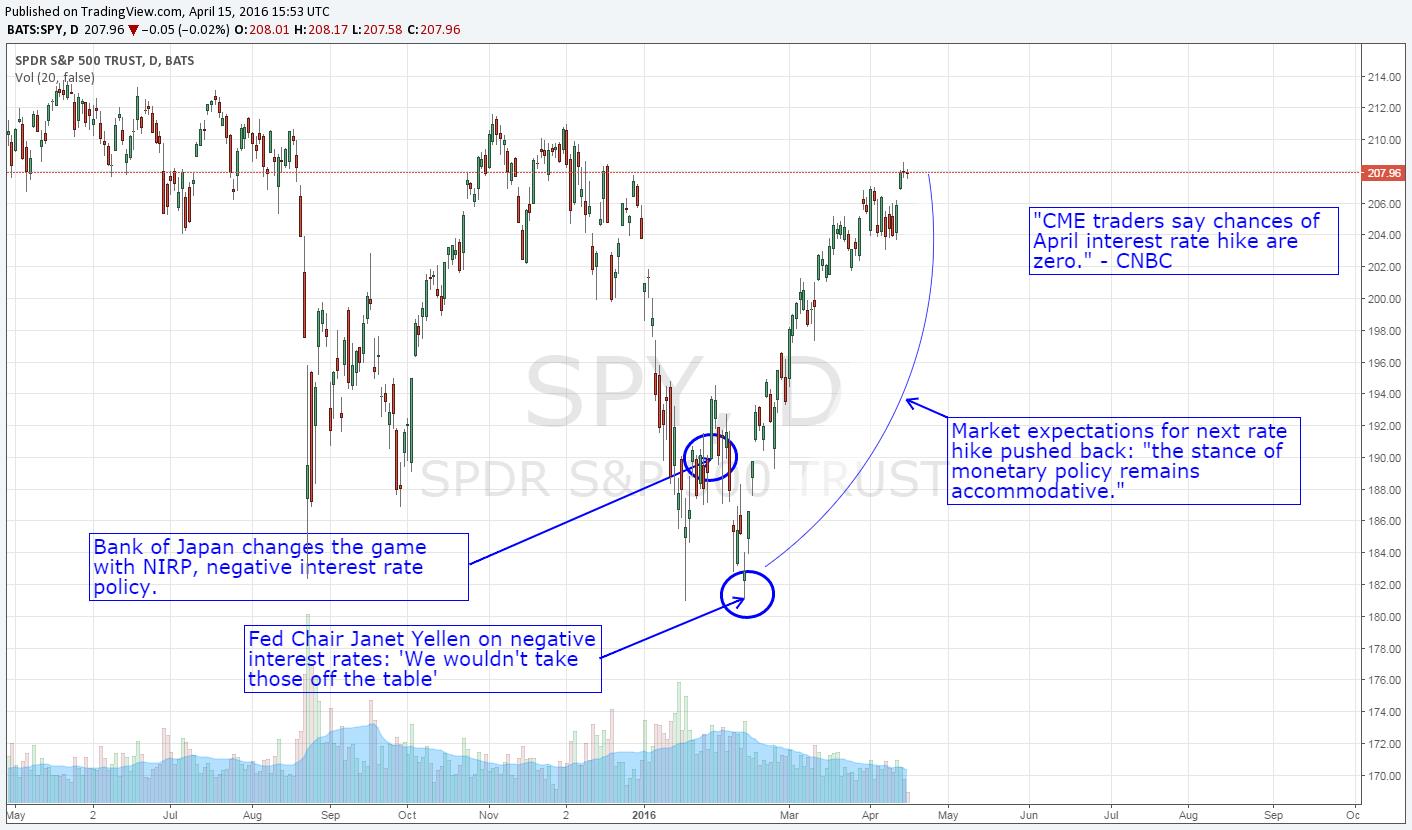
The laws of finance are being bent, broken even. NIRP (negative interest rate policy) has changed everything. The world is upside down.
At the beginning of the year, we were expecting ongoing contractionary monetary policy by the Fed, but on January 29, all of that changed. In a surprise move, the Bank of Japan introduced a negative benchmark interest rate of -0.1%, meaning that instead of paying interest on deposits, it would charge banks to hold their money. The move seemed to blindside the Fed, and from where we stand, it has effectively put rate increases on pause. There’s a reasonable chance of a rate hike in December, but the latest read from the CME is that there’s no chance at all we’ll see one in April, a sharply different view than a few months ago. After all, one might say: how can the Fed hike rates at a time when the rest of the world is engaged in subzero policy? We wrote extensively on the NIRP topic in the February 1 piece, “Dividend Growth ‘Bubble’ To Continue But For How Long?,” and from the looks of it, the stock-market bubble is poised to get even bigger.
Here’s the deal. Though a rather obscure article in the Journal, there was a rather peculiar story about how a Danish couple was paid interest on their mortgage. You read that correctly: they were paid interest on their mortgage, instead of paying interest. Denmark is not the only place that is pursuing NIRP either. Switzerland, Sweden, the European Central Bank and the aforementioned Bank of Japan are all using subzero rates in an effort to drive expansion. The story of the Danish couple may be overlooked by some, dismissed by others, but the implications are far-reaching when it comes to the laws of finance, in our view. Negative interest rates seem to bend everything we know about the financial discipline, and in some ways, break its core tenets. We’re in unchartered territory. Central banks around the world are playing with fire, and they know it.
As interest rates hover below zero in most of the world and the Fed contemplates the path of the federal funds rate in light of lackluster inflation and generally weak gross domestic product growth, the most important consideration in finance is starting to break down: the time value of money, or the idea that a dollar today is worth more than a dollar tomorrow (as the dollar today can be invested at a positive interest rate to be worth more in the future). Why is this important? For one, where future free cash flows within the valuation framework are worth less as they are discounted back to today, a negative discount rate means something entirely different. Certainly the cost of equity would mean discount rates stay positive even under NIRP thanks to non-zero equity risk premiums, but an asymptotic situation is likely to unfold as all-in discount rates on future free cash flows approach zero themselves. The result as the discount mechanism gets ever smaller: exponentially rising equity prices. This phenomenon seems to already be happening in the least risky areas of the equity markets, ones known for having the lowest costs of capital — the dividend-paying consumer staples (XLP) arena.
Get this. Shares of Coca-Cola (KO) are now trading hands at nearly $46 each, more than 22 times adjusted fiscal 2017 earnings. That’s fiscal 2017 earnings, not fiscal 2016 or trailing fiscal 2015 earnings. The market is granting the beverage giant such a lofty forward earnings multiple despite its full-year reported revenue falling 4% and reported operating income dropping 10% in 2015. Sure we can make a large number of non-GAAP adjustments to make the Coca-Cola’s results look better for the year, but the reported trajectory of the firm is downward, on a reported basis. Of course Coca-Cola is a great company, but the point we’re trying to make is that its shares have not been soaring because its fundamentals are doing great. The reality is that the discount rate that the market is placing on Coca-Cola’s future free cash flow stream is falling as expected interest rates collapse, driving the market’s view of its valuation (as evidenced by its price) higher, something exacerbated by dividend growth investors piling into the stock. We’re not saying readers should abandon the soda maker, but 22 times fiscal 2017 earnings is a lot to pay for any company, especially one where reported numbers are declining.
Coca-Cola is not the only company experiencing such an “asymptotic dynamic” either. Clorox (CLX) is trading at more than 24 times fiscal 2017 earnings, Colgate-Palmolive (CL) more than 23 times fiscal 2017 earnings, Kimberly-Clark nearly 21 times fiscal 2017 earnings, McDonald’s (MCD) more than 21 times fiscal 2017 earnings, Pepsi (PEP) at more than 20 times fiscal 2017 earnings, 3M (MMM) is trading at nearly 19 fiscal 2017 earnings, and Federal Realty (FRT) is exchanging hands at 27 this year’s expected funds from operations per share. Incredibly, most of these companies also hold net debt positions on the balance sheet, further illustrating the magnitude of enterprise “market cap” a lower discount rate is generating on these steady-eddy free cash flow generators.
Here’s what we’re getting at: if 20-30 times fiscal 2017 earnings is somehow reasonable today in light of existing conditions, why not 30 or 40 times fiscal 2018/2019 earnings eventually? This prognostication may sound like good news as it means higher stock prices, and maybe it’s actually great news for many, but in the event the market does move fervently higher, readers should understand the advance may be driven more by ever-falling assumed discount rates within equity valuation frameworks, buttressed by buying from dividend growth investors, more than anything else. Because this bubble is inflating on some of the strongest business models with household brand names, prices on these equities could inflate considerably without much pushback from holders. We continue to be mostly long in the Best Ideas Newsletter portfolio as we plan to participate in any strong advance that may be coming, but a healthy dose of skepticism of the market will keep us on our toes.
Clearly, we may have underestimated just how much “air” the prospect of NIRP, or a delay in a rate hike by the Fed, could force into an already “bubbly” equity market, but no matter what may be ahead of the markets, we simply can’t afford not to be cautious in light of existing valuations. Can you imagine the shock on investors if some of the outsize forward valuations on some of the most tried-and-true dividend-payers revert back to traditional mid-teen forward multiples? In some cases, capital positions could be halved. Please be cognizant of the capital risks as broader equity markets continue to reside near all-time highs. We’re always available for questions.