
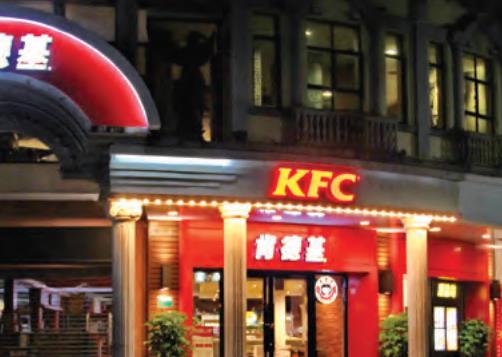
Image Source: Yum! Brands, 2015 Annual Report
By Jessica Bishop
Squashing a recent report from Bloomberg that suggested the Yum! (YUM) separation had been delayed, the executive team heading the KFC, Pizza Hut and Taco Bell franchises said in its second quarter 2016 report, released after the close July 14, that all is well with plans to separate its fast-growing operations in China from the rest of the company. We outlined our latest thoughts on the China separation in our late June piece, “Yum! Does One Plus One Equal More Than Two?” and while not much has changed in the past few weeks, we continue to monitor Yum! — not only in the event the separation causes a mispricing with respect to the two eventual separately-traded entities, but also as it relates to data points about the health of China itself.
Worldwide, the existing, pre-split Yum! Brands is moving full steam ahead, with the restaurant giant opening more than 370 new restaurants in the second quarter of 2016 (ended June 11, 2016). During the period, still-consolidated Yum! generated core operating profit growth of 7% and earnings per share growth of 9% (excluding special items), and we liked that its ‘KFC Division’ had the most improvement, as it has increased 6% in system sales and 2% in same-store sales in the quarter. Though industry conditions in the US challenged performance, overall global success of the company’s three core brands (KFC, Pizza Hut, and Taco) helped to keep operating-profit growth in-line with management’s expectations in the quarter. There’s room for improvement, however.
Sluggish growth in the US (particularly at Taco Bell) may have been in part due to price competition from other restaurants including Chipotle (CMG) and McDonalds (MCD), but Taco Bell has been lapping very difficult comparisons of late – so it may not be as fundamental as the headline numbers suggest. For example, while same-store sales declined 1% at Taco Bell in the US, the measure advanced 6% in the prior-year quarter, resulting in a two-year “SSS stack” of 5% (not bad and a pace ahead of its category). Pizza Hut’s same-store sales were flat in the quarter, even though US same-store performance advanced 1%. The promotional environment in “pizza” remains intense, and we doubt this will ever change. Not only are new fast-casual concepts advancing, “The Continued Rise of Pizza and How to Play It (May 2015),” including Buffalo Wild Wings’ (BWLD) Pizza Rev and RAVE Restaurant’s (RAVE) Pie Five, but traditional giants, Domino’s (DPZ) and Papa John’s (PZZA), aren’t letting up. New strategies at Yum! including the introduction of Taco Bell Cantina to Las Vegas and Pizza Hut’s $5 flavor menu have the potential to improve sales growth at these two concepts, respectively, moving forward.
The finalization of the split of Yum! into two publicly-traded, independent companies (Yum! Brands and Yum! China) is set to be complete around October 31st, 2016, a fine-tuning of previous estimates that slated the division to be completed by the end of 2016. Recapitalizing the new Yum! Brands, the entity divesting itself of its China business, has led to a piling on of more debt and reduced credit quality, but management doesn’t seem too worried about the heightened leverage as it intends to return a substantial amount of capital before and after the split (mostly through buybacks–it has already repurchased ~$3.3 billion of shares since announcing the split). The spin-off, Yum! China, on the other hand, will be debt-free following the split, leaving the debt burden to fall on the “China-free” Yum! Brands, which will pursue a capital-light, franchise mix of 96%+ by the end of 2017. Yum! China owns the substantial call option on growth of KFC and Pizza Hut Casual Dining in the country. After the separation, investors will either have a choice of Yum! China, which offers tremendous unit-expansion potential and a debt-free proposition (but with substantially more operating risk), or Yum! Brands, an income-oriented, capital-light franchisor but one with substantial leverage — or neither. Valuation matters.
Gross domestic product growth in China came in at 6.7% during the second quarter, at the low end of the government’s target, but things seemed to pick up beginning in the third quarter, at least if Yum!’s China Division is any indication. The pace of expansion in its China division during the first half of 2016 and during the third quarter thus far drove management to increase full-year operating profit growth expectations to 14% from 12% for the entire entity (KFC China’s same-store sales growth was a higher-than-expected 3% in the period). Pizza Hut Casual Dining weighed on the China Division’s overall pace of same-store sales expansion, however, declining 11% in the quarter, leading the total same-store change in Yum!’s China Division to be break-even. Management, however, noted substantial same-store sales improvement at both KFC and Pizza Hut Casual Dining during the third quarter thus far, with KFC pacing “double-digit” comps and Pizza Hut Casual Dining turning the corner into positive territory after a very weak showing in the second quarter (which had prompted management to slow gross and net new unit openings for the concept in China by 50-100). The improvement in same-store sales thus far at Pizza Hut Casual Dining has management encouraged, however, and the team has plans to re-step up build rates.
All in, it appears that consumer demand in China picked up a bit since the middle of June, as evidenced by the significant improvement in same-store sales at KFC China and Pizza Hut Casual Dining since the close of second-quarter books (the change was quite material). We continue to watch the separation closely for any snags, but it appears management will do all that it can to make it happen around Halloween this year. We plan to consider both income-rich Yum! Brands and Yum! China as ideas in the Dividend Growth Newsletter portfolio and Best Ideas Newsletter portfolio, respectively, but valuation will always be a primary consideration, something we won’t have a handle on (i.e. the price to fair value ratio) until the split is complete later this year.