Though the firms below aren’t included in the newsletter portfolios, we keep a close eye on them should an opportunity ever present itself. Not only are they fantastic companies with strong business models, but they also provide insight into the broad industries in which they operate. With only a couple weeks left in 2014, management teams are actively preparing their budgets for 2015. Let’s have a look at what a few bellwethers have been saying about their outlooks for next year.
Industrial Bellwether 3M (MMM)
The maker of Post-it notes has become the poster child of aggressive dividend growth policy as of late. Having traditionally raised its dividend a penny or two per year in the past, 3M upped the payout by more than $0.22 per share for 2014, to $0.855 per quarter, and then raised it December 16 by another $0.17 per share (a 20% increase), to $1.025 per quarter beginning in 2015. On the basis of 3M’s Dividend Cushion ratio of 1.9, we were expecting another big hike in the payout, but this pace of expansion will have to let up soon. The firm said it expects organic growth, ex-currency, to increase 3%-6% in 2015 and that earnings for the year would come in between $8.00-$8.30, bounding consensus of ~$8.20 per share. You won’t hear us say anything bad about 3M because it truly is a fantastic company, but at nearly $160 per share, investors are paying up for the company’s dividend growth potential, and this may not be wise if interest rates begin to head north in a hurry. The high end of our fair value estimate range for 3M is $145 per share at the time of this writing, implying downside risk.

Housing-related Bellwether Whirlpool (WHR)
Whirlpool continues to register a 9 on the Valuentum Buying Index, and the company has surged from under $130 per share to nearly $190 per share at the time of this writing. The leading manufacturer and marketer of major home appliances has significant operating leverage in its business model, where a small increase in sales has a very large impact on the bottom line. By our estimates, there remains a significant gap between “normal” annual appliance demand (as measured by US T7 industry shipments), and the current pace of unit sales. We’ve included the firm as one of our favorite housing related ideas in the past, and Whirlpool continues to deliver. Looking ahead, the firm said it expects full-year ongoing business earnings per diluted share of $14-$15 in 2015 and $700-$800 million in free cash flow generation for the year, in-line with consensus. We regret not adding it to the Best Ideas portfolio, as we do for most, but not all, 9- and 10-rated entities.

Consumer-related Bellwether Coca-Cola (KO)
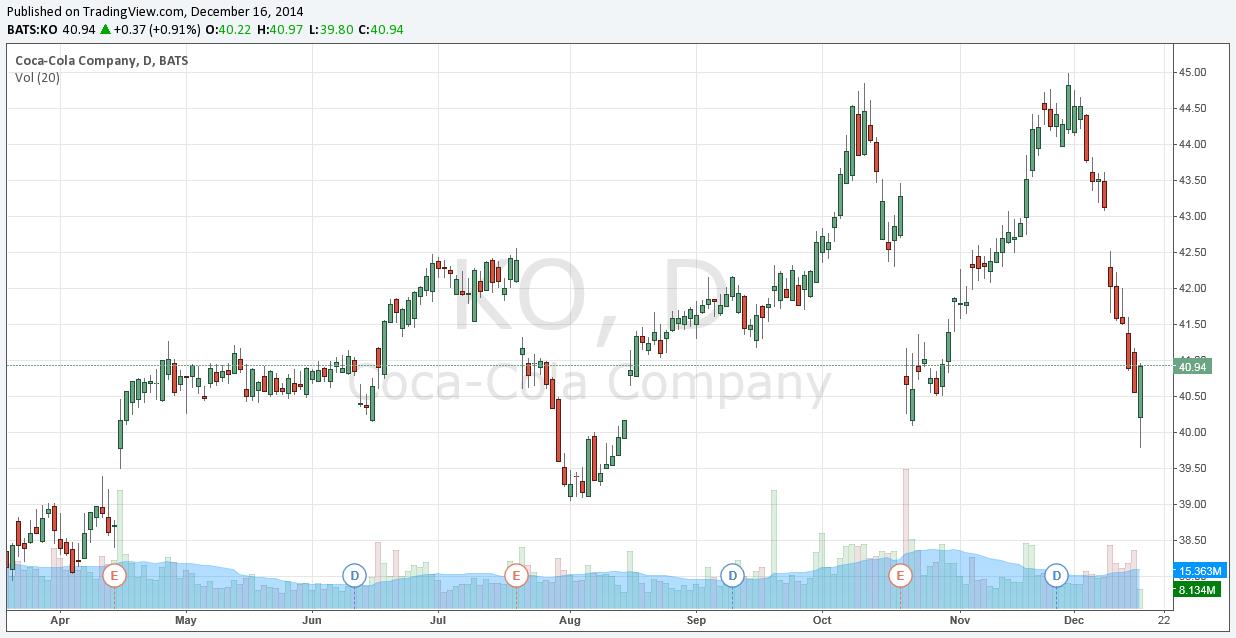
Coca-Cola is included in a lot of investor portfolios thanks in part to its brand awareness, but the company has had better times. The firm’s results were one of the bigger disappointments during third-quarter earnings season, and it recently reiterated its meager outlook for 2015. The beverage giant does not expect currency-neutral 2015 earnings per share growth to be “significantly different” from 2014, and foreign exchange is anticipated to provide a stiff headwind to performance during 2015. At more than $40 per share, the company is trading at nearly 20 times 2015 expected earnings, which aren’t expected to grow at any “significant” pace. We value shares in the mid-to-high $30s per share, and we note that we are being rather generous with the discount rate in the model given Coca-Cola’s easy ability to access capital. Under a more punitive scenario, we could see Coca-Cola’s shares drop 10% or more, and we wouldn’t think much of it given both earnings and the pace of expansion. The company’s dividend remains healthy, however.
Aerospace & Defense Bellwether Boeing (BA)
Orders continue to pile in for commercial airplanes, and we think the multi-year backlogs of unfulfilled deliveries at Boeing and Airbus (EADSY) are a key asset to any investment thesis in the commercial aerospace supply chain. For the airframe makers, however, the question is not whether there is burgeoning demand (there is), the question is whether they’ll be able to translate such unit demand into increased profitability and cash-flow generation. Boeing-rival Airbus, for example, recently noted that it expects flat profits in 2016 as it deals with sluggish performance from the A380 superjumbo as well as production and pricing uncertainty related to the A330. The long-awaited A350 is expected to be delivered December 22 to Qatar Airways, and while we think Airbus will be able to return to significant profit growth post-2016, we don’t think we’ve seen the last of production-related issues to the new A350 or even its A380 superjumbo.
Boeing’s third-quarter report showed a peculiar and unwelcome decline in cash-flow generation, and management is working to assuage concerns by upping its dividend and buyback program, which it announced December 15. The commercial aerospace giant increased its quarterly dividend 25%, to $0.91 per share, up from $0.73 per share previously and said that it would increase its repurchase authorization to $12 billion from the $4.8 billion that had been left. We like Boeing a lot, but we like the commercial aerospace supply chain better, as most constituents are not dependent on whether Boeing or Airbus wins the global aerospace duopoly. Firms such as Precision Castparts (PCP) and Rockwell Collins (COL), for example, are much better positioned.

Industrial Bellwether Honeywell (HON)
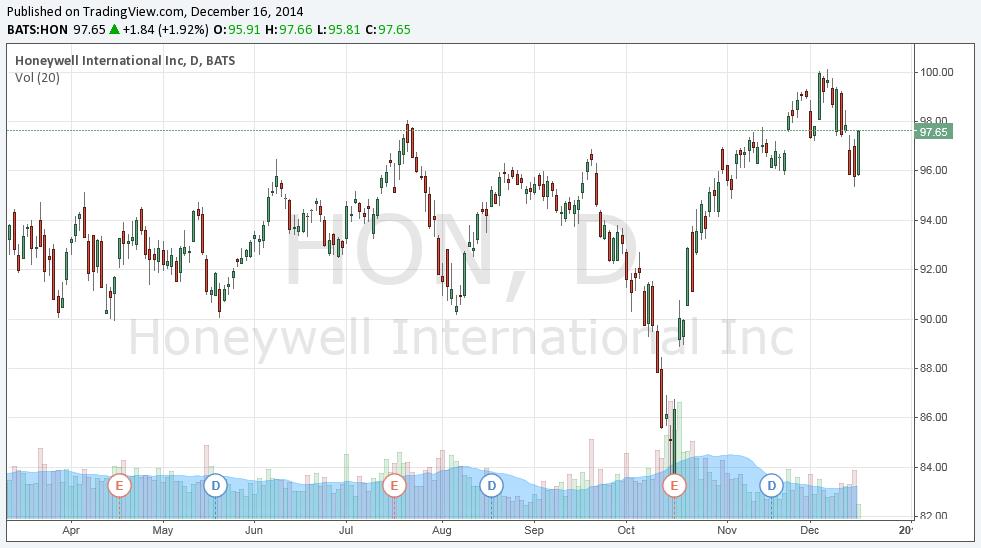
As with many of the industrial conglomerates, Honeywell is a fantastic company with a deep executive bench of talent. The firm recently showcased its strength during the third quarter, and management guided 2015 organic sales growth to ~4% and earnings per share in the range of $5.95-$6.15 per share, with free cash flow expected to come in at $4.2-$4.3 billion, a very impressive outlook. The firm continues to raise its dividend, and we view its payout as very healthy. Honeywell’s valuation opportunity isn’t as compelling, however, as our fair value estimate of shares falls roughly in-line with where the company is trading at the moment. We think a better entry point can be had with Honeywell in the next few years.