
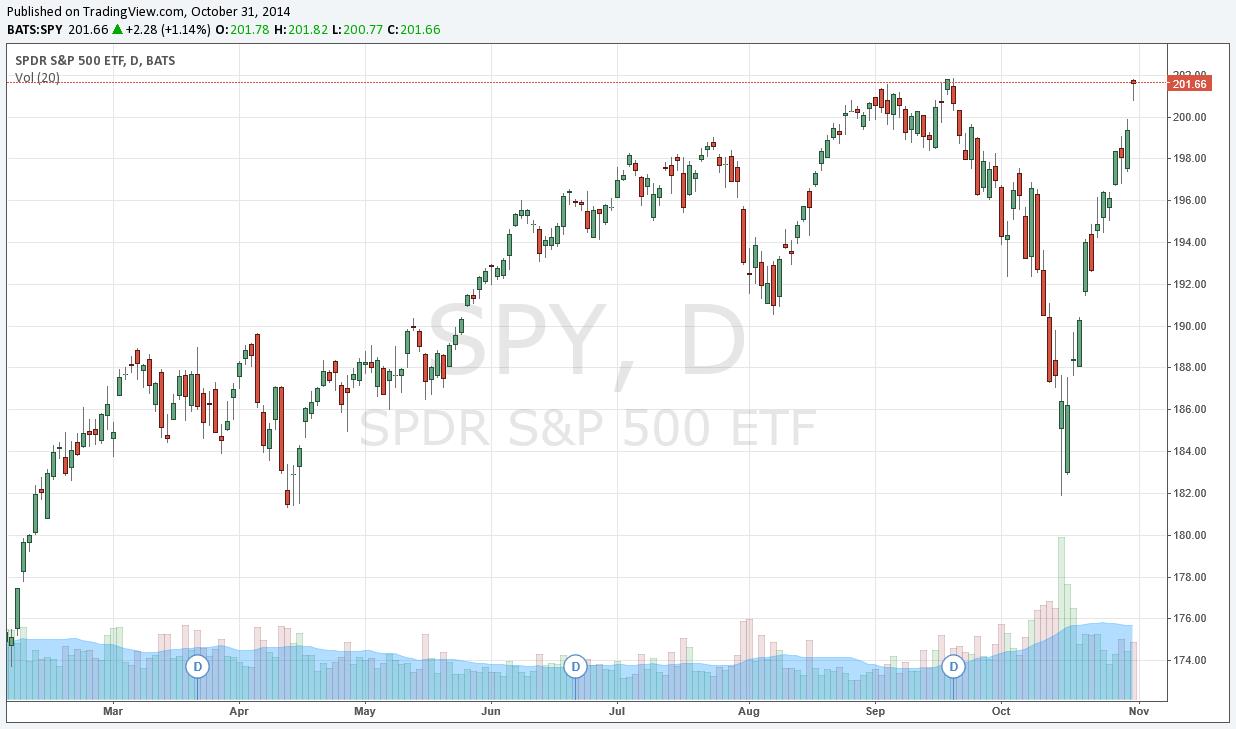
The taper came and went, and the markets don’t seem to care. The S&P 500 notched yet another high this week. The correction that we warned about came and went as well, almost as if market forces created such an event just to move higher.
From my experience, the market, at the present moment, is trading almost purely on technicals. For example, once we touched the 10% official mark of a correction, we started to move higher, and once the markets started to move higher, the move accelerated. Consecutive gap ups following pull-backs have become the norm. This market has become almost a pure technical market, where traders and moving averages are taking precedent over fundamentals. This won’t last forever.
The need to hold equities in one’s portfolio continues to be supported by ultra-low interest rates and the lack of opportunities across other asset classes. For one, Japan’s absolutely massive $1.2 trillion Government Pension Investment Fund is navigating through this dynamic, and it recently raised the equity portion of its holdings. For a fund of this size, it’s a big deal and such re-allocations are moving markets:
Under the new allocation guidelines, Japanese stocks and foreign stocks will each take up 25% of the fund’s holdings, up from 12% each previously. The fund intends to put 35% of its money in domestic bonds, down from 60%, while the ratio for overseas bonds will rise to 15% from 11%.
Global fund managers have been paying close attention to how the pension fund changes its strategy because of the potential for hundreds of billions of dollars to flow into markets inside and outside of the country. Even a one-percentage-point change to its portfolio could mean a shift of more than 1 trillion yen ($9 billion).
The lack of investment opportunities outside of equities has created a stock market that is being propped up because nothing else is as attractive. Said differently, equities have become attractive to scoop up, not because they are attractive, but because everything else out there isn’t offering a return high enough to achieve long-term goals. We could be setting up for a disaster as innocent investors are lured into risky equities, only to see their holdings impaired (perhaps temporarily) as valuations reset. The current 12-month forward price-to-earnings ratio, for example, is 15.5, “above the prior 5-year average forward 12-month P/E ratio of 13.5, and above the prior 10-year average forward 12-month P/E ratio of 14.1.” It’s hard to say stocks as a whole are “pound-the-table” buys.
Many are calling this earnings season a good one, but we’re not so sure. When IBM (IBM), Coca-Cola (KO), McDonald’s (MCD), and AT&T (T) all report disappointing calendar third-quarter performance, the internals of the market are worth a closer inspection. In any case, firms such as Dividend Growth portfolio holdings Apple (AAPL), Microsoft (MSFT), Chevron (CVX) and Altria (MO) have put up fantastic calendar third-quarter numbers. On the other hand, relatively fragile firms such as Groupon (GRPN), LinkedIn (LNKD), Expedia (EXPE), and Priceline.com (PCLN) led the market higher at the end of the week as a result of their own healthy quarterly reports. At best, however, we think the third-quarter reporting environment has been mixed, and while the market has catapulted back to new highs, we think caution remains in order.
The most recent position that we established in the Dividend Growth portfolio is Kinder Morgan (KMI). The energy giant currently yields ~4.6%. As it relates to the dividend growth watch list, AbbVie (ABBV) is our favorite in queue, and we’ll be looking to establish a position in shares once it fills the gap-up resulting from its third-quarter release. Please expect an email transaction alert regarding AbbVie in coming weeks. Be mindful, however, that most investors have been forced into equities, against their will. This could be setting the markets up for some very hazardous trekking.