
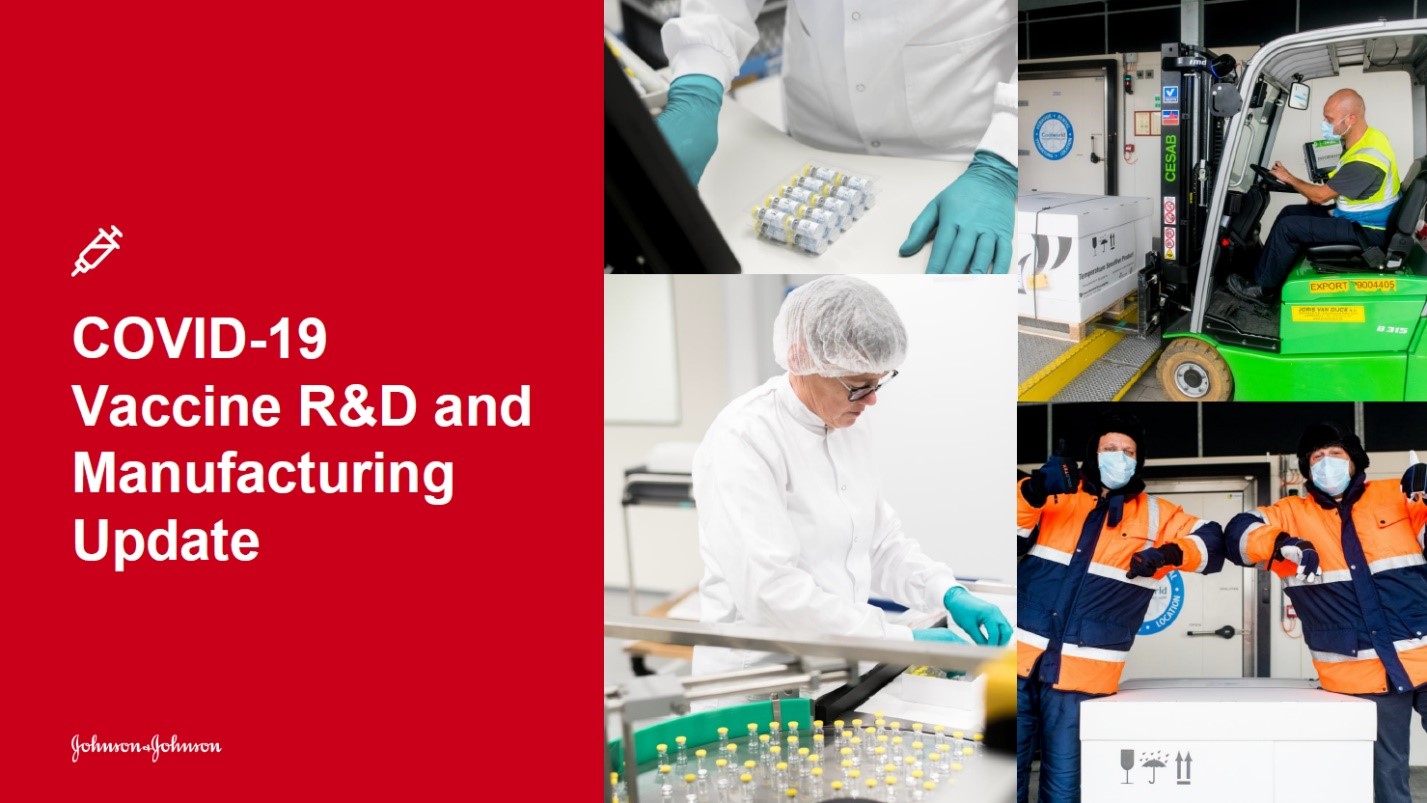
Image Source: Johnson & Johnson – Second Quarter of Fiscal 2020 IR Earnings Presentation
By Callum Turcan
The ongoing coronavirus (‘COVID-19’) pandemic has devasted the global economy (though things are starting to improve) and has fundamentally altered daily human life. According to a draft report from the World Health Organization (‘WHO’), there were 29 COVID-19 vaccine candidates undergoing clinical trials as of August 13 along with 138 other candidates undergoing preclinical evaluation. It is a race against the clock. Unfortunately, as of this writing on August 18, there have been ~170,000 COVID-19-related deaths in the US alone according to data from the US Centers for Disease Control and Prevention (‘CDC’).
We are optimistic that one of the many “shots on goal” will end up proving successful. The US launched Operation Warp Speed to accelerate the development of a COVID-19 vaccine, which involves providing funding to companies with promising vaccine candidates. Furthermore, please note that major economies around the world have adjusted their rules and procedures to allow for multiple phases of clinical trials to be conducted concurrently. Before getting into some of the most promising COVID-19 vaccine candidates, we hope everyone, their loved ones, and their family members are staying safe out there as we ride out the pandemic.
AstraZeneca
AstraZeneca plc (AZN) teamed up with the University of Oxford and the university’s spin-off company, Vaccitech, to develop the potential COVID-19 vaccine AZD1222. Oxford licensed AZD1222 to AstraZeneca back in April 2020. The goal is to leverage AstraZeneca’s global manufacturing capabilities to potentially make a COVID-19 vaccine available by the Fall or Winter of 2020 on a not-for-profit basis, with 30 million doses of the vaccine set to begin being delivered to the UK by this September if all goes as planned (and that is a big if).
For reference, the way AZD1222 works is by using a genetically engineered adenovirus taken from chimpanzees (which is modified so as to not replicate and not hurt the infected patient). The adenovirus carries the gene for one of the proteins found in COVID-19 and inserts that into the patient’s cells. This prompts those cells to make that protein which the immune system recognizes as foreign, creating an immune response. Antigens are substances on the surfaces of cells, usually proteins, which the human body recognizes as being associated with potentially harmful substances. The immune system, when it detects those antigens, tries to destroy the substances that have the related antigens with antibodies (which are proteins).
In the weekly peer-reviewed medical journal, The Lancet, AstraZeneca and Oxford published the results from their Phase 1/2, single-blind, randomized controlled trial at five trial sites in the UK. The results were promising, which is why the partnership moved forward with Phase 2/3 clinical trials in Brazil and the UK, where Phase 2/3 trials have already begun, and the US (which will soon begin if it has not already). Furthermore, AstraZeneca is conducting a Phase 1/2 trial in South Africa and has additional clinical trials planned for Japan and Russia.
AstraZeneca has already secured deals with various national governments (including the UK and the US) and multilateral government entities (such as the European Commission) to supply the potential COVID-19 vaccine, with the first doses expected to be available by the end of this year if all goes as planned and the vaccine candidate receives the necessary regulatory approvals (with vaccine production aggressively ramping up through 2021+ to meet global demand). Those government entities have pledged significant amounts of resources to secure potential COVID-19 vaccine supplies, with the US Department of Health and Human Services (‘HHS’) agreeing to provide AstraZeneca up to $1.2 billion to assist in the development of vaccine candidate and to secure 300 million doses should it prove safe and effective.
Please note that AstraZeneca (and all other pharmaceutical companies working on a COVID-19 vaccine) will still need to charge a modest sum per dose and that national governments are primarily seeking to secure their spot near or at the front of the line if/when supplies do become available. This partnership between AstraZeneca and Oxford is one worth watching very closely. Should it prove successful, the outlook for the global economy and the daily activities of households all over the world would change overnight. Many governments have pledged to make the vaccine cost their citizens nothing out of pocket, even in the US (though there are potentially exceptions), and others intend to offer it at a low cost (made possible by pharmaceutical companies indicating doses of the vaccine will be made relatively affordable).
Moderna
Another very promising potential COVID-19 vaccine is Moderna Inc’s (MRNA) mRNA-1273 candidate, which started Phase 3 clinical trials in the US in late-July. In the middle of July, Moderna published the results of its Phase 1 clinical trial in the New England Journal of Medicine, a peer-reviewed publication, and the data was quite promising which prompted the firm to continue pushing forward. As of mid-August, Moderna had secured ~$2.5 billion in funding commitments from the US government, funding that included the US securing access to 100 million doses should mRNA-1273 prove safe and effective (with the option to acquire up to an additional 400 million doses if needed).
Considering Moderna is a middle-stage biotech company that generates relatively little revenue and does not have the expansive manufacturing operations of bigger players like AstraZeneca, it needed a partner to allow the firm to scale up production to meaningful levels. Moderna teamed up with Catalent Inc (CTLT) in late-June to get access to Catalent’s biologics facility in Bloomington, Indiana, which would enable Moderna to start mass producing its mRNA-1273 COVID-19 vaccine by the third quarter of this year. Like AstraZeneca/Oxford, Moderna is far along in the clinical trial process and within the coming months the world will know whether its vaccine candidate is viable and safe, or not.
Moderna is using messenger RNA (‘mRNA’) biotechnology, which is significantly different than the way AstraZeneca’s COVID-19 vaccine candidate works. For reference, mRNA carries genetic code from DNA which effectively acts as a set of instructions for how cells make proteins and send those proteins throughout the human body. The general idea is that an mRNA vaccine can “trick” the human body’s immune system to produce the antibodies needed to fight off COVID-19 by making it think the virus is present, without having to actually use the virus (which is the case with traditional approaches to vaccines, such as AstraZeneca/Oxford’s AZD1222 candidate). In theory, this approach is safer, though please note that mRNA biotechnology is the cutting edge of vaccine development effort and that more research is needed on the issue.
Like AstraZeneca/Oxford, Moderna is a key company to watch in the race to discover a COVID-19 vaccine. With Phase 3 clinical trials underway already, Moderna is near the front of the pack. During a House Committee on Energy and Commerce hearing held in July, Stephen Hodge, President of Moderna, commented that the company would not sell the vaccine candidate at cost, meaning the firm may try to generate a profit on the vaccine (though the cost per dose is expected to be within the realm of what other pharmaceutical companies have stated or agreed to).
Johnson & Johnson
A holding in both our Best Ideas Newsletter and Dividend Growth Newsletter portfolios, Johnson & Johnson (JNJ) is also in the race for a COVID-19 vaccine. Phase 1/2 clinical trials commenced during the second half of July after previously being targeted for September on its Ad26.COV2-S candidate in the US and Belgium (by the end of July those trials had begun in both countries). This is a randomized, double-blind, placebo-controlled trial that if successful, with help set the stage for Phase 2/3 trials within the coming weeks. Johnson & Johnson seeks to commence Phase 3 trials by this September. Furthermore, Johnson & Johnson plans on conducting (or has already started) clinical trials in other nations such as Spain, Germany, and the Netherlands.
With a major global manufacturing presence enhanced by its partnership with Emergent Biosolutions Inc (EBS) that was announced back in April 2020, Johnson & Johnson should be in a position to quickly ramp up production if its Ad26.COV2-S vaccine candidate proves to be safe and viable. The US government has secured access to 100 million does if the vaccine candidate receives regulatory approval and has committed to providing over $1.0 billion in funding to support development efforts. Johnson & Johnson’s Janssen pharmaceutical unit is working with Beth Israel Deaconess Medical Center (‘BIDMC’), which is the teaching hospital of Harvard Medical School in Boston, Massachusetts. This is an adenovirus candidate, like AstraZeneca/Oxford’s candidate, and Johnson & Johnson published a manuscript covering its initial efforts in the peer-reviewed Nature science journal (though please note this is not the same as publishing clinical trial data, and the manuscript had not yet been peer-reviewed as of this writing according to the science journal’s disclosure).
Johnson & Johnson aims to supply more than 1 billion doses of its vaccine candidate to economies around the globe, and the firm is simultaneously ramping up its manufacturing capacity while developing its vaccine candidate to speed this process along. The company is reportedly talking with the European Union (‘EU’) about securing Europe’s access to its potential vaccine. As of this writing, no deal has materialized so far. Johnson & Johnson intends on selling the vaccine on a not-for-profit basis. Please note Johnson & Johnson is a bit behind AstraZeneca/Oxford and Moderna in the face to find a COVID-19 vaccine, though it is following closely behind the front of the pack.
We do not see Johnson & Johnson’s potential COVID-19 vaccine generating a needle-moving amount of revenue for the firm, though should it prove successful, the company’s outlook would improve materially as the macroeconomic outlook would improve materially. Additionally, its consumer facing businesses may receive a boost due to the public relations win. If Johnson & Johnson is unfortunately not successful, we would still like shares of JNJ in both our Best Ideas Newsletter and Dividend Growth Newsletter portfolios. To read more about our thoughts on Johnson & Johnson, we encourage our members to check out this article here.
Other Key Companies
Pfizer Inc (PFE) and BioNTech SE (BNTX) are working together on their BNT162b2 COVID-19 vaccine candidate, which uses “advance nucleoside-modified messenger RNA (‘modRNA’)” biotechnology, and Phase 2/3 clinical trials are currently underway. The US government has committed almost $2.0 billion in funding towards the BNT162b2 candidate to secure 100 million doses with the option to acquire up to an additional 500 million doses. According to the partnership, the goal is to develop 100 million doses by the end of 2020 and 1.3 billion doses by the end of 2021, assuming the vaccine candidate receives the necessary regulatory approval. The partnership is offering the potential vaccine at a price comparable to the other candidates out there.
However, please note that BioNTech is working with Shanghai Fosun Pharmaceutical Group (SFOSF) in China on both the development and commercialization of BNT162b2. BioNTech and Pfizer teamed up to develop BioNTech’s vaccine candidate back in the middle of March 2020, and that partnership excluded China. That collaboration is what put Pfizer near the front of the pack. BNT162b2 is already far along in the clinical trial process.
Concluding Thoughts
The race is on to discover a COVID-19 vaccine that is both safe and effective, and we are optimistic that one of the 150+ candidates out there that are either in clinical or preclinical stages will prove to be viable. At the earliest, regulatory approval (from major Western nations) for any of these COVID-19 vaccine candidates is not expected until late-September or October.