

Image Shown: Tyson Foods Inc put up stellar results for fiscal 2021. Image Source: Tyson Foods Inc – Fourth Quarter of Fiscal 2021 IR Earnings Presentation
By Callum Turcan
On November 15, Tyson Foods Inc (TSN) reported fourth quarter earnings for fiscal 2021 (period ended October 2, 2021) that beat both consensus top- and bottom-line estimates largely due to the firm’s impressive pricing strength, the focus of this article. The company is facing major headwinds from the coronavirus (‘COVID-19’) pandemic, from labor shortages to supply chain bottlenecks to rising input costs, though Tyson has adeptly navigated this turbulence while bolstering both its revenues and its margins. For reference, please note that Tyson’s fiscal year ends around late-September or early October.
Pricing Strength Powering Margin Improvements
Tyson’s ability to push through meaningful pricing increases is simply stunning as its GAAP operating margin was up in fiscal 2021 versus both fiscal 2019 and fiscal 2020 levels. Its pricing power to offset inflationary and other headwinds is one of the reasons shares of TSN are up over 31% year-to-date (before taking dividend considerations in account) as of this writing.
In the upcoming graphic down below, we highlight Tyson’s GAAP financial performance from fiscal 2019-2021. The company’s net sales have grown at a nice clip while its gross and operating margins expanded robustly during this period. Additionally, please note Tyson’s margins continued to expand even though it incurred meaningful incremental expenses related to keeping its workforce safe from the COVID-19 pandemic.

Image Shown: Tyson’s financial performance has trended in the right direction over the past few years, seen through its nice net sales growth and meaningful margin expansion from fiscal 2019 to fiscal 2021. Image Source: The author, with data from Tyson provided by its earnings press releases covering the fourth quarter of fiscal 2019, fiscal 2020, and fiscal 2021
The upcoming tables down below highlight Tyson’s ability to use its pricing strength to offset headwinds from reduced selling volumes and rising costs. Please note Tyson’s fiscal 2020 had an extra week, and management adjusted the volume and average selling prices for fiscal 2020 for comparison purposes.

Image Shown: Tyson’s pricing power at its beef and pork offerings and volume strength at its ‘International/Other’ segment helped mitigate headwinds from the COVID-19 pandemic during fiscal 2020. Image Source: The author, with data from Tyson provided by its earning press release covering the fourth quarter of fiscal 2020
Looking now at Tyson’s fiscal 2021 performance versus fiscal 2020, it is clear the company has tremendous pricing power. What makes its pricing strength particularly noteworthy is that it covers all its major product segments. Tyson has been steadily buying up brand name consumer staples firms in the food/meat industry (such as Hillshire Brands and Keystone Foods) over the past decade to support its margin performance, and this strategy appears to be playing out quite favorably.
Inflationary pressures and related pricing increases pushed through by Tyson’s competitors can’t be ignored, as those factors are partially why these average pricing changes are so material. However, there is more to the story given Tyson’s expanding GAAP gross and operating margins of late while its GAAP net sales continue to grow.

Image Shown: Tyson’s pricing power is simply stunning. Image Source: The author, with data from Tyson provided through its earning press releases covering the fourth quarter of fiscal 2021
Financial Overview
Pivoting now to Tyson’s cash flow performance, the firm generated $2.6 billion in free cash flow in fiscal 2021 and spent $0.6 billion covering its dividend obligations along with another $0.1 billion buying back its Class A common stock (Tyson has a dual class structure that we will cover later). From fiscal 2019-2021, Tyson’s annual free cash flows averaged ~$2.2 billion.
Tyson exited fiscal 2021 with a net debt load of $6.8 billon (inclusive of short-term debt) with $2.5 billion in cash and cash equivalents on the books at the end of this period providing the firm with ample liquidity. In July 2021, Tyson completed the divestment of its pet food business to General Mills Inc (GIS) for $1.2 billion in cash.
Recently, the company boosted its quarterly dividend on a sequential basis by ~3% on both its Class A and Class B common stock (announced in its latest earnings press release), encouraged by its stellar free cash flow generating abilities and promising outlook. Tyson Limited Partnership owned virtually all of Tyson’s Class B common stock (which have ten votes per share) at the end of fiscal 2021, which gives the Tyson family and related entities control of over 71% of the total voting power at Tyson.
During its acquisition spree seen over the past decade, Tyson took on a lot of (net) debt to fund those deals. More recently, Tyson has been focused on paring its leverage ratios back down to more manageable levels. At the end of fiscal 2019, Tyson had a net debt to (non-GAAP) adjusted EBITDA ratio of 2.8x, which fell down to 1.2x by the end of fiscal 2021 in large part due to its improving financial performance, rock-solid free cash flows, and the sale of its pet foods business to General Mills. We appreciate that Tyson brought its leverage ratios down sharply and that management remained committed to deleveraging activities throughout the COVID-19 pandemic.
Productivity Initiatives Announced
During Tyson’s latest earnings call, management announced a major productivity initiative that aims to generate ~$1 billion in annualized cost savings by the end of fiscal 2024 from fiscal 2021 levels. Here is what management had to say on the issue during the earnings call (emphasis added, lightly edited):
“Relating to operational excellence and market competitiveness… we are announcing the launch of a new productivity program, designed to drive a better, faster, and more agile organization that is supported by a culture of continuous improvement and faster decision-making. The program is targeted to deliver $1 billion in recurring productivity savings of the end of fiscal ’24 relative to fiscal 2021 cost baseline…
Execution of the effort will be supported by a program management office that will ensure delivery of key project milestones and report on savings achievements connected to 3 imperatives. The first is operational and functional excellence and is targeted to deliver greater than $300 million in recurring savings. This includes functional efficiency efforts in finance, HR, and procurement that are focused on applying best practices to reduce cost.
The second is digital solutions, which is targeted to deliver more than $250 million in recurring savings. We’ll achieve this goal by leveraging new digital solutions like artificial intelligence and predictive analytics to drive efficiency and operations, supply chain planning, logistics, and warehousing. For example, we’re using technology to ensure that our shipments are optimally loaded to [save on] freight costs and enhance customer service levels. In many ways, the pandemic has already accelerated our push to more digital footing and our commitment in this space will continue that focus.
The third is automation. We will leverage automation and robotics technologies to automate difficult and higher turnover positions. For example, we have substantial opportunity to automate the deboned process within our poultry harvest facilities using a combination of both third-party and proprietary technologies.” — Donnie King, CEO and President of Tyson
Tyson also issued favorable guidance for fiscal 2022 in conjunction with its latest earnings update that at the midpoint calls for ~6% revenue growth over fiscal 2021 levels and broadly speaking, for its margins to hold up relatively well across its business. However, Tyson does expect its capital expenditures in fiscal 2022 will jump up to ~$2 billion from $1.2 billion in fiscal 2021 as it embarks on its productivity enhancement drive. Tyson is also forecasting decent volume growth (in terms of sales of its protein and other products) in fiscal 2022 over fiscal 2021 levels.
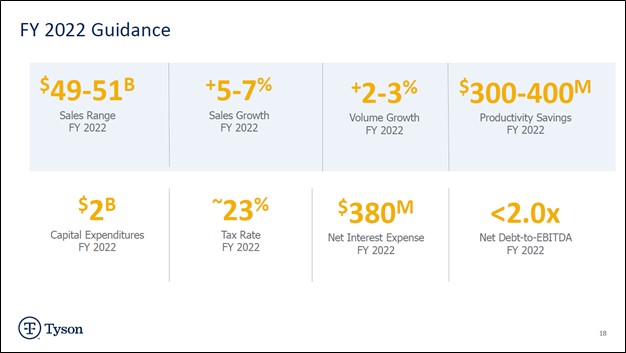
Image Shown: Tyson’s guidance for fiscal 2022 indicates its strong performance is expected to continue going forward, keeping various headwinds in mind. Image Source: Tyson – Fourth Quarter of Fiscal 2021 IR Earnings Presentation
Concluding Thoughts
Tyson has done a great job building up a brand portfolio with ample pricing strength while steadily improving its cost structure and paring down its leverage ratio in recent years. In light of these major improvements, Tyson’s Dividend Cushion ratio will likely improve materially when we roll our cash flow model forward. As of this writing, shares of TSN yield ~2.2%.
We don’t include Tyson in any of the simulated newsletter portfolios, though we include the Vanguard Consumer Staples Index Fund ETF (VDC) in our High Yield Dividend Newsletter portfolio (more on that here) which had modest exposure to Tyson as of the end of October 2021.
The VDC ETF is a solid way to gain diversified access to top quality names within the consumer staples space, many of which have ample pricing power and have proven capable of adeptly navigating both inflationary and supply chain headwinds seen of late (as it concerns managing their financial performance).
Investors should not overlook the valuations of many in the consumer staples space, however, as net debt positions and meager top-line growth should not necessarily translate into 20x forward earnings numbers, the levels at which many are trading.
—–
Recession Resistant Industry – BUD, CL, CLX, CPB, COST, FDP, GIS, HRL, K, KDP, KHC, KMB, KO, KR, MDLZ, MKC, MO, PEP, PG, PM, SJM, TAP, TGT, TSN, WMT
Tickerized for TSN, GIS, VDC, TTCF, STKL, THS, FARM, SMPL, FDP, BRBR, BGS, CVGW, LW, TWNK, ACI, GO, KR, COST, BJRI, TGT, WMT, HSY, SJM, UNFI, HAIN, SPTN, DOLE, ANDE, CENTA, USFD, PPC, IMPF, BYND, SAFM, HRL, NSRGY, ADM, DTEA, DAR, SENEA, CALM, FREE, KHC, K, FLO, CAG, OTLY
Valuentum members have access to our 16-page stock reports, Valuentum Buying Index ratings, Dividend Cushion ratios, fair value estimates and ranges, dividend reports and more. Not a member? Subscribe today. The first 14 days are free.
Callum Turcan does not own shares in any of the securities mentioned above. Philip Morris International Inc (PM) and Vanguard Consumer Staples ETF (VDC) are both included in Valuentum’s simulated High Yield Dividend Newsletter portfolio. Some of the other companies written about in this article may be included in Valuentum’s simulated newsletter portfolios. Contact Valuentum for more information about its editorial policies.