
Image Source: Teva
We continue to watch the implosion of Teva with some interest; the company was once a Best Ideas Newsletter portfolio idea thanks to its strong ability to generate a copious amount of free cash flow. However, Teva made the classic mistake of purchasing a company that operates in a highly-commoditized industry at a market top while loading up the balance sheet with an enormous amount of debt at the precise time the favorable industry dynamics began transitioning to a headwind. Let’s review the company’s progress for signs of a turnaround.
By Alexander J. Poulos
Management Shakeup
Corporate leadership remains a challenging field where a critical misstep can often end a once-promising career. The management team of Teva (TEVA) was gifted a balance sheet with a near absence of debt but faced the challenge of its top-selling product Copaxone facing the end of its lucrative run as the patent was set to expire. Management believed it was forward thinking when the ill-fated decision to leverage up the balance sheet was made to acquire the Actavis generic division from Allergan (AGN), a move that was led by the shrewd dealmaker Brent Parsons. The thought was that by adding Actavis to its formidable generic division, Teva would become the undisputed leader in the generic drug market with hoped-for pricing power. Teva wildly miscalculated, however, as the expected pricing power met the realities of a commodity business–namely once new supply enters the market, pricing will not hold up as there is little to differentiate a generic product from a competitor’s. In essence, Teva decided to tie its fortunes to the no-moat generic drug market with the misconception that bigger is better instead of utilizing the same equity ($33.48 billion in cash plus 100 million shares of Teva stock) to further develop its branded drug business by acquiring smaller biotechs with approved products.
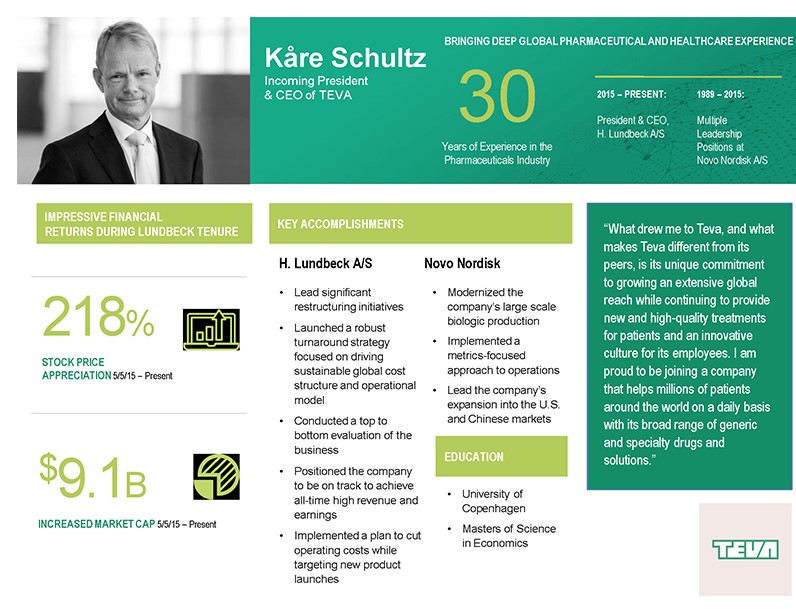
We are now more than a year post the completion of the deal and the fallacy of the thesis has become abundantly evident. We admit that even we had been taken, even as we pointed to significant evidence of free cash flow as support to a thriving undertaking. More recently, the board of Teva has decided to step in and clean house by leading a search for a new CEO, a move that was widely expected yet necessary as the strategic vision of the former CEO has proven to be an abysmal failure. Teva announced September 11 that Kare Schultz the CEO of the Denmark based Pharmaceutical company Lundbeck (HLUKF) will take over as the new chief executive officer of Teva. Schultz has extensive experience in branded pharmaceuticals having served the bulk of his career at Novo Nordisk (NVO) and the past few years as the CEO of Lundbeck. We view the hiring of Schultz as a good one; we are inferring from the move a pivot away from generic drugs more towards a higher-margin branded drug space.
Schultz has earned a bit of a reputation for aggressive cost-cutting from his recent stint at Lundbeck, a desperately needed skill as TEVA is close to violating its debt covenants. We feel his background is well suited for the challenge that Teva poses in its current state—a view the board of Teva appears to agree with; hence the upfront payment of $20 million with an overall pay package worth 52 million dollars.
Asset Sales
Teva is in the midst of selling off a few non-core assets in an attempt to generate funds to pay down some of the $40 billion in debt currently on the company’s balance sheet. Coincidentally, Teva announced September 11th a deal had been agreed to with Cooper Surgical a division of Cooper Companies (COO) for the rights of its intrauterine device Paragard for $1.1 billion in cash. Cooper Companies is a leading manufacturer of medical devices, most notably in contact lenses and women’s health.
We feel the deal is an outstanding move for Cooper as Paragard will seamlessly blend with its existing line of women’s health products. The ability to acquire Paragard for cash further illustrates our preference for underleveraged balance sheets. Teva is not negotiating from a position of strength as prospective buyers are keenly aware of Teva’s need to raise cash; hence the acquirer can hold out for more favorable terms.
The stark difference was on display in the recent press release from Cooper Companies discussing the deal. We found the following comment from Cooper in the news release discussing the deal as rather illuminating:
PARAGARD is currently sold only in the U.S. and had revenues of approximately $168 million for the trailing twelve-month period ending June 30, 2017. Excluding acquisition and integration related expenses and deal-related amortization, the transaction is expected to be accretive to Cooper’s gross and operating margins, and approximately $0.70 to $0.75 accretive to earnings per share in year one. The acquired business includes Teva’s manufacturing facility in Buffalo, NY, which exclusively produces the PARAGARD IUD.
We suspect Paragard had become a “forgotten non-core asset” with a lack of resources devoted to growing the top line. We feel an aggressive marketing push by Cooper will unlock the full potential of the asset. The synergies with Cooper’s legacy women’s health products is an added bonus from a sales rep perspective, as the existing workforce has built numerous long-standing contacts with practitioners which will remove initial resistance to full utilization of the product.
Outlook
We remain in wait-and-see mode pertaining to our view on TEVA. Though we are impressed with the background of the new CEO and feel the pace of asset sales may accelerate under his guidance, our concern remains the massive debt load coupled with generic price deflation that is sweeping through the generic drug industry.
Thus far, there is scant evidence the deflationary headwind is abating which underpins our caution in the sector. We feel the heavy lifting is ahead of TEVA but we will continue to monitor the story as it unfolds. TEVA does have the potential for re-inclusion to the newsletter portfolios as evident with the recent inclusion of Gilead Sciences (GILD) at a critical inflection point in the company’s history.
We are impressed with the saviness of the CEO of Cooper as we feel the company has made an outstanding deal for an asset that is in dire need of new leadership. As is often the case in today’s frothy market, the share price of Cooper is trading well above our fair value estimate at the time of this writing. In any case, we wanted to highlight the deal as we feel it is a meaningful event for both companies.
Independent healthcare and biotech contributor Alexander J. Poulos is long Gilead.