
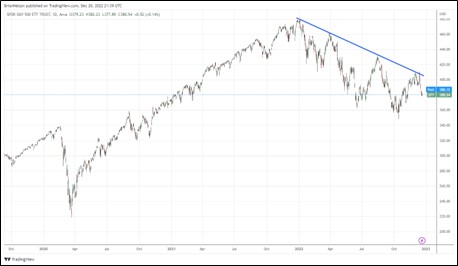
Image: The stock market has been locked in a downtrend through all of 2022, and the latest bull trap has spoiled the Santa Claus rally. 2023 may be an equally rough year.
By Brian Nelson, CFA
This market just doesn’t want to go higher in the near term, and the latest bull trap wasn’t encouraging at all. We think long term investors should stay the course, but it is looking more and more like we won’t see a stock market bottom until sometime in 2023. Santa brought coal this year.
The false breakout of the downtrend on December 13 was very telling. Just when investors thought the markets just might be headed for a strong Santa Claus rally and a strong break through for the back half of this month, trading turned into a bull trap. Those that levered up through the breakout December 13 then became forced sellers in the following trading days, and now the markets look weak heading into the final two weeks of trading for 2023.
It’s looking more and more likely that the markets may give back all of the COVID-19 gains to fall back to the February 2020 highs, before regrouping and then moving forward. What a bloodbath 2022 turned out to be. If a re-test of the February 2020 highs is in the cards, the S&P 500 can fall all the way back to 3,400 in the next few months for yet another 10% downside. My best guess is that’s what is going to happen.
But how to play the odds?
Well, as we’ve done for much of this year, we’ve been watching 2022 run its course. Right now, the S&P 500 is at levels first reached in January 2021, right before a huge rally during that year. But times are different this go-around, with tremendous wealth wiped out during 2022 due to a speculative frenzy that even gripped some of the most seasoned investors.
According to the CNBC Millionaire Survey, millionaires, which own the vast majority of individually-held equities, haven’t been this bearish since the beginning of 2008, and we all know what happened that year, a near-37% decline in the S&P 500. Millionaires are expecting a double-digit decline in stocks during 2023, and we think a 10% decline from current levels is just the base case. It may take some time before buyers step in again during 2023, meaning the trough in 2023 could be much greater than a 10% decline.
Our readers tend to be somewhat conservative, so we’re focused on generating relative “outperformance” across the simulated newsletter portfolios as well as fantastic ideas in the Exclusive and across our options commentary–and applying what we’ve learned the past decade in managing the simulated newsletter portfolios. A key lesson the past 10 years has been to not layer on too many put option considerations in the simulated newsletter portfolios, as the “expired premiums” have tended to eat into “returns,” “3 Lessons in Portfolio Management Over 10 Years (September 2020).”
We’re sorry to be the bearer of bad expectations, but 2023 looks to be another tough year ahead. That said, we wouldn’t mind being pleasantly surprised to the upside during 2023 (in fact, we’d prefer to be completely wrong in this case!). However, readers should be mindful of the risks to the equity markets in the coming months as buyers and sellers continue to battle it out to find a bottom for this painful bear market. So much for the Santa Claus rally – the markets instead gave us coal! Bah humbug!
Tickerized for the largest 25 ETFs by AUM.
———————————————
About Our Name
But how, you will ask, does one decide what [stocks are] “attractive”? Most analysts feel they must choose between two approaches customarily thought to be in opposition: “value” and “growth,”…We view that as fuzzy thinking…Growth is always a component of value [and] the very term “value investing” is redundant.
— Warren Buffett, Berkshire Hathaway annual report, 1992
At Valuentum, we take Buffett’s thoughts one step further. We think the best opportunities arise from an understanding of a variety of investing disciplines in order to identify the most attractive stocks at any given time. Valuentum therefore analyzes each stock across a wide spectrum of philosophies, from deep value through momentum investing. And a combination of the two approaches found on each side of the spectrum (value/momentum) in a name couldn’t be more representative of what our analysts do here; hence, we’re called Valuentum.
———————————————
Brian Nelson owns shares in SPY, SCHG, QQQ, DIA, VOT, BITO, and IWM. Valuentum owns SPY, SCHG, QQQ, VOO, and DIA. Brian Nelson’s household owns shares in HON, DIS, HAS, NKE, RSP. Some of the other securities written about in this article may be included in Valuentum’s simulated newsletter portfolios. Contact Valuentum for more information about its editorial policies.
Valuentum members have access to our 16-page stock reports, Valuentum Buying Index ratings, Dividend Cushion ratios, fair value estimates and ranges, dividend reports and more. Not a member? Subscribe today. The first 14 days are free.