
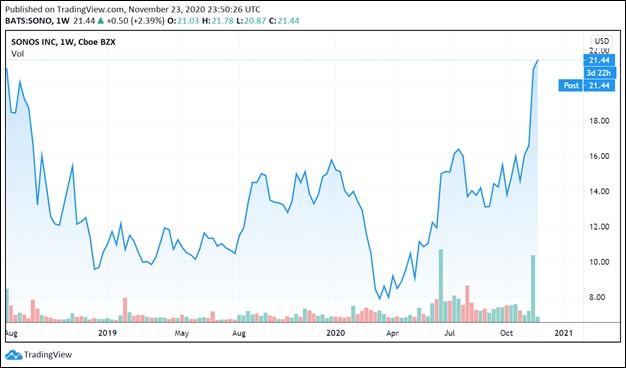
Image Shown: Shares of Sonos Inc are showing signs of life in 2020 after its poor showing in the quarters that followed its initial public offering back in August 2018.
By Callum Turcan
Shares of the audio streaming services and wireless home audio products company Sonos Inc (SONO) are starting to show signs of life after their poor showing in the quarters that followed its initial public offering back in August 2018. More recently, shares of SONO have started to surge higher after the firm reported fourth quarter and full year earnings for fiscal 2020 (period ended October 3, 2020) on November 18. The company smashed past consensus top- and bottom-line estimates, though most importantly, Sonos provided very promising guidance for fiscal 2021. First, let us go over how our view towards Sonos has changed over the past couple of years before digging into its improving outlook.
Background
Back in February 2019, we wrote an article (link here) covering Sonos’ lackluster outlook at the time. From the date that article was published to the end of March 2020, the start of the early days of the ongoing coronavirus (‘COVID-19’) pandemic in North America, shares of SONO were down ~25%. Please note that Sonos does not pay out a common dividend at this time. Here is what we said in that article:
Sonos has a fantastic product suite, and we think customers continue to enjoy its products. The problem, however, is that Sonos’ business is not as recurring as one might prefer, given that most sales are driven by products, themselves (i.e. speakers, components, etc.). Though its software may be a differentiated product and existing customers continue to add new products to their Sonos home sound system (existing households account for ~40% of new product registrations), the company will have to continue to innovate to keep revenue moving in the right direction over the long haul. Technology, especially in the music and home entertainment business, changes fast, and those on top of the market today may not be on the top of the market 10 or 20 years from now. Picking long-term winners in emerging-growth equities with nascent products is hit or miss at times.
Additionally, we noted that Sonos operates in an incredibly competitive environment as the firm competes against Bose, Sound United, Bang and Olufsen AS (BGOUF), Samsung Electronics Co. Ltd. (SSNLF) through Samsung’s Harman Kardon and JBL brands, and many other companies. We ended that article with “Sonos lacks a moat.”
However, the COVID-19 pandemic has fundamentally altered the landscape Sonos operates in, and some of those changes have legs. As households “cocooned” inside, demand for indoors entertainment options grew with an eye towards quality home audio options. Sonos’ past digital investments and omni-channel sales capabilities enabled the firm to better meet consumer demand at a time when many retail outlets were closed.
Sonos’ digital strength combined with the launch of new products and services has resulted in its outlook improving considerably of late. In fiscal 2020, Sonos’ GAAP revenues grew by ~5% year-over-year, though we caution that was partially due to fiscal 2020 including an extra week. Looking ahead, Sonos expects its growth rate will pick up considerably in fiscal 2021, and that has caught our attention.
Guidance Update and Tariffs
Management provided guidance for Sonos’ fiscal 2021 during the firm’s latest earnings report that pleasantly surprised. The company’s adjusted EBITDA (a non-GAAP metric) is expected to come in at $170 million-$205 million in fiscal 2021, up 57% – 89% over fiscal 2020 levels. Its adjusted EBITDA margin (a non-GAAP metric) is expected to improve by 380-540 basis points this fiscal year on a year-over-year basis, aided by expected gross margin expansion and growing economies of scale. Sonos forecasts that its revenues will climb up to $1.44 billion – $1.50 billion in fiscal 2020, up 11% – 15% over fiscal 2020 levels on a comparable 52-week basis (excluding the 53rd week in fiscal 2020).
Please note that when excluding the effects of tariffs, these forecasts change significantly but the overall trajectory remains the same. On this note, we caution that the simmering US-China trade war and the related tariffs remain a major downside risk going forward. Here is what Sonos had to say in its Fiscal 2019 Annual Report (lightly edited, emphasis added):
In addition, there is no guarantee that our efforts to diversify manufacturers will be successful… We have also historically manufactured our products in China and have recently begun to diversify our supply chain through the addition of contract manufacturing in Malaysia.
Additionally:
…[I]f significant tariffs or other restrictions are placed on Chinese imports or any related counter-measures are taken by China, our revenue and results of operations may be materially harmed. For example, the U.S. government has imposed significant new tariffs on China related to the importation of certain product categories, which currently affect our products. In May 2019, tariffs on accessories were increased to 25% and tariffs on most remaining imports were imposed at 15% effective September 2019.
In the event that future tariffs are imposed on imports of our products, the amounts of existing tariffs are increased, or China or other countries take retaliatory trade measures in response to existing or future tariffs, our business may be impacted and we may be required to raise prices or make changes to our operations, any of which could materially harm our revenue or operating results.
When Sonos publishes its Fiscal 2020 Annual Report, the company will likely have more to say on the matter, and please note that the relevant tariffs (as it concerns Sonos) may have changed since its Fiscal 2019 Annual Report was published,especially in light of the “Phase 1” US-China trade deal/truce that was signed in January 2020. The state of US-China trade relations could have an outsize impact on Sonos’ financial and operational performance going forward, which poses a significant risk to its promising fiscal 2021 guidance. Management is attempting to diversify Sonos’ supply chain, but those efforts will likely take years to fully implement, and even then, that is no guarantee that Sonos will be able to avoid potential tariff increases in the future.
Operational Update
Sonos expects that sales generated via its digitally-oriented direct-to-consumer (‘DTC’) business as a percent of its company-wide revenues will stay flat this fiscal year versus fiscal 2020 levels. According to its earnings press release, Sonos’ DTC sales represented 21% of its total revenues in fiscal 2020, a record, and this was up sharply from 12% in fiscal 2019. Sonos’ DTC business played a key role in enabling the firm to meet elevated demand during the initial phases of the COVID-19 pandemic as households turned to e-commerce offerings to meet their consumption needs. Sales at Sonos’ DTC segment were up 84% year-over-year in fiscal 2020.
Here is what Sonos’ management team had to say regarding the firm’s overall growth strategy during the company’s latest earnings call (lightly edited, emphasis added):
“As challenging as 2020 has been for everyone, our model has proven resilient. In terms of attracting new customers, we just delivered the 15th year in a row where we’ve grown the number of homes we’re in by 20% or more, ending this year with nearly 11 million households globally.
Even with this strong growth in new homes, we continued to see 2.9 products per home in fiscal 2020. And when it comes to existing customers adding additional products, we have typically seen 35% to 40% of our annual product registrations coming from existing customers who are adding another Sonos product to their home. This year it hit 41% as the launch of Move was a particular success with our existing customers.
I believe we’re at an inflection point in the fourth quarter because we are seeing the kind of free cash flow and adjusted EBITDA this model can deliver as it scales… We achieved our 15th consecutive year of revenue growth, and we are planning to accelerate revenue growth in fiscal 2021.” — Patrick Spence, CEO of Sonos
Some of Sonos’ new initiatives include Sonos Move, a battery-powered smart speaker that can travel outdoors, and Sonos Radio, an audio streaming service. Recently, the firm launched a premium audio streaming subscription service without ads, and the firm also offers an ad-supported audio streaming service. The audio streaming business is full of competitors including Spotify Technology SA (SPOT), Apple Inc (AAPL), Alphabet Inc (GOOG) (GOOGL), Amazon Inc (AMZN) and others. We applaud Sonos’ efforts in this arena, though we question whether the firm will be able to build up a significant subscriber base given the competitive advantages of its well-funded peers.
Another downside consideration includes supply chain disruptions, as management noted several times during Sonos’ fiscal fourth-quarter earnings call that the firm was having trouble keeping up with demand. The company is addressing the issue by revamping its supply chain. For instance, management noted that Sonos is “investing in expedited air freight shipments in order to better meet the demand” though we caution that increased logistical costs are a factor here. Looking ahead, Sonos sees itself being able to better match supply with demand, which should further assist its financial performance over the coming fiscal quarters.
Financial Update
In fiscal 2020, Sonos generated $129 million in free cash flow, up significantly from the $97 million in free cash flow it generated in fiscal 2019, even as its capital expenditures rose by 42% during this period. Sonos has a relatively asset-light business profile, and the firm needs to invest only a relatively modest amount towards its capital expenditures to maintain a certain level of revenues. This in turn puts Sonos in a better position to generate free cash flows.
As of October 3, Sonos had $407 million in cash and cash equivalents on hand (not including restricted cash). Stacked up against $7 million in short-term debt, $18 million in long-term debt and $50 million in long-term operating lease liabilities on the books, the firm exited fiscal 2020 with a nice net cash position of ~$332 million (when excluding restricted cash and including short-term debt and long-term operating lease liabilities). We are big fans of Sonos’ pristine balance sheet.
Sonos’ strong balance sheet provides the company with the financially flexibility and firepower required to revamp its supply chain, roll out new products and services, and continue buying back its stock. In fiscal 2020, Sonos spent $50 million repurchasing its common shares and during its latest earnings update, the firm initiated another $50 million stock buyback program after completing its previous program of the same size in the fourth quarter of fiscal 2020.
Concluding Thoughts
After treading water over the past two years, shares of Sonos are showing signs of life as its long-term strategy is starting to pay off. Though we caution that Sonos does not appear to have much of a moat in any of the industries it operates in, its financials have been impressive of late and its near-term outlook is improving–two key factors that have caught our attention. Meaningful downside risks remain, but if Sonos delivers on its guidance for fiscal 2021, the company’s long-term outlook may now be significantly brighter than it was back in February 2019.
On a final note, Sonos recently partnered up with The Walt Disney Company (DIS) in an attempt to improve its marketing strategy. It will be interesting to see how that partnership plays out. We are keeping an eye on Sonos.
—–
Also tickerized for LOGI, SIRI, SNE, BBY, CRSR, HEAR
—–
Valuentum members have access to our 16-page stock reports, Valuentum Buying Index ratings, Dividend Cushion ratios, fair value estimates and ranges, dividend reports and more. Not a member? Subscribe today. The first 14 days are free.
Callum Turcan does not own shares in any of the securities mentioned above. Apple Inc (AAPL), Cisco Systems Inc (CSCO) and Microsoft Corporation (MSFT) are all included in both Valuentum’s simulated Best Ideas Newsletter portfolio and Dividend Growth Newsletter portfolio. Alphabet Inc (GOOG) Class C shares, Dollar General Corporation (DG), Facebook Inc (FB) and The Walt Disney Company (DIS) are all included in Valuentum’s simulated Best Ideas Newsletter portfolio. Oracle Corporation (ORCL) is included in Valuentum’s simulated Dividend Growth Newsletter portfolio. AT&T Inc (T) is included in Valuentum’s simulated High Yield Dividend Newsletter portfolio. Some of the other companies written about in this article may be included in Valuentum’s simulated newsletter portfolios. Contact Valuentum for more information about its editorial policies.