
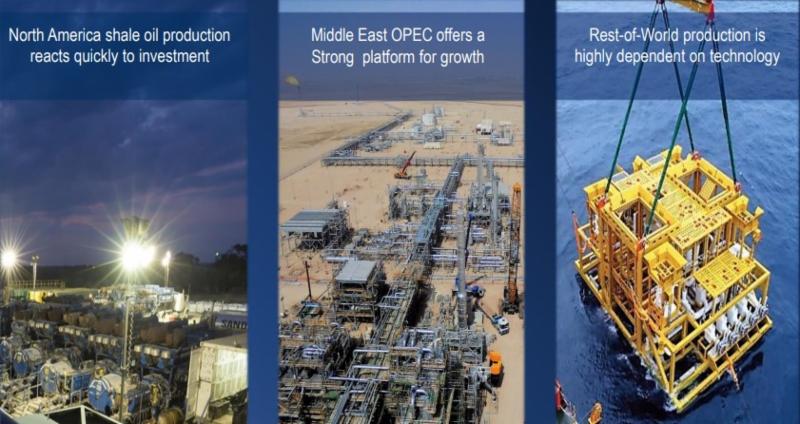
Image source: Schlumberger investor presentation
We recently put Schlumberger on members’ radars, and it appears as though the market is picking up on what we’ve been highlighting as shares surged following its fourth quarter report.
By Kris Rosemann
Shares of leading energy equipment and services provider Schlumberger (SLB) received a nice boost following its fourth-quarter 2018 earnings report, released January 18, thanks to expectations for a positive supply/demand balance to drive a gradual recovery in oil prices in 2019. Uncertainty in its North American onshore outlook continues to raise concerns, but management is anticipating solid single-digit growth in international markets in 2019. Here’s what we had to say about the company prior to the release of its earnings report:
—–
Schlumberger has been hurt by greater than expected softness in US hydraulic frac activity and pricing in recent quarters, and some are questioning the viability of the Permian basin to continue to provide its previously expected production growth as unit well productivity has eroded more than anticipated.
Schlumberger continues to have confidence in its global portfolio, however, as its unmatched footprint allows it to pursue to most attractive growth opportunities across the globe. Its expanding technology portfolio is a notable strength as well, and management reports that it has expanded its total addressable market by 50% over the past three years.
The company’s Dividend Cushion ratio is just above parity as our expectations for free cash flow generation remain relatively solid, but the less-than-ideal ratio is picking up risks associated with its exposure to volatile energy resource pricing and its sizable net debt load. We currently value shares at $52 each, but the lower end of our fair value range may be more appropriate should crude oil prices face additional pressure in the face of global economic growth concerns and an ever-fluid supply/demand environment.
—–
In the fourth quarter of 2018, which was marked by a material decline in oil prices due to increased US shale production and the impact of geopolitical issues on supply/demand balance, revenue fell 4% on a year-over-year basis due in large part to lower activity and pricing in its North American onshore operations. North America revenue fell 12% on a quarter-over-quarter basis. The company’s pretax operating margin contracted 230 basis points from the year-ago period to 11.8% in the fourth quarter due in part to reduced pricing and activity in its North America onshore operations, seasonal activity decline in Russia, and increased spending on international drilling resources. Pretax operating income fell 16% from the fourth quarter of 2017 to $967 million.
Schlumberger’s free cash flow generation improved nicely in the full year 2018 as it jumped to nearly $2.5 billion from ~$1.4 billion in 2017 thanks to cash flow from operations more than doubling. (Investors should note that the calculation of free cash flow includes Schlumberger Production Management investments and multiclient seismic data capitalized.) However, cash dividends paid in the year came in at nearly $2.8 billion, marking the third consecutive year in which it failed to cover dividends paid with internally-generated cash flow. With high yield comes high risk.
The company finished 2018 with net debt of just under $13.3 billion compared to $13.1 billion a year earlier. This debt load, though not yet cause for material concern, and uncertainty related to North American onshore customer spending levels weigh on Schlumberger’s Dividend Cushion ratio, which currently sits at 1.1. Free cash flow should benefit from the company’s expectations for capital spending to decline in 2019, though it did not provide guidance for Schlumberger Production Management investments and multiclient seismic data capitalized. We like the flexibility baked in to 2019’s budget, and shares yield ~4.5% as of this writing.
Looking ahead to 2019, management expects a positive supply/demand balance to lead to gradually more promising outlook for oil prices as the OPEC+ production cuts take hold and the relatively-reduced activity in the North American onshore space impacts production growth trends. Exemptions from Iran export sanctions will expire–if they are not renewed will provide further restriction to global supply–and the potential resolution of the US-China trade conflict has the potential to stimulate global demand, though we note a slip up in negotiations could have the opposite effect.
Nevertheless, volatility in oil prices has raised uncertainty regarding E&P spending levels in 2019, and Schlumberger notes that its customers are taking a more conservative approach to the year. Management believes it has seen a normalization of E&P capital spending towards what it calls “a more sustainable financial stewardship of the global resource base.” It expects investments on the part of North American onshore E&P operators to be tied much more closely to free cash flow generation, a trend we wholeheartedly support, and international operators are expected to begin investing in production capabilities after four years of underinvestment to maintain cash flow.
Management is projecting single-digit revenue growth in international markets in 2019 at current oil prices given its expectations for relatively higher levels of spending, but the alignment of investments to internal cash flow generation in the North America onshore space muddies the picture for the region in 2019. Our fair value estimate for Schlumberger currently sits at $52 per share, and shares are changing hands in the lower half of our fair value range. We think this offers a great high yield dividend idea for consideration.
Energy Equipment & Services (Large): BHGE, FTI, HAL, NBR, NOV, SLB, TS, WFT
—–
Valuentum members have access to our 16-page stock reports, Valuentum Buying Index ratings, Dividend Cushion ratios, fair value estimates and ranges, dividend reports and more. Not a member? Subscribe today. The first 14 days are free.
Kris Rosemann does not own shares in any of the securities mentioned above. Some of the companies written about in this article may be included in Valuentum’s simulated newsletter portfolios. Contact Valuentum for more information about its editorial policies.