
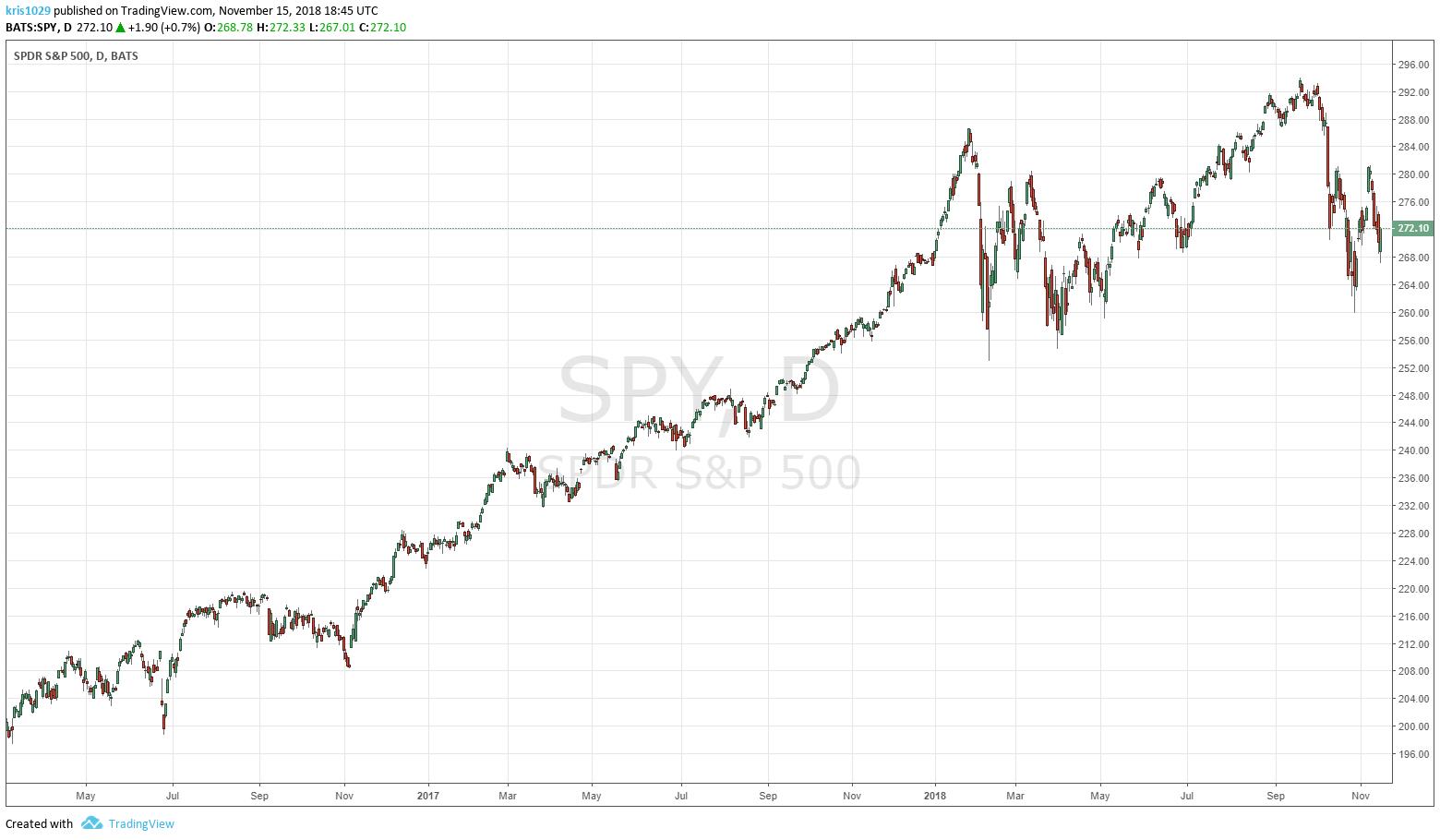
Image shown: SPDR S&P 500 ETF (SPY) share price performance since early 2016. Source: TradingView.
Market volatility looks to be here to stay. Let’s take a look at some of the recent developments that have market observers concerned. Let’s also dissect recent commentary from Fed Chairman Jerome Powell.
By Kris Rosemann
Volatility in US equities (SPY) is back in a notable way and is not likely to disappear anytime soon. Market participants continue to weigh the pros and cons of a number of factors, including 1) rising interest rates and their impact on asset prices, 2) the massive corporate debt loads found across the landscape (global debt to GDP ratios are at all-time highs), 3) a seemingly strong and steady US economy, 4) steady but slowing global economic growth, 5) trade disputes, and 6) a potential economic slowdown in China. We’re not raising any major red flags, but even if stocks continue to move higher in aggregate, the straight incline of years past may be coming to an end.
Federal Open Market Committee (FOMC) Chairman Jerome Powell recently gave himself a bit of a pat on the back and expressed confidence in the US economy, though he noted that the global economy has not been keeping pace with domestic growth (as was the case in 2017). Headwinds to US economic growth are certainly present, however, with softness in housing beginning to crop up and the potential for the stimulating effect of tax cuts to wear off in the relatively near future. Then there is the massive shadow cast by the unsustainable path US debt and deficits are on as national debt is over $21 trillion and the annual budget shortfall is closing in on the $1 trillion mark, which may eventually call in to question the long-term sustainability of recently-enacted tax cuts.
When pressed on the recent volatility the US markets have faced, Powell stated that equity prices are only “one of many, many factors” taken into account when the Fed assesses the economy, but those educated in valuation concepts are aware of the fact that considerable empirical research documents that stock returns are negatively related to changes in interest rates. Not only does the denominator in valuation calculations rise via a higher discount rate, but a number of fundamental factors can be impacted as well by rising borrowing costs, not to mention the rising cost of servicing debt eating into net profit margins.
Market observers must be prepared for the Fed to potentially raise rates at times other than quarterly meetings, and all eight FOMC meetings in the year will be followed by a press conference to allow the Chairman explain the committee’s thought process. The committee’s goals remain focused on extending the economic recovery while keeping unemployment and inflation low, but how the markets, economy, and businesses react to its policy will be considered as well. The recent midterm election results, which ended with a Democratic House and Republican Senate, or a gridlocked Congress, has resulted in a greater focus on the Fed’s policy decisions moving forward.
Chairman Powell is not alone in expressing concern over the gradual slowdown in global economic growth as the International Monetary Fund recently lowered its global economic growth estimates for 2018 and 2019 and OPEC cut its forecast for 2019 global oil demand growth for the fourth consecutive month in November. Global fund managers are adding to the apprehension surrounding equity markets with 44% of global fund managers expecting global growth to decelerate in the next year, which is the worst mark since November 2008, according to a recent survey. Key concerns shared by the group include trade disputes, quantitative tightening, and economic slowdown in China, but fund managers are still putting dry powder to work as cash levels fell to 4.7% from 5.1% in the months of November.
Oil demand tends to move in concert with economic activity, but the tepid slowdown has coincided with a reversal of sentiment in the global crude oil markets. Russia and Saudi Arabia began to ramp production ahead of US sanctions against Iran taking effect only to have the US grant a number of short term exemptions to key buyers, and this goes without mentioning the ongoing increase in activity among US onshore players taking part in the shale boom. Nevertheless, geopolitical uncertainty will continue to feed into the volatility of energy resource pricing, and energy equities have been on a roller coaster ride of late with shares of the Energy Select Sector SPDR ETF (XLE) falling from the upper-$70s to the mid-$60s in a matter of weeks.
Apple (AAPL) has been a notable decliner in recent weeks as well, and the sheer size of the company means it will a greater impact on the broader markets than its smaller counterparts. We continue to have confidence in Apple’s long-term potential, thanks in part to its incredible brand strength and the massive opportunity present in its growing ‘Services’ business, the growth of which is driven by installed base and not new unit sales alone. iPhone unit sale concerns may very well be founded in a concerning reality, but any weakness may impact component suppliers more than Apple itself. Cautious holiday guidance from Apple may be in part to blame for the market’s heartburn, but the financial flexibility of the company is second to none as it continues to throw off substantial amounts of free cash flow and holds a massive net cash position. Our fair value estimate for shares remains $236 each.
General Electric (GE) has held a significant presence in headlines of late as well, and its recent decision to accelerate its plan to part ways with a material portion of its stake in Baker Hughes (BHGE) has sent investors scurrying to reassess the company’s true risk levels. The industrial giant built its total debt load to ~$115 billion as of the end of the third quarter of 2018 thanks in part to it once holding a reputation as one of the most trusted borrowers around–it held a pristine triple-A credit rating as recently as 2015. GE’s credit rating is now three notches above junk territory according to Moody’s (Baa1), and some market observers are already anticipating a potential downgrade to junk status.
Such a downgrade would increase the amount of tradable high-yield debt on the junk bond market by ~10%, which has the potential to materially impact prices elsewhere in the high yield space. Though nowhere near the scale of GE, California utility holding company PG&E (PCG) could also play a role in the potential flooding of the high yield debt market after it warned that it may be subject to significant liability in excess of insurance coverage due to its role in the start of the deadly California “Camp Fire.”
We would like to take this opportunity to express our most sincere concern for those impacted by the wildfires in California as a portion of our advisor member base has been forced to prioritize personal safety over business endeavors, which is a situation many of us may never come to know. Our thoughts are with you, and we wish you a rapid return to “normalcy.”
In addition, we are working through a number of issues regarding the functionality of some reports on our website. Please bear with us as we work with our website host to resolve these issues, and if you are in need of a report that appears to be missing or out of place, please reach out to us at info@valuentum.com. As always, we are available for any questions, comments, or feedback you may have as well.
—–
Valuentum members have access to our 16-page stock reports, Valuentum Buying Index ratings, Dividend Cushion ratios, fair value estimates and ranges, dividend reports and more. Not a member? Subscribe today. The first 14 days are free.
Kris Rosemann does not own shares in any of the securities mentioned above. Some of the companies written about in this article may be included in Valuentum’s simulated newsletter portfolios. Contact Valuentum for more information about its editorial policies.