
Image Source: PepsiCo Inc – IR Presentation
By Callum Turcan
While foreign currency headwinds are proving quite troublesome, PepsiCo continues to post strong organic growth that helped drive its outperformance during the first quarter of 2019. That strong performance will be needed as Amazon gets ready to enter the energy beverage arena.
PepsiCo Inc’s (PEP) shares shot up to record highs on April 17 after posting first quarter results that clearly impressed the market. With shares now trading around $127 as of this writing, the beverage and snack giant yields 2.9% with decent dividend coverage going forward. The company beat consensus top and bottom-line estimates while reaffirming 2019E guidance, which signals to the market that management is confident in PepsiCo’s brand power.
Earnings and Guidance Overview
Underlying organic revenue growth came in at 5.2%, with net revenue growing by 2.6% year-over-year during the first quarter of 2019. Negative foreign currency movements were the primarily factor holding down sales growth as net revenue touched $12.9 billion, above market expectations for $12.7 billion in net revenue. GAAP EPS came in at $1.00, up from $0.94 in the same quarter a year ago. PepsiCo’s non-GAAP core EPS climbed by 3.0% annually to $0.97 last quarter, beating expectations calling for $0.92 in core EPS. The company reduced its share count by 1.2% year-over-year during this period, better enabling GAAP and non-GAAP EPS growth, as its GAAP net income rose by 5.2% to just over $1.4 billion during the first quarter of 2019.
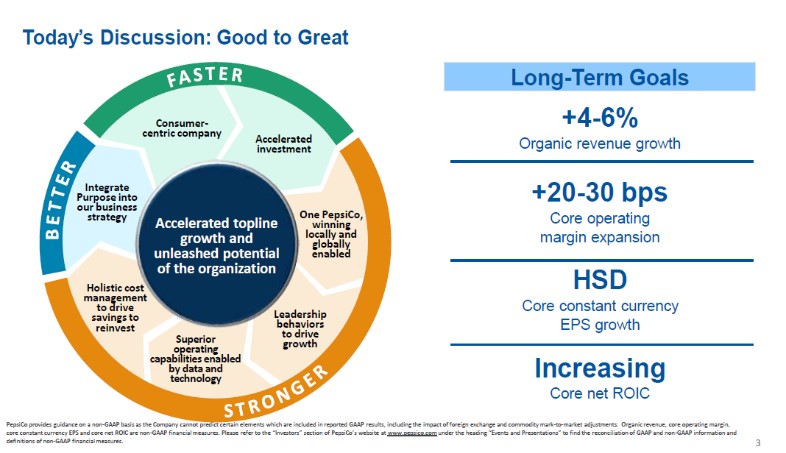
Management reiterated guidance for 2019 that calls for 4% organic sales growth (meaning revenue growth adjusted for foreign currency movements, which have been very negative of late) and a 1% decline in core constant currency EPS (an adjusted EPS measure that removes the effects of foreign currency movements and one-off events like certain restructuring charges) on an annual basis. In its press release PepsiCo noted that:
“Current market consensus rates implies a 2-percentage-point foreign exchange translation headwind to both reported net revenue and EPS performance. This assumption and the guidance above implies 2019 core earnings per share of $5.50, a 3 percent decrease compared to 2018 core earnings per share of $5.66.”
Foreign currency headwinds have been a key theme for US-based companies that have reported first quarter earnings so far, and that is unlikely to go away in the near-term. While the US FED is now holding off on raising rates, relatively speaking, the US dollar is still quite strong and will remain so for year-over-year comparisons throughout 2019 unless things change. PepsiCo still intends on being very free cash flow positive this year and reiterated guidance that calls for:
“Approximately $9 billion in cash from operating activities and free cash flow of approximately $5 billion, which assumes net capital spending of approximately $4.5 billion [this forecast is for 2019, and there appears to be generous rounding here]… Total cash returns to shareholders of approximately $8 billion, comprised of dividends of approximately $5 billion and share repurchases of approximately $3 billion.”
Turbulent foreign currency movements aside, PepsiCo remains committed to rewarding its shareholders. That commitment is part of the reason why PepsiCo’s share price has been on a strong upward trend since the nadir of the Great Recession. As things stand today, PepsiCo is trading at the upper end of our range of potential fair value outcomes, indicating the market is likely pricing in expectations for continued outperformance going forward.
Competition Creeping In
As has been the case for several other industries, the beverage space (specifically energy drinks) is possibly on the verge of getting disrupted by Amazon Inc (AMZN). Amazon’s private-label Solimo Red Energy Drink and Solimo Silver Energy Drink spooked shareholders of Monster Beverage Corporation (MNST) as the launch of those energy drinks marked the first time Amazon directly entered the energy drink market. Monster Beverage shares were down sharply last week the day the news broke (before later rebounding), highlighting investor apprehension as it relates to both margins and sales when it comes to competing with Amazon.
PepsiCo is active in the energy drink market through its AMP Energy brand, which underwent a major rework in 2017 – 2018 in order to revamp that offering as sales were lackluster due to intense competitive pressures. The company launched AMP Energy Organic in a bid to remain relevant in a world where consumers are increasingly favoring healthy options (or at least the perception of being healthy). Keep in mind PepsiCo is also playing the energy drink market through Mountain Dew Kickstart, an energy drink that leverages the popularity of the Mountain Dew soda brand with consumer’s love of caffeine. Beyond selling energy drinks, PepsiCo distributes Rockstar Energy drinks through a deal struck in 2009 that saw PepsiCo steal away business from The Coca-Cola Company (KO).
For reference, a 12-pack of Solimo Red Energy Drinks sells for $14.99 on Amazon without any discounts, while a 12-pack of AMP Energy Original sells for $19.99 on Amazon without any discounts. A lot of energy drinks are purchased in stores as consumers need that caffeine fix right away, where prices may be a tad different, but it’s clear that Amazon wants to fight on price and that is a major concern for a company like PepsiCo (and competitors like Monster Beverage).
PepsiCo’s Energy Drink Strategy
Here is an excerpt from our 16-page stock report that highlights how we view the non-alcoholic beverage market;
“The nonalcoholic beverage segment of the commercial beverage industry is highly competitive, consisting of numerous companies that make various sparkling beverages, water products, juices, fruit drinks, energy and other performance enhancing drinks. Pricing, advertising, product innovation, the availability of in-store private-label beverages, and health concerns about sugar-sweetened beverages are key drivers that impact demand. Leading brands with high levels of consumer acceptance and an expansive distribution network are sources of competitive strengths. We like the structure of the group.”
Overall, we like the space because there is room for differentiation and the ability to make moats. Having a large distribution system on top of a massive advertising budget offers two solid ways to keep the competition at bay, or in some cases, encourage the competition to team up with a giant in the industry like PepsiCo as was the case with Rockstar Energy.
Changing up the size, shape, and aesthetic appeal of its AMP Energy brand so the cans appear slim and sleek is a perfect example of PepsiCo attempting to differentiate its products. Another example can be found at PepsiCo’s new Mountain Dew AMP Game Fuel offering, which is attempting to appeal to younger gamers who often enjoy drinking caffeinated beverages while sitting down playing videogames or watching professional gamers play (including competitions that are streamed on Amazon’s Twitch service). In 2018, PepsiCo launched Gatorade Zero in order to cater to athletes that are seeking a hydrating beverage without sugar or carbohydrates. Having a commanding presence in the athletic beverage market is a core part of PepsiCo’s business strategy. PepsiCo’s management had this to say during the company’s latest conference call with investors;
“So in energy, we’re challengers, and our opportunity in energy is clearly innovate to go into spaces that the current players are not now playing. So we’re addressing energy from the coffee market. We’re addressing energy from energy, like Game Fuel, with specific positionings within that, narrower but probably more functional. And so we are challengers, and we want to have that mentality of going after existing leaders in this category and trying to get market share from that segment.
In the other 2 categories that you mentioned [coffee, sports, and energy were the three topics brought up by the analyst], our critical role is to keep building the — make sure that those categories remain very healthy. They keep growing above NRB, and that’s what’s happening with coffees and with sports drinks. They’re both growing fast. Our biggest innovation in beverages is Gatorade Zero. I think it’s going to be a, I think, very good innovation, very incremental to the category and good for our share of market.
So we’re investing big into Gatorade Zero, and we’re investing big into Gatorade. Of course, Propel is doing very well. So we have a broad-based approach to the sports category, and we see our velocities improving. When it comes to coffee, the same approach. And we think our role is to continue to innovate in this category, make sure that we “premiumize”. At the same time, we give value. We cover all the different spaces where the category can go. And we see our Starbucks coffee partnership very strong and clearly growing above what is the average of our company, so very accretive.”
International markets are a key growth driver for all consumer staples and consumer discretionary companies, and PepsiCo is no exception. Last quarter, PepsiCo posted 1% annual net sales growth from its Latin American division on a GAAP basis. However, when factoring out massive foreign currency headwinds, PepsiCo’s organic sales growth in Latin America clocked in at 10% during the first quarter of 2019. The firm’s Latin American beverage sales volumes grew by 7% annually on an organic basis last quarter.
PepsiCo entered into an agreement with Starbucks Corporation (SBUX) back in 2015 that covered the marketing, sale, and distribution of Starbuck’s ready-to-drink beverages in Latin American markets, specifically coffee and energy drinks. So far that partnership seems to be panning out favorably on an organic basis, the main problem is outside the control of the partnership, with that problem being the strong US dollar.
Concluding Thoughts
As PepsiCo is trading at the upper end of our fair value estimate range and sports a good (but not stellar) dividend growth trajectory, we still prefer ideas in the simulated newsletter portfolios instead. The company is doing a solid job maintaining its position in several key markets, but it will be imperative for PepsiCo to find a way to combat Amazon now that the tech giant is moving into the energy drinks space. We will be closely monitoring the energy drink market going forward. Bigger picture, PepsiCo has a lot of potential, but one of the major risks of pushing forever deeper into international markets relates to the threat of a strong US dollar becoming very real.
Beverages – Nonalcoholic: CCEP, KO, KDP, MNST, FIZZ, PEP
Related: PBJ
—–
Valuentum members have access to our 16-page stock reports, Valuentum Buying Index ratings, Dividend Cushion ratios, fair value estimates and ranges, dividend reports and more. Not a member? Subscribe today. The first 14 days are free.
Callum Turcan does not own shares in any of the securities mentioned above. Some of the companies written about in this article may be included in Valuentum’s simulated newsletter portfolios. Contact Valuentum for more information about its editorial policies.