
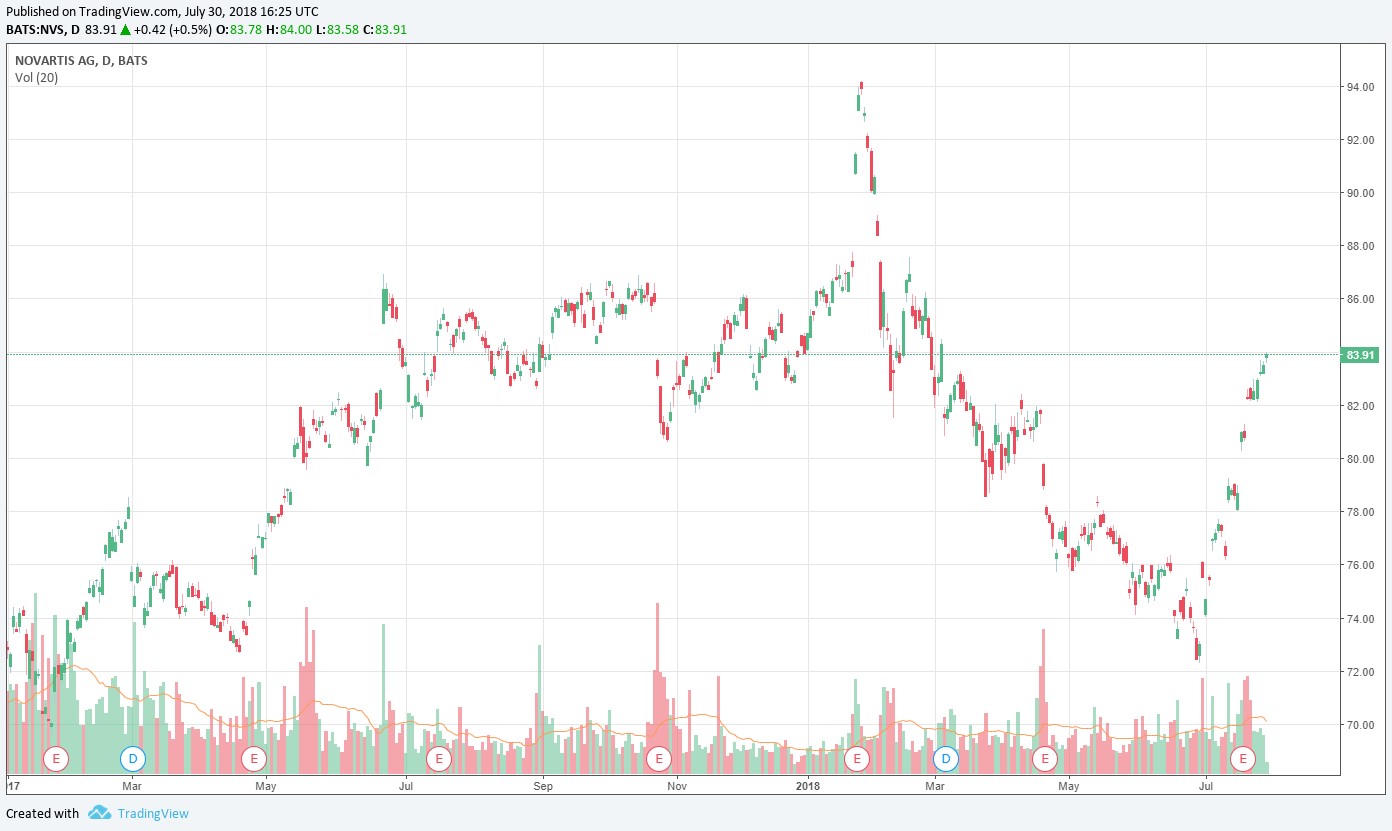
Image shown: The performance of Novartis’ stock price since the beginning of 2017.
We’re still fans of Novartis as we feel the steps taken by the new CEO to radically reshape the healthcare conglomerate will unlock significant shareholder value. The company remains one of our favorite dividend growth ideas within the healthcare space.
By Alexander J. Poulos
Key Takeaways
The transformation of Novartis continues as the company looks to shed its conglomerate image.
The Alcon division will be split-off in what we believe should unlock significant shareholder value.
The core new drug discovery business continues to perform well as new products, most notably Cosentyx, continues to show strength.
We agree with the decision to retain the Sandoz generic drug division as we view the coming biosimilar revolution as a worthy area of development for Novartis.
Novartis remains a key dividend growth idea, posting a Dividend Cushion ratio of 1.7. Shares yield ~3.9% at the time of this writing.
Business Transformation
Our initial interest in Novartis (NVS) centered on its emerging new product portfolio buttressed with a strong stable of established pharma products coupled with its Sandoz generic business and Alcon eyecare division. Ordinarily, the strength of Novartis’ new drug pipeline would excite investors, but the growth from this division is overshadowed by the slower growth Sandoz and Alcon segments, which tend to mitigate any meaningful jump in sales growth.
We applaud the moves undertaken thus far in the brief tenure of Novartis’ new CEO Vas Narasimhan. Since ascending into the role of CEO, he has spearheaded the move to divest the JV venture of Novartis with GlaxoSmithKline in the slow-growth OTC business for $13 billion. The divestiture paved the way to fund the audacious bid to acquire AveXis to gain control of its novel gene-therapy treatment for Spinal Muscular Atrophy. By divesting the OTC division, the focus of Novartis is shifting back towards faster-growth innovative medications, which naturally carry a higher degree of risk.
The second part of the equation for Narasimhan now pivots towards the Sandoz/Alcon division as the mediocre results continues to weigh on the overall group’s performance. We remain big fans of the potential for the biosimilar revolution to have a transformative effect on the overall cost of healthcare as key top-selling biological products such as Humira and Enbrel are poised to lose patent protection. We agree with Narasimhan’s decision to retain the Sandoz division as it will serve as the launchpad for Novartis to establish a leadership in the biosimilar industry.
The Alcon division possesses a unique dilemma as Lucentis, in our view, does not seem to fit in the overall direction Novartis is taking under Narasimhan. Our suspicion was validated with the recent announcement of an impending spin off of Alcon, which is expected to be completed in the first half of 2019. Alcon would become the largest pure-play eye care company, thus freeing the company to exclusively focus on developing a new innovative suite of eyecare products. We generally are fans of such transactions as the recent track record has been positive, as witnessed by the returns on Baxalta and Bioverativ, which were both acquired shortly after being spun-off from its respective parent.
In its second-quarter results, released July 18, Novartis reported an eye-pleasing 7% jump in top-line revenue on a constant-currency USD basis led by the strength of its pharmaceutical division, which continues to offset a decline in the sales of the Sandoz generic drug division. Novartis’ operating income advanced 9% on a constant-currency USD basis during the second quarter, and the company reiterated its 2018 guidance calling for net sales to advance in the low-to-mid single-digits and core operating income to advance at a mid to high-single digit pace, both on a constant-currency basis.
Oncology Division
Novartis retains a broad product suite in the Oncology Division headlined by established treatments Tasigna for treatment of chronic phase and accelerated phase Philadelphia chromosome-positive chronic myelogenous leukemia (Ph+ CML) in adult patients resistant or intolerant to at least one prior therapy and its former star performer Gleevec, which lost patent protection in 2017. The duo of Tasigna and Gleevec account for $1.76 billion of the divisions $6.62 billion in sales, thus underscoring the need for new innovative medications to offset the steep decline in Gleevec.
Thankfully for Novartis, the Tafinlar/Mekinist, Jakavi, Promacta and Kisqali are firmly in the early stages of its growth ramp, which we feel will more than offset the decline in Tasigna/ Gleevec as time progresses. We remain bullish on the prospects for Jakavi as we think the product will gain the additional indication of Graft versus Host disease, which will expand the overall market for the product. Kisqali for the treatment of certain forms of breast cancer also holds excellent potential, though the product does have an inferior side-effect profile versus the industry standard Ibrance. The sheer volume of patients may allow Kisqali to achieve blockbuster status (sales north of $1 billion in sales).
Neuroscience
Gilenya remains the top-selling product for Novartis, with a six-month sales tally of $1.687 billion. Gilenya is utilized for the treatment of multiple sclerosis; one of the key points of differentiation is the easy once-a-day capsule formulation which simplifies the overall dosing regiment for patients. Novartis is aggressively asserting its patent right for the product arguing the patent covering the IP estate for Gilenya should not lapse in 2019. Instead, it believes the product should retain protection through 2027. Novartis did score a recent win in court, but the patent battles continue.
The move to acquire AveXis seems like a masterstroke as Novartis now has a worthy successor to Gilenya in case the patent challenge fails. As a quick point of reference, Biogen’s Spinraza generated $365 million in revenue for the first quarter of 2018, good for an annual run rate of $1.46 billion. Assuming the AveXis treatment gains approval, we view the product as a potential disruptive force with an enormous price tag that should vault the product towards sales of over $1 billion per year. We will continue to monitor the clinical progress of the product to determine if the product is a once-a-lifetime event, or if it will require “booster” treatments as the clinical effects may wane over time.
Immunology
Cosentyx remains the growth star in Novartis patent portfolio as the continued sales ramp should allow the product to morph into the crown jewel of Novartis portfolio, in our view. Sales of Cosentyx clocked in at $1.28 billion, a stellar jump of 42% in US dollar terms in the first six months of 2018 as the product continues to gain traction. Immunology remains the largest overall specialty healthcare spend with Cosentyx possessing a clear ramp, in our view, until a generic version of Humira appears on the scene in the US. Even though Cosentyx possesses superior head-to-head results, we feel the payers will push for a Humira biosimilar as a first-line treatment unless Novartis is willing to negotiate on price. The days of near double-digit annual price hikes may be ending abruptly.
Alcon
The pace of the active turnaround that Alcon is undergoing has begun to produce results as the division reported a jump of 5% in revenue for the second quarter (7% on a constant currency USD basis). Operating income at Alcon leapt 14% in the period (cc, +16% USD). The star of the show for Alcon remains Lucentis, which generated sales of $1.035 billion during the first half of 2018.
Lucentis remains locked in fierce competition with Eylea for sales dominance in the treatment of macular degeneration with Eylea continuing to retain the upper hand. Alcon is attempting to advance brolucizumab as a next-generation treatment with the potential to displace Eylea as the treatment of choice. We feel once the spin-out of Alcon is complete, a greater emphasis on additional ophthalmic clinical targets will commence at Alcon as the division will no longer have to compete for resources with other products such as oncology.
Sandoz
We are not at all surprised with the recent struggles at Sandoz as the generic drug market continues to face deflationary headwinds. Sandoz reported a sales decline of 3% when viewed from a constant currency perspective. First half of 2018 results, as reported, thanks in large part to the strength in the US dollar, allowed Sandoz to post an anemic revenue growth of 2%, which we do not view as a valid marker of the trends in the industry. We agree with the decision to retain Sandoz as recent events point to a potential reversal of the disinflationary drug trend, however.
We are watching closely the stepped-up enforcement of quality standards of generics as witnessed by the sudden removal of various forms of the top-selling blood pressure medication called Valsartan from the market due to concerns surrounding the quality of the manufactured product. We can envision a scenario where some of the recent entrants into the marketplace may be forced out over the increased costs to comply with heightened safety protocols. If such a scenario would develop, it would abruptly end the recent bout of deflation, thus perhaps ushering in a more rational pricing environment. This could be positive for Teva Pharma (TEVA) and other generic players.
Concluding Thoughts
We remain impressed with the pace of the transformation ushered in by new CEO Vas Narasimhan as he so eloquently summed up “The age of the healthcare conglomerate is over.” We remain big fans of the dividend, the primary reason for our inclusion of the idea into the simulated Dividend Growth Newsletter portfolio. We think the move to simplify the business may unlock an additional avenue to reward shareholders. Novartis remains a key dividend growth idea, posting a Dividend Cushion ratio of 1.7. Shares yield ~3.9% at the time of this writing.
—–
Valuentum members have access to our 16-page stock reports, Valuentum Buying Index ratings, Dividend Cushion ratios, fair value estimates and ranges, dividend reports and more. Not a member? Subscribe today. The first 14 days are free.
Alexander J. Poulos does not own shares in any of the securities mentioned above. Some of the companies written about in this article may be included in Valuentum’s simulated newsletter portfolios. Contact Valuentum for more information about its editorial policies.