
By Callum Turcan
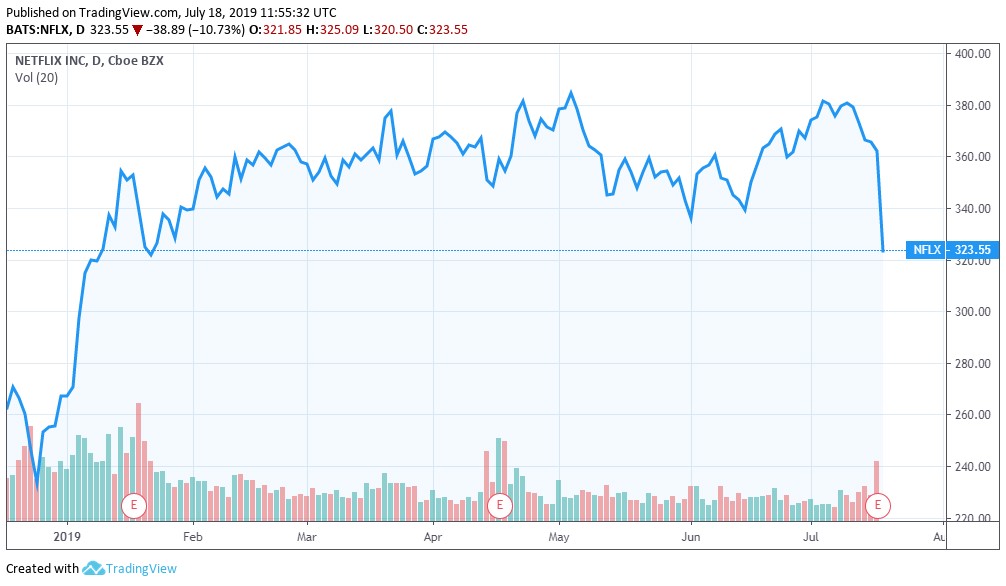
Shares of Netflix Inc (NFLX) were crushed during the trading session July 18 after the video streaming company posted second-quarter 2019 earnings. The big miss in its net subscriber additions was the main reason why.
The company added 2.7 million net paying subscribers to its ranks during the quarter (way below guidance calling for 5.0 million), bringing its total paid subscriber count to 151.6 million worldwide at the end of the second quarter. That’s along with 6.1 million free trial accounts, which could be viewed as a growth pipeline considering some, but not all, of those subscribers will likely become paying members. Most see the big miss on net subscriber additions as the key culprit behind Netflix’s selloff and we agree with that sentiment. On the conference call management mentioned that:
“When we’re forecasting, Mike, in the beginning of the quarter, we make our best estimate. And as you can see over the past 3 years, sometimes we’re forecast high, sometimes we forecast low. This is one where we forecasted high. There was no one thing.”
Netflix’s net subscriber additions last quarter were nowhere near its quarterly average of 7.2 million in 2018. Furthermore, Netflix’s free trial subscriber count dropped by 0.5 million sequentially during the second quarter of 2019. One could argue that this is somewhat a result of the 9.6 million net subscriber additions during the first quarter of this year, and that growth would likely slow down sequentially after that burst, but please keep in mind Netflix hasn’t added less than 4.6 million net subscribers in a quarter since the start of 2017. The “pull-forward effect” cited by management was only partially responsible for the big miss; the other culprit was apparently price increases.
Regions with price increases saw bigger misses relative to management’s forecasts. That could be seen as Netflix not properly taking into account the dynamic effects price increases might have on both its paying subscriber base but also future subscribers in light of the number of trial customers falling sequentially. Management noted that higher levels of churn and lower retention rates were at play in regions where prices rose.
It’s important to keep in mind that price increases in most, if not all regions, will eventually be required in order to bolster Netflix’s cash flows to cover massive investments in original content. That’s just part of any recurring business model with large investment requirements. Companies that can’t pass on rising costs to its customers are generally companies that face shrinking margins over time. In the hypercompetitive video streaming business that’s competing against both old and new forms of entertainment distribution and content creation, management is walking a fine line. In Netflix’s earnings release the company mentioned (emphasis added):
“While our US paid membership was essentially flat in Q2, we expect it to return to more typical growth in Q3, and are seeing that in these early weeks of Q3. We forecast Q3 global paid net adds of 7.0m, up vs. 6.1m in Q3’18, with 0.8m in the US and 6.2m internationally. Our internal forecast still currently calls for annual global paid net adds to be up year over year. There’s no change to our 13% operating margin target for FY19, up 300 basis points year over year.”
One quarter doesn’t make a trend, and the knee-jerk reaction in NFLX shares may be an overdone if Netflix does post a sharp rebound in growth this quarter by adding 7.0 million net subscribers to its customer base. Netflix exceeded forecasted net subscriber additions during the third and fourth quarters of 2018, and in the first quarter of 2019, meaning its latest miss was out of character. In America, Netflix lost over 0.1 million net subscribers last quarter which further scared investors. It’s important that Netflix’s US net subscriber count keeps growing, as its domestic division is more profitable than its international divisions.
On July 12, Netflix announced it had appointed a new Chief Marketing Officer (“CMO”), Jackie Lee-Joe, who had previously worked at BBC Studios as its CMO. It will be interesting to see how she shakes up Netflix’s marketing division given the subscriber miss.
Financial Performance
Netflix grew its revenue by 26% year-over-year to $4.9 billion last quarter while its GAAP operating income climbed by 53% to $0.7 billion. The firm’s GAAP net income dropped 30% year-over-year to $0.3 billion due to a significant increase in its effective reported corporate income tax rate, which sent its GAAP diluted EPS down to $0.60 in the second quarter.
As expected, Netflix remained a far cry away from positive free cash flow generation with $3.8 billion in cash outlays related to ‘additions to streaming content assets’ pushing its net operating cash flow down to -$1.2 billion (negative $1.2 billion). A note from our 16-page Stock Report covering NFLX:
“Netflix’s firmwide profitability is improving, but free cash flow generation is non-existent. The company is trading at a significantly high earnings multiple, and its long-term debt load may balloon significantly in coming years. We’d like to see the company improve its balance sheet.
Though we’ve become more optimistic about Netflix’s potential earnings leverage, it will continue to burn through cash for years to come. Free cash flow is expected to be flat in 2019 over 2018 levels (negative $2.9 billion) before improving in 2020 with breakeven status ‘a few years’ away as of 2018. Total contractual obligations (debt, content, lease, and other purchase obligations) sat at ~$36.6 billion at the end of 2018.
We believe Netflix is a risky stock, and its junk-rated credit speaks to this. Competition is intensifying, and the company continues to spend robustly on creating and acquiring content. Subscriber performance will continue to make headlines, and price increases will help profitability. Earnings leverage should be watched closely in coming years.
Though Internet TV and ‘cord cutting’ trends are in its favor, how industry earnings will be distributed among players is a big question. Netflix’s distribution platform could be replicated with enough marketing dollars, in our view, and international growth hasn’t been as profitable as its domestic operations.”
At some point in the early-2020s, Netflix is targeting free cash flow neutrality based on management commentary. That’s the right goal, but the timeline is vague. Netflix has access to capital markets as indicated by its recent “junk” bond offerings, and while its long-term liabilities are onerous, they aren’t unmanageable based on its growth trajectory.
Netflix would benefit from the US Fed cutting rates for several reasons. For starters, lower interest rates enhance the discounted value of future estimated free cash flows by putting downward pressure on the discount rate. Secondly, in light of management expecting Netflix to remain free cash flow negative for at least a couple more years, issuing debt is made easier. If credit markets were to tighten that could put tremendous pressure on Netflix’s financials as debt issuance is being utilized to fund major investments in its original content.
Concluding Thoughts
Shares of Netflix are under pressure. Netflix doesn’t usually miss, especially not this badly, and investors are worried that days of 5-7+ million net subscriber adds being the quarterly norm may be coming to an end. The company added 2.8 million net overseas subscribers, a fine figure, but not enough to justify its lofty valuation after a major run up in its stock price this year. Our fair value estimate for shares of NFLX stands at $298/share.
Media Entertainment Industry – CNK DIS IMAX ISCA LYV MSG NFLX NWSA SIRI
Related: ROKU
—–
Valuentum members have access to our 16-page stock reports, Valuentum Buying Index ratings, Dividend Cushion ratios, fair value estimates and ranges, dividend reports and more. Not a member? Subscribe today. The first 14 days are free.
Callum Turcan does not own shares in any of the securities mentioned above. Some of the companies written about in this article may be included in Valuentum’s simulated newsletter portfolios. Contact Valuentum for more information about its editorial policies.