
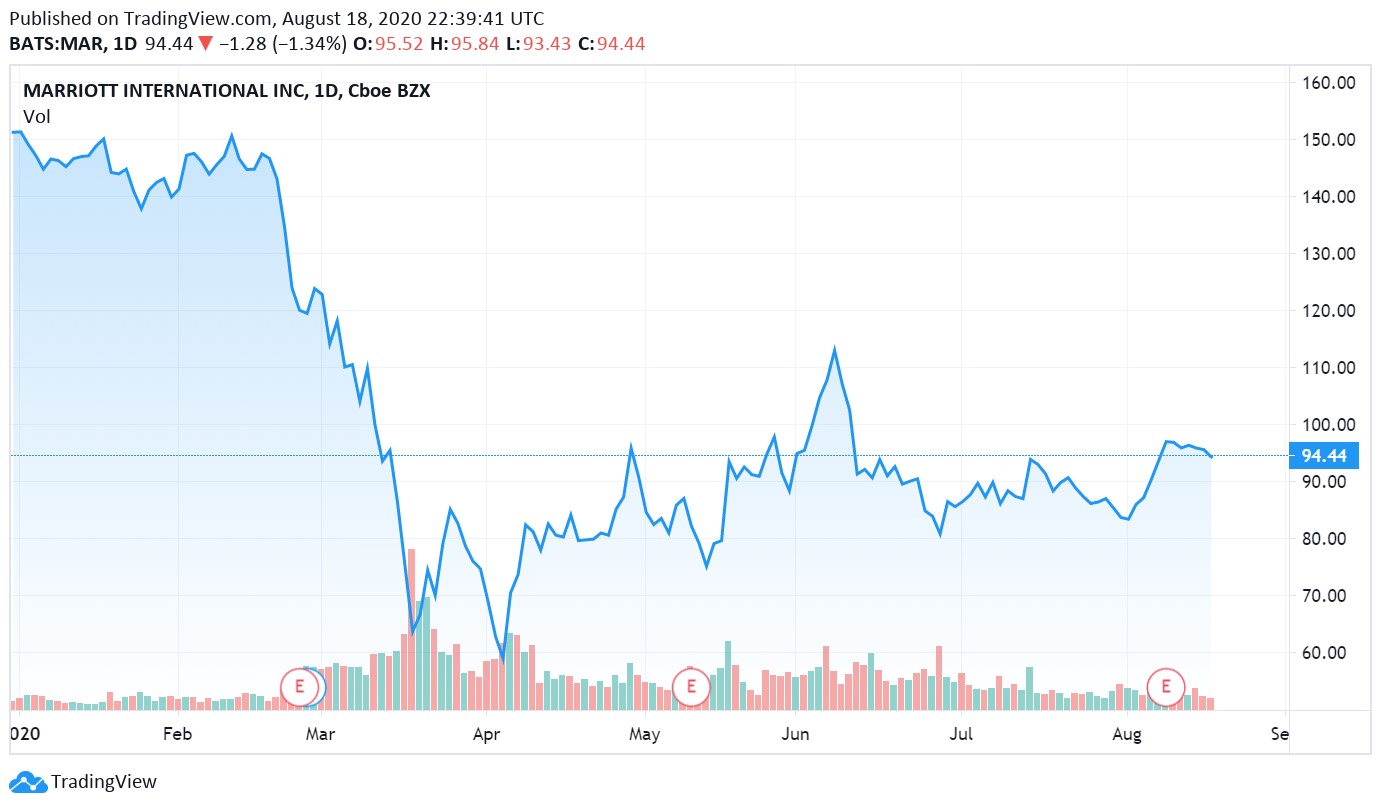
Image Shown: Shares of Marriott International Inc have recovered somewhat from their March 2020 lows and are currently trading in the lower bound of our fair value estimate range.
By Callum Turcan
On August 10, Marriott International Inc (MAR) reported second quarter 2020 earnings that missed both consensus top- and bottom-line estimates. Marriott International’s financials have been devasted by the ongoing coronavirus (‘COVID-19’) pandemic, though its saving grace has been its asset-light business model which is built around property management and franchise fees. Most of its revenue comes from managing third-party locations and franchising out its various hotel brands to third-parties including Courtyard, Fairfield by Marriott, Residence Inn, Marriott Hotels, Sheraton, Westin, and others. Please note many of its franchised locations are also managed by Marriott International.
Quarterly Update
During the first half of 2020, Marriott International generated $1.5 billion in net operating cash flow and spent less than $0.1 billion on capital expenditures, allowing for $1.4 billion in free cash flow. Marriott International spent ~$0.15 billion on both its share repurchases and dividend obligations during this period, though the company suspended its dividend program (announced back in March 2020) and does not intend on repurchasing a significant amount (or any) of its stock going forward under business conditions improve. Though its business got hammered, the firm was able to still generate meaningful cash flows last quarter.
As travel-related activities has been devastated by COVID-19, Marriott International reported that its Revenue per Available Room (‘RevPAR’) declined by 84.4% year-over-year last quarter on a constant-currency systemwide basis. This saw the firm’s GAAP revenues decline by 72% year-over-year in the second quarter, which led to Marriott International posting a GAAP operating loss of ~$0.15 billion and a GAAP net loss of ~$0.25 billion last quarter. Marriott International’s franchise and management fees, along with revenue generated from its owned and leased locations, were decimated.
Looking ahead things appear much brighter as Marriott International’s worldwide occupancy rate improved from just 11% in April to 34% by the week ended August 1. As of its latest earnings report, Marriott International noted 91% of its worldwide locations were open, up from 74% in April. When individuals and households start travelling again in earnest is a different matter, and one that will likely depend on the discovery of a safe and viable COVID-19 vaccine. Marriott International has not provided guidance for 2020 after pulling its forecast in February.
Financial Update
The firm’s net debt load is enormous, which exacerbates the pressures the company is facing due to COVID-19. Marriott International exited June 2020 with $2.3 billion in cash and cash equivalents on hand versus $1.7 billion in short-term debt and $10.1 billion in long-term debt. Furthermore, please note a little more than two-thirds of its total assets were represented by intangible assets at the end of June 2020. Marriott International appears to retain access to capital markets at reasonable rates given its debt issuances last quarter. Management is responding to the crisis by embarking on a major restructuring program to cut costs. Here is what the firm had to say during its latest earnings call (emphasis added):
“We’re still working through the details, but currently expect these restructuring efforts will reduce total above property controllable costs, which includes both corporate G&A and program and services costs by roughly 25%. We’ll know more about the specific impact on G&A as we work through the 2021 budget process. We’re also developing restructuring plans to achieve cost savings specific to each of our company operated properties, including our owned leased hotels. We expect to implement these plans over the next couple of quarters.
In addition to focusing on preserving cash, we’ve substantially boosted our liquidity, and extended our average debt maturities. During the quarter, we raised $2.6 billion of long-term debt [the firm issued $1.6 billion of Series EE 5.750% Senior Notes due 2025 in April and $1.0 billion of Series FF 4.625% Senior Notes due 2030 in June] and $920 million of cash through amendments to our credit card deals.
As part of our liability management, the $1 billion raised in June was largely used to tender and retire a portion of our near-term debt maturities. At quarter end, our cash and cash equivalents on hand was around $2.3 billion; adding that cash to the undrawn capacity of our revolver of approximately $2.9 billion and deducting around $800 million of commercial paper outstanding; our net liquidity was approximately $4.4 billion at the end of the second quarter. We believe our strong liquidity position, cash flow from operations and access to capital markets comfortably position us to meet our short and long-term obligations.” — Leeny Oberg, CFO of Marriott International
Marriott International now has the financial means to ride out the storm, though we caution that it will likely be a while before its dividend is reinstated given its large net debt load and the lack of certainty as it relates to its outlook.
Concluding Thoughts
Our fair value estimate stands at $110 per share of MAR, though at the low end of our fair value estimate range, MAR fetches a fair value of $83 per share. Given that shares of Marriott International are trading in the lower bound of our fair value estimate range as of this writing, it appears MAR is fairly valued at this time. We are not interested in shares of Marriott International currently as we prefer companies that have pristine balance sheets and have operations that are better suited to ride out the pandemic.
—–
Gaming & Hotels Industry – HLT LVS MAR MGM WYNN CHDN
Related: IHG, H, WYD, RLH, WH, CHH, HST, HT, PEB, RHP, RLJ, SHO, SVC, XHR, VICI, DRH, BKNG, EXPE, TRIP, APLE, AWAY
—–
Valuentum members have access to our 16-page stock reports, Valuentum Buying Index ratings, Dividend Cushion ratios, fair value estimates and ranges, dividend reports and more. Not a member? Subscribe today. The first 14 days are free.
Callum Turcan does not own shares in any of the securities mentioned above. Some of the companies written about in this article may be included in Valuentum’s simulated newsletter portfolios. Contact Valuentum for more information about its editorial policies.