
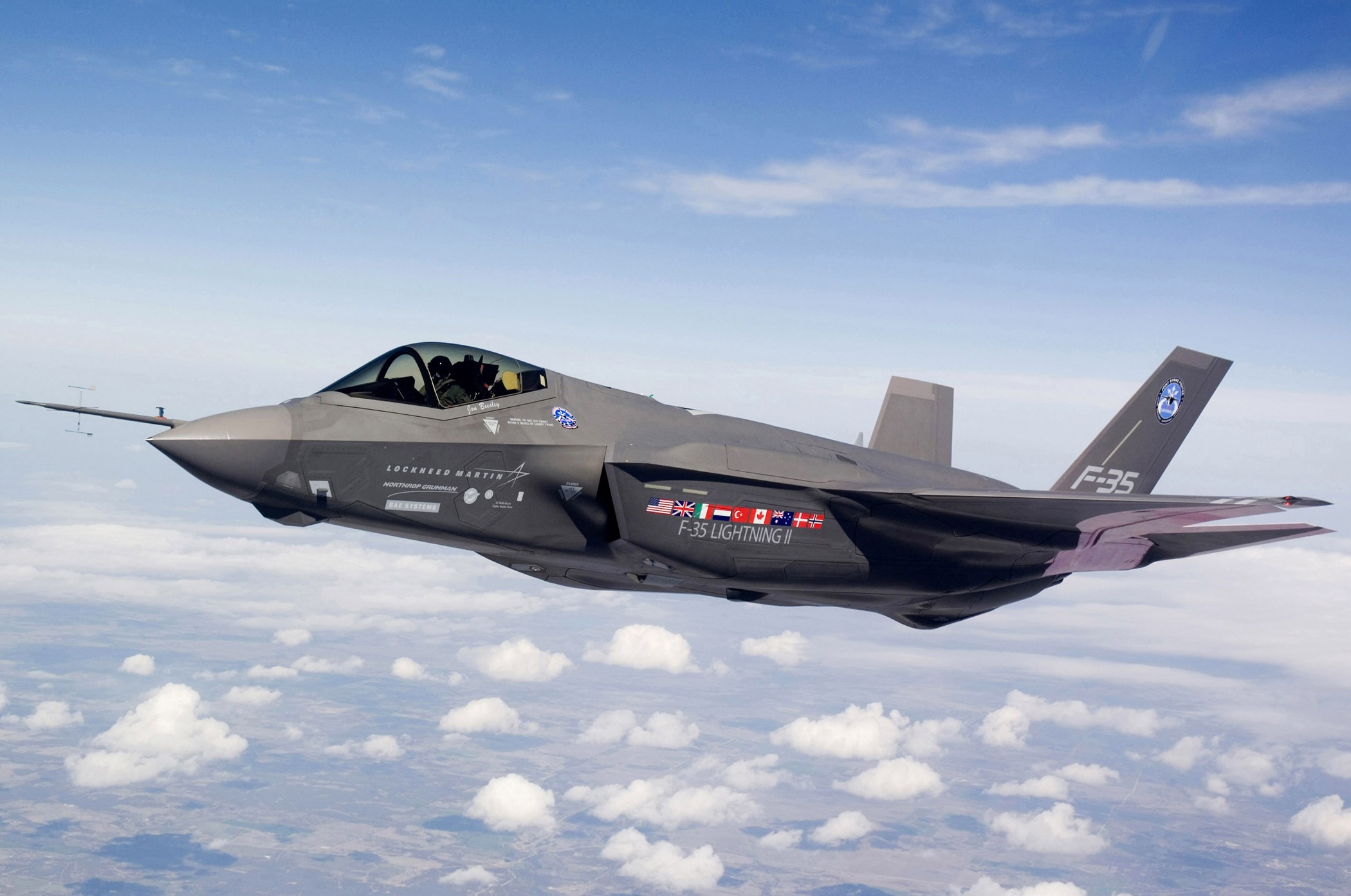
Image shown: “Lockheed Martin F-35 Joint Strike Fighter Lightning II test aircraft AA-1 undergoes flight testing over Fort Worth, Texas (source).”
We liked Lockheed Martin’s first-quarter 2018 report, and we liked even more that the company raised its full-year outlook for revenue, operating income and earnings per share. Operating cash flow performance was weighed down by pension contributions and backlog didn’t advance in the period, but the backdrop for defense spending remains healthy given ongoing geopolitical tensions. Shares of Lockheed aren’t cheap, however.
By Brian Nelson, CFA
We were generally pleased with Lockheed Martin’s (LMT) first-quarter 2018 results that showed revenue advancing ~3.8%, and the company leveraging top-line growth into ~20% expansion in business segment operating profit, to $1.31 billion. Revenue in its ‘Aeronautics’ and ‘Missiles and Fire Control’ segments advanced at a high-single-digit pace on a year-over-year basis, the former in part due to increased volume and production on the F-35 program, while sales in its ‘Rotary and Mission Systems’ division increased 3%. Lockheed Martin’s ‘Space’ division experienced declines in both sales and operating profit during the period, but this was largely expected.
The biggest delta in operating income on a year-over-year basis came from Lockheed’s ‘Rotary and Mission Systems’ division, but the improvement was due mostly to a one-time charge in the year-ago period related to revised costs to complete the EADGE-T contract. Operating cash flow dipped considerably on a year-over-year basis as a result of pension contributions, but the measure still advanced meaningfully on an apples-to-apples basis. Net earnings and diluted earnings per share leapt to $1.16 billion and $4.02, respectively, in the period, which compared to ~$789 million and $2.69 in the year-ago period, though the increase was bolstered in part by a lower effective tax rate (14.9% versus 23.8%).
Looking ahead, Lockheed may continue to benefit from ongoing geopolitical uncertainty, even as talks between the US and North Korea look to potentially result in de-nuclearization of the peninsula. Missile strikes in Syria seemed to have only increased tensions between the US and Russia, and we think governments around the world will have to continue to spend to keep warfighters in tip-top condition. Lockheed’s backlog declined modestly on a sequential basis at the end of the first quarter of 2018 ($104.8 billion versus $105.5 billion at the end of the December quarter), but we’re not reading too much into the modest decline. For starters, it’s hard not to like that the company raised its 2018 outlook across the board, for net sales ($50.35-$51.85 billion), business segment operating profit ($5.315-$5.465 billion), and diluted earnings per share ($15.80-$16.10 per share).
We like the defense contractors a lot, particularly with President Donald Trump in the White House, but shares of many of them are getting a little ahead of themselves, in our view. Our fair value estimate for Lockheed Martin, for example, is significantly lower than where shares are currently trading. We like the company’s dividend growth potential, but shareholders should be mindful of competing government budget priorities and the company’s net debt position, both of which could weigh on the pace of dividend growth in coming years. Shares yield ~2.3% at the time of this writing.
Aerospace & Defense – Prime: BA, FLIR, GD, LLL, LMT, NOC, RTN
Related: RSX, RSXJ
—–
Valuentum members have access to our 16-page stock reports, Valuentum Buying Index ratings, Dividend Cushion ratios, fair value estimates and ranges, dividend reports and more. Not a member? Subscribe today. The first 14 days are free.
Brian Nelson does not own shares in any of the securities mentioned above. Some of the companies written about in this article may be included in Valuentum’s simulated newsletter portfolios. Contact Valuentum for more information about its editorial policies.