
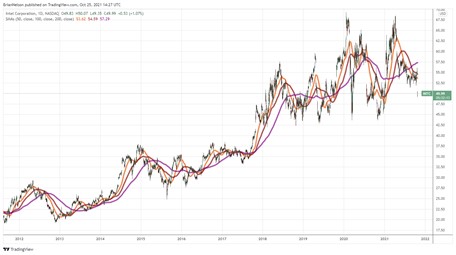
Image: Intel has advanced nicely during the past several years, but more recently, its choppy stock behavior is reflective of the market having trouble figuring out the future direction of this tech behemoth, particularly in light of encroaching competition and huge expected capital spending growth. Shares offer investors a healthy 2.8% dividend yield, however, which gives the stock a sturdy foundation for the time being.
By Brian Nelson, CFA
As we noted in our prior update on Intel (INTC) earlier this year, we removed the tech giant from the Best Ideas Newsletter portfolio and Dividend Growth Newsletter portfolio in late October 2020, almost a year ago to the date. Since that time, shares of Intel, on a price-only basis, have advanced about ~11%, while the S&P 500 (SPY) has increased ~38%. We think we made a prudent move.
Intel reported mixed third-quarter earnings Thursday, October 21, with revenue growth (+4.6%) coming in a bit shy of expectations and non-GAAP earnings per share of $1.71 beating the consensus mark by a nice margin. The quarter was solid by most measures, with the chip giant achieving an all-time record in revenue in its Internet of Things Group (“IOTG”) and record third-quarter revenue in its Data Center Group (“DCG”).
Here’s what CEO Pat Gelsinger had to say in the press release:
Q3 shone an even greater spotlight on the global demand for semiconductors, where Intel has the unique breadth and scale to lead. Our focus on execution continued as we started delivering on our IDM 2.0 commitments. We broke ground on new fabs, shared our accelerated path to regain process performance leadership, and unveiled our most dramatic architectural innovations in a decade. We also announced major customer wins across every part of our business. We are still in the early stages of our journey, but I see the enormous opportunity ahead, and I couldn’t be prouder of the progress we are making towards that opportunity.
Looking ahead, Intel raised its full-year 2021 earnings per share and gross margin guidance, now expecting non-GAAP earnings per share of $5.28 and non-GAAP gross margin of 57% for the year. Non-GAAP free cash flow generation is also expected to be resilient during 2021, with the measure expected to come in at $12.5 billion on capital spending projections of $18-$19 billion. Expected non-GAAP free cash flow will likely cover cash dividend payments by ~2.2x this year, so Intel’s payout remains very well-covered in the near term.
What made us ditch Intel’s underperforming stock a year ago today still rings true, however: “Though we continue to like the company as we outline in our latest work here, competitive pressures and a balance sheet that sports a growing net debt position make it much less attractive of a stock, in our view. We tend to prefer healthier balance sheets in this environment, namely ones with huge net cash positions.” Intel’s future expected free cash flow profile has also deteriorated since that time.
Advanced Micro Devices (AMD) continues to make inroads against Intel (as the former’s stock price has shown), and Intel is contending with a balance sheet that is likely to get gradually weaker in coming years as spending ramps. At the end of the third quarter of 2021, Intel’s total debt stood at $40.3 billion and ~$5.7 billion on a net basis, after accounting for cash equivalents, short-term investments and trading assets. Intel’s future free cash flows (FCF) are also expected to face pressure in the coming periods, per Fitch:
Fitch expects lower than historical FCF and FCF margins as Intel accelerates process technology development while adding significant capacity to meet expected internal and foundry customer demand. Fitch expects more than $5 billion of annual FCF and FCF margins in the mid-single digits through the forecast period, down from $15 billion and nearly 20% in 2020, respectively, although subsidies could offset investments as the U.S. governments seeks to incentivize the build-out of U.S.-based manufacturing capacity.
Our free cash flow expectations are a bit more optimistic than those of Fitch, but Intel’s capital spending expected in the coming years will certainly dent free cash flow relative to the $20.9 billion mark Intel registered in 2020. We’re modeling in non-GAAP free cash flow north of $10 billion for 2021, and we expect the measure to recover to nearly $14 billion over the next four years, but capital spending expected in the range of $25-$28 billion in 2022 with the “potential for further growth in subsequent years” is quite the shocker, explaining why shares of Intel tumbled aggressively after the earnings report.
Concluding Thoughts
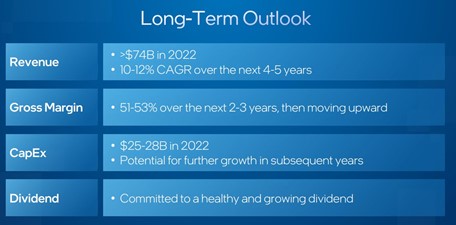
Image: Intel is planning to spend a considerable amount on capital expenditures in the coming years, and while management notes it is “committed to a healthy and growing dividend,” free cash flow will take a hit. Image Source: Intel
In October 2020, we decided to remove Intel from the Best Ideas Newsletter portfolio and Dividend Growth Newsletter portfolio as competition was heating up and the firm’s balance sheet started to lose its luster. Weakening free cash flow due to a huge expected capital-spending build now makes Intel incrementally less attractive of an idea, though we note shares continue to trade within our fair value estimate range ($45-$67), which may be revised slightly lower on the next update.
A dividend yield of ~2.8% is supported by future free cash flow in the near term, but there may be more clouds on the horizon (and investors should expect a lower Dividend Cushion ratio upon the next update, too). We’re comfortable being on the sidelines as there are so many other investment considerations that fit the financial bill better, in our view–namely those capital-appreciation and dividend-growth considerations with strong net cash positions and strong future expected free cash flow growth.
Tickerized for INTC, AMD, MU, TXN, AMAT, KLAC, LRCX, HLBZ, SSNLF, MRVL, WDC, SMICY, XLNX, QRVO, ADI, SMH, XLK
—–

Image Source: Value Trap
———-
Valuentum members have access to our 16-page stock reports, Valuentum Buying Index ratings, Dividend Cushion ratios, fair value estimates and ranges, dividend reports and more. Not a member? Subscribe today. The first 14 days are free.
Brian Nelson owns shares in SPY, SCHG, QQQ, DIA, VOT, BITO, and IWM. Valuentum owns SPY, SCHG, QQQ, VOO, and DIA. Brian Nelson’s household owns shares in HON, DIS, HAS. Some of the other securities written about in this article may be included in Valuentum’s simulated newsletter portfolios. Contact Valuentum for more information about its editorial policies.