
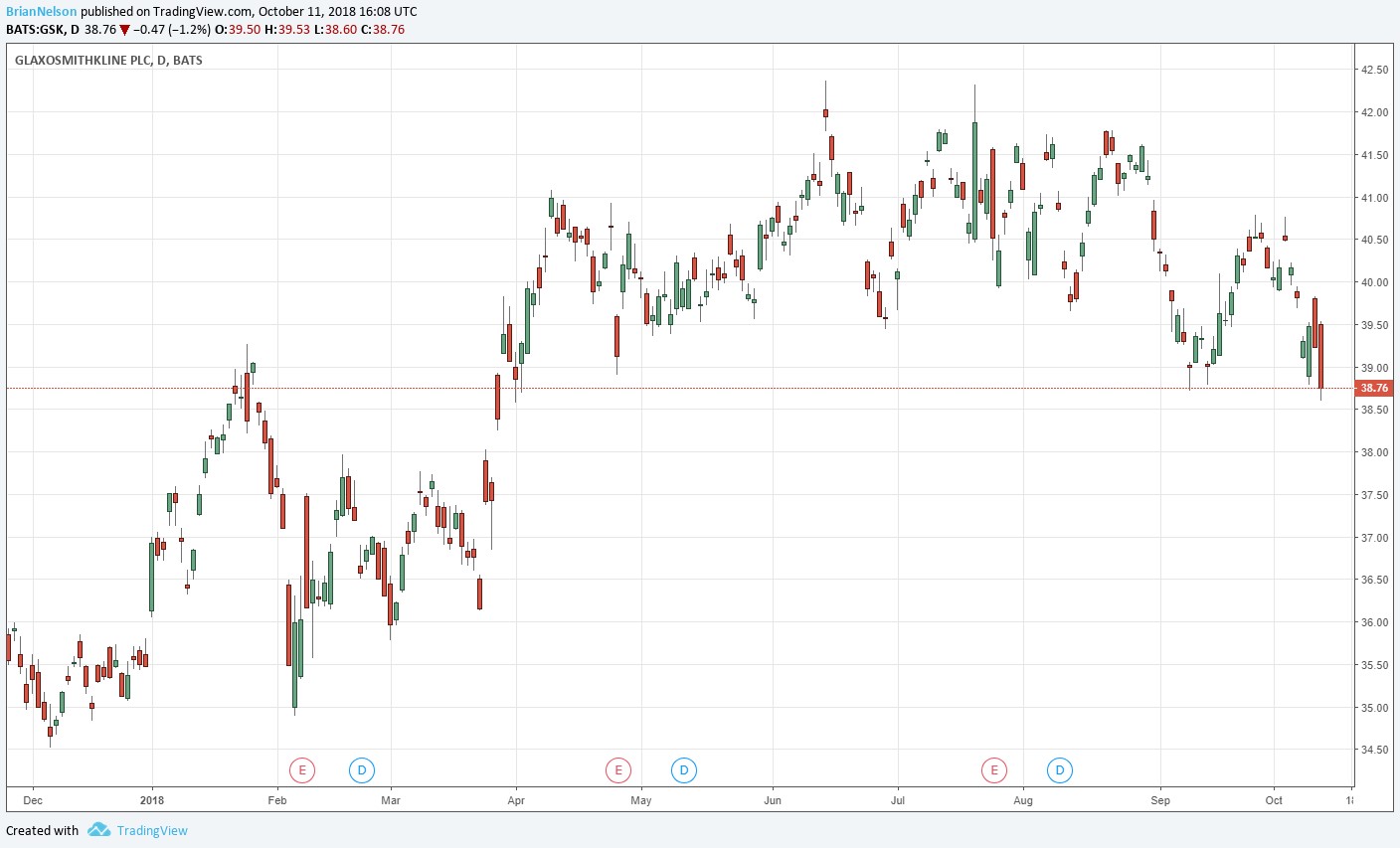
Image Shown: GlaxoSmithKline’s share price performance since early 2014.
GlaxoSmithKline may be poised to enter an earnings trough if generic competition is successful in providing a replacement for key product Advair, but management is working to right the ship. The company’s dividend yield is compelling, but its success will ultimately depend on the progress of its clinical pipeline.
By Alexander J. Poulos
Key Takeaways
GlaxoSmithKline may be poised to enter an earnings trough should key product Advair face pending generic competition.
CEO Emma Walmsley is engineering a turnaround with multiple achievable targets, but the success of her tenure ultimately depends on the success of the company’s clinical pipeline.
The stock’s generous dividend yield is compelling, and the potential for capital appreciation exists if cost saving initiatives are well executed and improved clinical success occurs.
GlaxoSmithKline: A History of Strategic Blunders
GlaxoSmithKline (GSK) is currently paying the price for years of misguided leadership after former CEO Sir Andrew Witty left the company in utter shambles upon his departure in March 2017. Recent years at GSK have been marred by a string of high profile clinical flops coupled with a smattering of bribery scandals that sapped the management team’s attention away from drug development as it was forced to placate issue after issue.
The drug discovery process remains an imperfect art as promising molecules can fail in clinical trials due to unforeseen side effects developing. However, our issue with GSK is the series of costly phase 3 flops, which we view this as an indication of poor internal controls as phase 3 trials tend to be much larger and far more costly to conduct than earlier stages of development. Though the risks of a drug still in clinical development should never be understated prior to receiving approval, a well-designed slate of phase 2 trials can often eliminate a notable degree of risk.
The slate of relatively poor clinical performance has left GSK with a dearth of near-term products to drive top-line growth, and the lack of a compelling clinical pipeline coupled with the bribery scandal paved the way for Witty to exit the company, in our opinion.
Enter New CEO Emma Walmsley
GSK tabbed Emma Walmsley in April 2017 to replace the “retired” Witty. Walmsley is an internal candidate whose most notable experience came from her time leading GSK’s Consumer Healthcare joint venture with Novartis. Walmsley appears to be a well-qualified choice in light of Witty’s short sighted move to trade GSK’s early stage oncology assets to acquire a stake in Novartis’ (NVS) consumer health division, which resulted in aforementioned joint venture, along with a full takeover of Novartis’ vaccines business. Under terms of the deal, Novartis paid GSK $16 billion in cash for its oncology assets with GSK subsequently paying ~$7.1 billion for the vaccine business and a 63.5% stake in the newly formed consumer health JV. Instead of reinvesting the upfront proceeds of the deal back into its business, GSK launched a B share scheme to return the capital to shareholders.
As a result of Witty’s gambit, the company is repositioned towards lower margin/higher turnover products, which made Walmsley an optimal candidate to run the new GSK. She is intimately aware of the strengths of the new JV, which was a crucial consideration as Novartis held a put to offer to sell its stake in the JV back to GSK. Novartis executed this right in June of 2018, resulting in GSK paying Novartis $13 billion to gain full control of the business.
Respiratory
GSK possess an enviable lineup of respiratory products headlined by the mainstay asthma treatment Advair. The respiratory segment remains GSK’s key franchise, but the pending introduction of a generic version of Advair continues to weigh on sentiment as the product has lost patent protection. GSK remains fortunate thus far the generic industry has not produced an acceptable substitute as it has bought GSK additional time for its new product suite to establish itself.
GSK introduced a new dry powder version of its mainstay respiratory treatments via the new Ellipta dry powder device. The goal is to provide a more consistent dose to the patient while layering on additional patent protection as the generic manufacturers will have to duplicate not only the medication but the delivery system which has thus far bedeviled attempts at a proper generic substitute for Advair.
The Ellipta product suite, including Trelegy, generated £509 million in the second quarter of 2018 versus £590 million for Advair. The spread between the two products continues to narrow which likely helped embolden management to raise 2018 guidance on a constant exchange rate (CER), but the potential entry of a generic substitute for Advair required two sets of guidance to be issued. The company expects 4-7% earnings growth CER (prior -3% to flat CER) if a generic competitor for Advair hits the market October 1, and earnings growth of 7-10% at CER is expected if a generic version of Advair does not hit the market in 2018 (prior 4-7% CER).
GSK remains at least in part dependent on sales of Advair to help drive earnings growth, however, as the Ellipta suite continues to grow, and fierce competition from AstraZeneca’s (AZN) Symbicort has led to a year-over-year sales drop of 24% at CER for Advair in the first six months of 2018. We view the pending introduction of a generic version of Advair as a “clearing event” for GSK as it may very well signify the onset of an earnings trough.
HIV
GSK’s ‘HIV’ segment remains a source of growth despite the space being highly competitive. However, GSK can retain share while generating growth as the overall market of affected patients continues to grow, and the company just released a doublet sold under the trade name Juluca in an attempt to carve out a further niche in the industry. The growth trajectory will not be easy as Gilead Sciences’ (GILD) Biktarvy continues to take share, but GSK’s main source of defense of its market share is Tivicay, which posted 25% revenue growth at CER. The most notable takeaway, in our view, is that Tivicay is not seeing material pressure from patients switching to Biktarvy. GSK’s top selling HIV treatment remains Triumeq, but it is seeing some competitive pressure from Biktarvy. The product still managed to post 9% year-over-year sales growth at a CER in the second quarter of 2018, which was the first full quarter with Biktarvy on the market, but this growth for Triumeq marked a deceleration from a 20% CER growth rate in the first quarter of the year.
GSK continues to invest in additional R&D in HIV with impressive data posted on Cabotegravir as a long acting injectable treatment for HIV. GSK is aiming to combine Cabotegravir with Rilpivirine to form a potential effective long acting doublet therapy. GSK is pushing the doublet thesis, which, based on the anemic sales data of Juluca, is meeting stiff resistance form prescribers who continue to prefer triple-therapy to avoid potential drug-resistance. There may be a path forward for such a long acting therapy, especially for the patient class that is non-compliant with therapy, but those that tend to be non-compliant may find the need to make an appointment and receive a shot as a burden.
Vaccines
GSK’s ‘Vaccines’ segment received a proverbial “shot in the arm” with the recent introduction of Shingrix for the treatment of shingles. The treatment protocol for Shingrix requires a two-injection process with the second shot to be completed within six months of the first administration of the vaccine. Unlike other vaccines such as Pfizer’s (PFE) Prevnar 13, which is a one and done process, GSK can extract two payments per patient thus generating a higher overall net revenue per patient than Prevnar and its chief rival, Merck’s (MRK) one and done Zostavax. Shingrix is considered a far superior treatment than Zostavax as sales of Zostavax have dropped considerably of late.
Unfortunately for GSK shareholders, the management team badly miscalculated the end demand for Shingrix as significant delays in shipping the vaccine hampered initial uptake. Walmsley has stepped up by devoting additional resources to the manufacturing of Shingrix along with its entire suite of vaccines. The company currently holds the crown as the preeminent supplier of vaccines, an enviable yet lower margin business than branded pharmaceuticals. We view GSK’s leadership in vaccines as a worthy business endeavor considering the significant scale GSK possess, especially from a potential dividend growth perspective as the demand for vaccines remains stable.
Consumer Health
GSK is in the midst of restructuring its ‘Consumer Health’ segment with an eye towards cost cutting to improve margins. It has received $4+ billion bids for the Horlicks brand, but a strategic review of key brands and assets is ongoing. The JV with Novartis was likely not optimally structured from a headcount perspective, which has the potential to lead to material cost savings. The ‘Consumer Health’ segment generated year-over-year sales growth of 2% at CER for the first six months of 2018, underscoring the steadiness of the group.
Clinical Pipeline
GSK’s near-term pipeline remains devoid of promising treatments, but the longer-term product suite holds some promise. We are particularly intrigued by the potential of GSK 916 for the treatment of Multiple Myeloma as it posted data indicating a GSK 916 treated sub-group achieved an overall response of 60% versus 20-30% for the competing Kyprolis/Darzalex combo. Granted, the indication is fifth line, which is a notoriously difficult group to treat and has failed numerous previous rounds of therapy thus limiting initial uptake.
However, the goal here is to establish clinical superiority in the hard to treat population thus setting a baseline to fund additional research to expand the prescribing label up to and including first line treatment. Assuming the clinical data remains positive, the product is still a few years away from commercial launch. Ultimately, Walmsley’s success as a CEO will hinge on the company’s ability to restore the clinical viability of its pipeline.
Role of the Dividend
GSK’s 5%+ dividend yield may offer a compelling opportunity for income-seeking investors, and the company as currently configured has ample opportunity to restructure operations (‘Consumer Health’ segment and Advair sales force), thus driving improved margins and cash flow. The increased focus on profitability should only strengthen GSK’s long-term ability to fund its generous quarterly dividend, which is well above typical yields found in the pharma space.
Shares are currently trading roughly in-line with our $40 per share fair value estimate, but its Dividend Cushion ratio remains just below parity due to a combination of a notable debt load and sizable dividend obligations. Investors must note, however, that GSK is a British company that pays the dividend in British pounds, which is converted to US dollars for holders of American depository receipts (ADRs). This means the net payout of the dividend may fluctuate as a result of currency concerns–a risk investors in GSK must ultimately become comfortable with.
—–
Valuentum members have access to our 16-page stock reports, Valuentum Buying Index ratings, Dividend Cushion ratios, fair value estimates and ranges, dividend reports and more. Not a member? Subscribe today. The first 14 days are free.
Alexander J. Poulos does not own shares in any of the securities mentioned above. Some of the companies written about in this article may be included in Valuentum’s simulated newsletter portfolios. Contact Valuentum for more information about its editorial policies.