
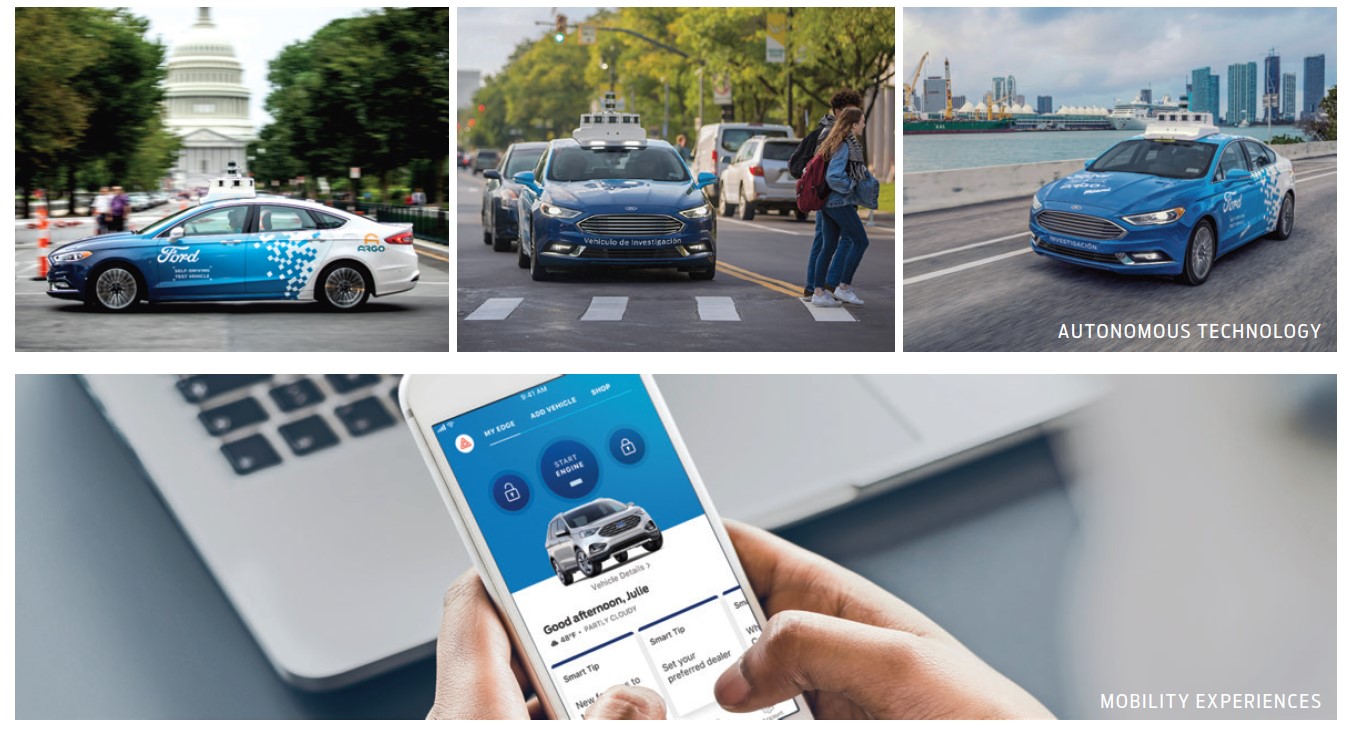
Image Source: Ford Motor Company – 2018 Annual Report
By Callum Turcan
On October 21, Ford Motor Company (F) published a blog post on Medium providing an update on its self-driving ambitions. Jim Farley, who was promoted to president of Ford’s ‘New Businesses, Technology & Strategy’ division effective May 2019 (previously Mr. Farley worked at Ford’s ‘Global Markets’ division), authored the Medium blog post. The company reiterated that the goal was to begin commercializing its autonomous driving investments starting in 2021 via a self-driving service, likely something akin to a fleet of taxi cabs with built-in autonomous driving equipment and software. Self-driving taxi cab services could in theory create substantial recurring revenue streams that are less cyclical than demand for automobiles, allowing for smoother financial performance and more consistent free cash flows at an automaker like Ford.
The Plan
Mr. Farley mentioned that the automaker would spend more than initially planned to prepare its self-driving segment for commercialization, which was originally budgeted a as ~$4 billion investment through 2023. These investments are primarily going towards Ford’s ‘Mobility’ division.
Ford recognizes that it will take time to build up the scale required to earn economic returns on its investment, but Mr. Farley noted spending alone wouldn’t necessarily yield promising results. Potential customers care about the ease of which an autonomous taxi service picks them up, the smoothness of the drive, and how effective the service is at navigating the complexities of urban and suburban roadways. Mr. Farley mentioned in the blog post that suburban markets will be critical for autonomous driving services, more so than Ford had previously expected. Spending more can increase the chances of getting these things right (larger workforce, more resources, etc.), but that will also require those investments to be allocated to the right areas (i.e. spending more on novel pet projects with non-existent commercial or practical uses won’t augment the self-driving service in the eyes of the core future customers).
There are three markets where Ford is actively testing out its self-driving capabilities (referred to as “launch markets” by Mr. Farley): Miami-Dade County in southeastern Florida, Washington D.C, and Austin, Texas. Particularly in Miami-Dade County and the city of Austin, Ford should build up extensive experience figuring out how to navigate the logistical complexities that traversing between urban and suburban markets poses to autonomous driving services. In Washington D.C., it’s likely Ford is attempting to master the urban complexities of self-driving technology.
In order to ensure Ford’s future autonomous driving service is scalable is an economical manner, the company is placing a big focus on the kind of markets that it should cater to in the future. Geofencing will be used to keep self-driving automobiles within range of large demand centers, indicating that the geographical reach of the proposed self-driving services will be somewhat limited, at least initially. However, as most Americans live in urban areas and suburban areas near major urban areas, that should still allow a company like Ford to meet the transportation needs of hundreds of millions of customers in the US (including US residents, tourists, and professionals travelling).
Concluding Thoughts
On Wednesday October 23, Ford plans to release its third-quarter 2019 results after the market closes. We aren’t interested in shares of Ford at present levels as we prefer General Motors Company (GM), which is included in both our Dividend Growth Newsletter and Best Ideas Newsletter portfolios. Please note that General Motors’ self-driving Cruise segment, whose backers include Honda Motor Co (HMC), SoftBank Group (SFTBY), and T. Rowe Price Group (TROW), is one of the best in the business and also has plans to roll out an autonomous taxi cab service in the medium-term.
General Motors plans to publish its third-quarter 2019 earnings before the market opens on Tuesday October 29. Before then, all eyes will be on the upcoming vote over whether General Motors’ UAW workers approve of the four-year compensation and investment commitment deal recently reached between leaders of the UAW and General Motors. Votes will be counted on Friday October 25, but the UAW strike at General Motors’ US factories which is now in its second month is still ongoing. There’s at least a decent chance that the deal will get approved, but nothing’s certain until it’s all said and done.
Our fair value estimate for Ford stands at $10 per share, with shares of F trading near ~$9 as of this writing. Our fair value estimate for General Motors stands at $48 per share, with shares of GM trading near ~$36 as of this writing, a steep discount to their intrinsic value in part a result of concerns over when the UAW strike will end. We’ll keep our members posted on the situation at General Motors as more information becomes available.
Auto Making Industry – F GM HOG HMC TSLA TM
Auto Specialty Retailers Industry – AAP AN AZO CPRT GPC KMX KAR MNRO ORLY PAG
Related: CARZ, ADRA, RXI
—-
Valuentum members have access to our 16-page stock reports, Valuentum Buying Index ratings, Dividend Cushion ratios, fair value estimates and ranges, dividend reports and more. Not a member? Subscribe today. The first 14 days are free.
Callum Turcan does not own shares in any of the securities mentioned above. General Motors Company (GM) is included in Valuentum’s simulated Best Ideas Newsletter portfolio and simulated Dividend Growth Newsletter portfolio. Some of the other companies written about in this article may be included in Valuentum’s simulated newsletter portfolios. Contact Valuentum for more information about its editorial policies.