
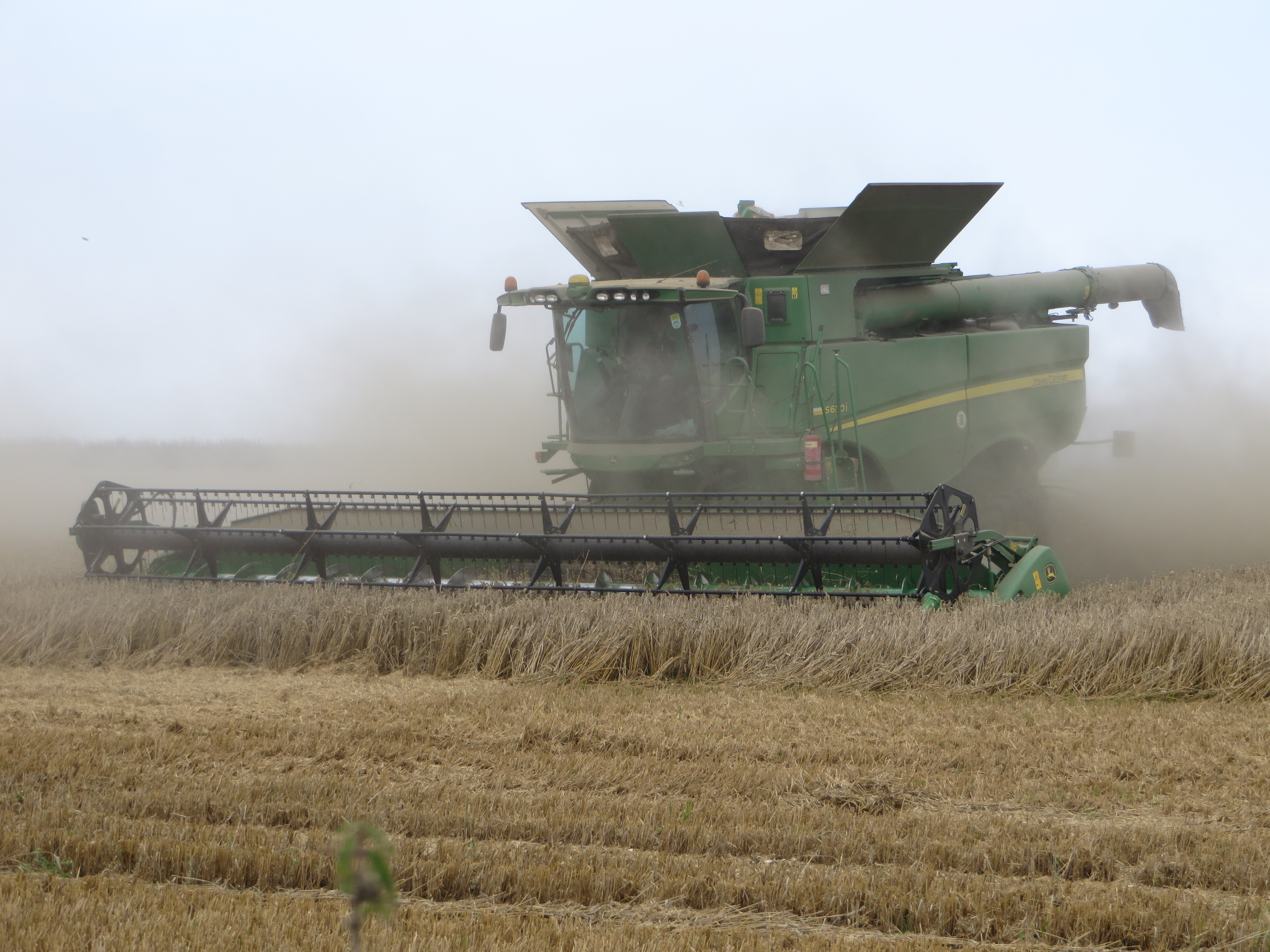
Image Source: David Wright
Deere & Co’s fiscal 2018 fourth quarter report included expectations for the replacement cycle for farm machinery to continue despite global trade tensions and other geopolitical uncertainty. Its equipment operations have performed well of late as it continues to ride a wave of solid demand.
By Kris Rosemann
Ag equipment giant Deere & Company (DE) reported fiscal 2018 fourth quarter earnings November 21, and the company continues to take advantage of the replacement cycle for farm machinery amid global trade tensions and other geopolitical uncertainty. New and innovative products are also helping drive its top line, according to management, and net sales advanced 18% in the fiscal fourth quarter on a year-over-year basis. Equipment net sales in North America leapt 21% from the year-ago period, while international equipment sales grew 13%, and the recent acquisition of Wirtgen also aided in revenue growth.
Operating profit in the quarter advanced nearly 27% on a year-over-year basis thanks to the Wirtgen acquisition, higher shipment volumes, price realization, and lower warranty costs, but higher production costs and R&D spending partially offset these benefits. The company’s equipment operations reported net income growth of roughly 23% from the year-ago period as income tax adjustments related to US tax reform impacted reported income in the quarter.
Cash flow from operations took a notable step back in the full fiscal year as it fell more than 17% to just over $1.8 billion compared to purchases of property and equipment and cost of equipment on operating leases in the period of $896 million and ~$2.1 billion, respectively. When considering the cash flow of Deere’s equipment operations, however, its cash flow profile becomes far more appealing. In the full fiscal year, it generated nearly $2.4 billion in free cash flow on substantially higher cash flow from operations and capital spending compared to that of fiscal 2017. Cash dividends paid in the fiscal year came in at $806 million, and the company repurchased $958 million worth of its shares in the year.
At the end of the fiscal year, Deere held nearly $42.3 billion in total debt compared to roughly $4.4 billion in cash, cash equivalents, and marketable securities. Roughly $36 billion of this debt is attributed to the company’s financial services operations, which is why we calculate an adjusted Dividend Cushion ratio in assessing the sustainability of its dividend via its core operations, but investors should be aware of its exposure to the credit quality of its customers, many of which are heavily tied to cyclical end markets.
Looking ahead to fiscal 2019, Deere expects equipment sales to advance by roughly 7% from fiscal 2018 due in part to Wirtgren being a part of the company’s operations for a full year instead of 10 months as in fiscal 2018, and management expects global agricultural and construction equipment markets to continue growing in the near term. Net income attributable to the company in fiscal 2019 is expected to be roughly $3.6 billion, up from ~$2.4 billion in fiscal 2018.
Deere’s ‘Agriculture & Turf’ business is expected to grow sales by ~3% in fiscal 2019 with replacement demand for large equipment and ongoing demand for small tractors driving agriculture product demand in North America, where ag equipment sales are expected to be flat to up 5% over fiscal 2018 levels. Turf and utility equipment in North America is expected to grow at a similar pace, while South American industry sales of tractors and combines are expected to be flat to up 5% with strength in Brazil a potential driver of growth. Sales to EU member nations are expected to be roughly flat due to drought conditions in key markets, and Asian sales are expected to be flat to down slightly.
In its ‘Construction & Forestry’ segment Deere expects worldwide sales growth of approximately 15% in fiscal 2019, which will be in part due to the aforementioned additional two months of Wirtgren being included in its operations compared to fiscal 2018. The company expects continued growth in US housing demand in addition to transportation investment and global economic growth. Forestry sales are expected to be up ~10% from fiscal 2018 as demand improves around the world, led by the US.
Shares of Deere are trading roughly in line with our fair value estimate of $141 as of this writing, so we’re not rushing to add exposure in either of the simulated newsletter portfolios. The company’s adjusted Dividend Cushion ratio currently sits at 2.7 as its equipment operations have done well in generating solid levels of free cash flow of late, but we must remind investors of the sizable debt brought on by its financial services operations, which exposes it to the credit health of customers that operating in cyclical end markets. We’re not expecting this potential weakness to rear its ugly head in the immediate future, but long-term investors need to be aware of the risk. Shares yield ~1.9% as of this writing.
Agricultural Machinery: AGCO, CAT, CNHI, DE, HEES, MTW, RBA, TEX
—–
Valuentum members have access to our 16-page stock reports, Valuentum Buying Index ratings, Dividend Cushion ratios, fair value estimates and ranges, dividend reports and more. Not a member? Subscribe today. The first 14 days are free.
Kris Rosemann does not own shares in any of the securities mentioned above. Some of the companies written about in this article may be included in Valuentum’s simulated newsletter portfolios. Contact Valuentum for more information about its editorial policies.