
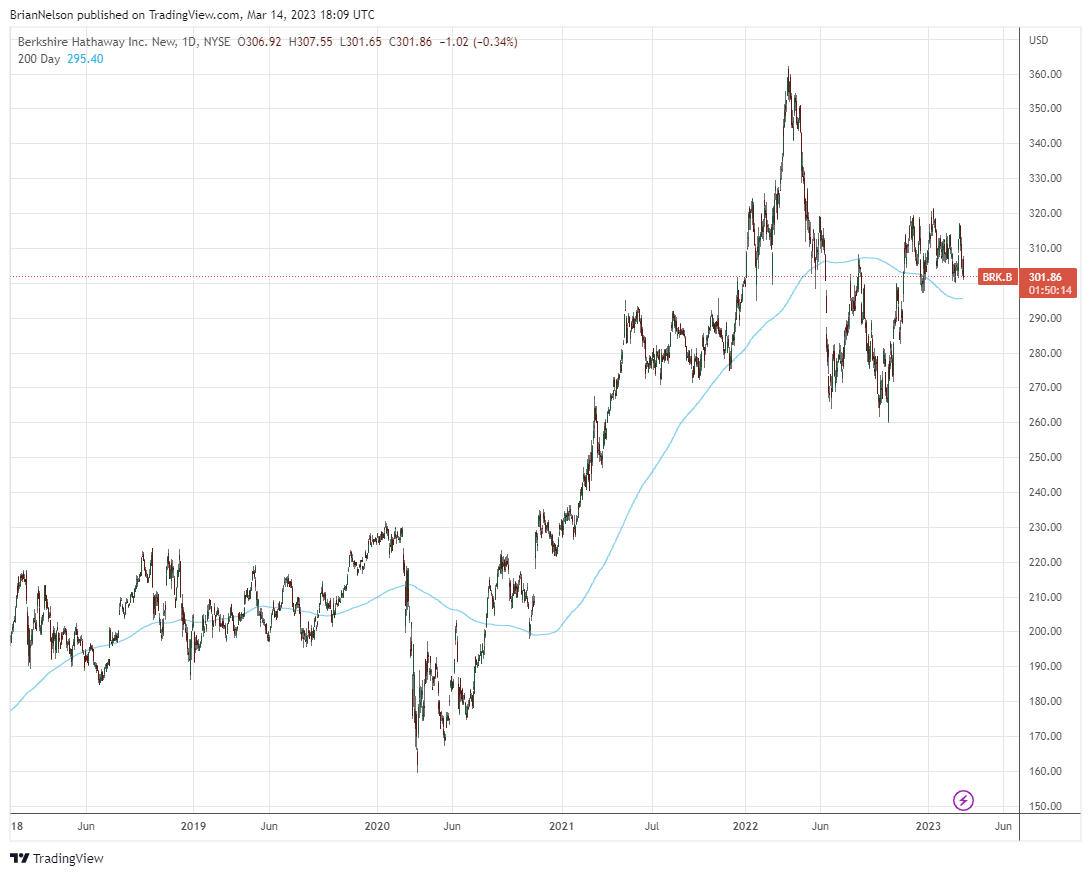
Image: Berkshire Hathaway has held up fairly well following the market rout in 2022. Image Source: TradingView
—
“A very minor gain in per-share intrinsic value took place in 2022 through Berkshire share repurchases as well as similar moves at Apple and American Express, both significant investees of ours. At Berkshire, we directly increased your interest in our unique collection of businesses by repurchasing 1.2% of the company’s outstanding shares. At Apple and Amex, repurchases increased Berkshire’s ownership a bit without any cost to us. The math isn’t complicated: When the share count goes down, your interest in our many businesses goes up. Every small bit helps if repurchases are made at value-accretive prices. Just as surely, when a company overpays for repurchases, the continuing shareholders lose. At such times, gains flow only to the selling shareholders and to the friendly, but expensive, investment banker who recommended the foolish purchases. Gains from value-accretive repurchases, it should be emphasized, benefit all owners – in every respect. Imagine, if you will, three fully-informed shareholders of a local auto dealership, one of whom manages the business. Imagine, further, that one of the passive owners wishes to sell his interest back to the company at a price attractive to the two continuing shareholders. When completed, has this transaction harmed anyone? Is the manager somehow favored over the continuing passive owners? Has the public been hurt? When you are told that all repurchases are harmful to shareholders or to the country, or particularly beneficial to CEOs, you are listening to either an economic illiterate or a silver-tongued demagogue (characters that are not mutually exclusive).” – Berkshire Hathaway 2022 Letter to Berkshire Shareholders
By Brian Nelson, CFA
The 2022 edition of Warren Buffett’s Letter to Berkshire Hathaway (BRK.A) (BRK.B) shareholders was a great read, and the Oracle of Omaha took a jab at politicians that are in favor of banning or taxing buybacks. As Buffett puts it in the above excerpt, share buybacks play an important role in the stock market and can be significantly value-creating for long-term investors. At Valuentum, we love when companies buy back stock at a price below their estimated intrinsic value. After all, this instance is how buybacks are value-creating, per Value Trap:
In most cases where companies have a simple capital structure, an intrinsic value estimate of any operating, non-financial equity is generally calculated as follows: the sum of the discounted future expected enterprise free cash flows to the firm (enterprise cash flow) are added to the company’s current balance-sheet net cash position (or net debt is subtracted), and that sum (or difference) is divided by current shares outstanding. Share buybacks influence the enterprise value equation as follows: shares are reduced by the number of shares repurchased, and cash on the balance sheet is reduced by the aggregate cost of the share repurchase program (price paid per share multiplied by number of shares outstanding), which may influence the capital structure and the estimate of a company’s WACC.
The net impact is either value-creating to the fair value estimate output (it increases it) or value-destroying to the fair value estimate output (it decreases it). It all depends on which change is more powerful. Either the impact of the reduction of the number of shares has a smaller positive impact on the fair value estimate than the negative impact of a reduction in cash on the balance sheet and changes in the WACC, or the impact of the reduction of the number of shares has a greater positive impact on the fair value estimate than negative impact of a reduction in cash on the balance sheet and changes in the WACC. Generally speaking, if share buybacks are completed at a price level that is below an estimate of a company’s intrinsic value, the activity can be considered value-creating. If share buybacks are completed at a price level that is above an estimate of a company’s fair value, they can be considered value-destroying.
Buffett’s shareholder letters are always a refreshing read, a reminder of just how important it is to practice good business principles and to view stocks as pieces of businesses and not pieces of paper. In a world where value investing may be gone forever, as Greenlight Capital (GLRE) founder David Einhorn has said: “Value investing as an industry is dead…The money has moved from value investors to index funds and it’s not coming back,” it becomes even more important to pay attention to the prices you pay for businesses (stocks). After all, if “everyone” is indexing, who’s going to set the right price? One just can’t accept the price as a good one.
We remain huge fans of intrinsic value investing and don’t see much ‘value’ in quantitative value investing. These are two very different things, often misconstrued. When it comes to intrinsic value investing, there are only either undervalued, fairly valued, or overvalued stocks. Undervalued stocks are stocks that are trading at a price far below their estimated intrinsic value. Fairly valued stocks are stocks that are trading about in-line with their fair value estimate (range), while overvalued stocks are stocks that are trading at a price far above their estimated intrinsic value. When it comes to quantitative value investing, value stocks are stocks with low price-to-book ratios, while growth stocks are stocks with high price-to-book ratios, but simple multiple analysis doesn’t tell the full story about valuation, “Brain Teaser – Reflexive versus Reflective.”
We’ve said it before, and we’ll say it again: There are not really growth and value stocks!
Tickerized for BRK.A, BRK.B, GLRE, AAPL, AXP
———-
Brian Nelson owns shares in SPY, SCHG, QQQ, DIA, VOT, BITO, RSP, and IWM. Valuentum owns SPY, SCHG, QQQ, VOO, and DIA. Brian Nelson’s household owns shares in HON, DIS, HAS, NKE, DIA, and RSP. Some of the securities written about in this article may be included in Valuentum’s simulated newsletter portfolios. Contact Valuentum for more information about its editorial policies.
Valuentum members have access to our 16-page stock reports, Valuentum Buying Index ratings, Dividend Cushion ratios, fair value estimates and ranges, dividend reports and more. Not a member? Subscribe today. The first 14 days are free.