
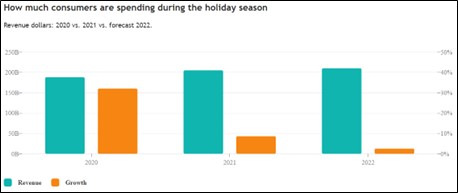
Image: Holiday sales are expected to expand ~2.5% in 2022 over very strong growth in 2021 and 2020. Image Source: Adobe
By Brian Nelson, CFA
Tesla (TSLA) CEO Elon Musk and Apple (AAPL) CEO Tim Cook seemingly have worked out a plan for Apple to keep advertising on the Twitter platform after what looked to be a temporary pause by the iPhone maker. Though the news is immaterial to our thesis on Apple in any respect, it was good to see the two tech giants work whatever differences they had out. Certainly, a fallout between Musk and Cook would not be a good thing for the tech sector and innovation, more broadly, as the two wield large influences across Silicon Valley.
“A River of Blood” in China
During the week of Thanksgiving, reports circulated on social media that Foxconn (HNHPF), a key iPhone supplier was experiencing labor unrest in Zhengzhou, nicknamed “iPhone City,” as workers at the plant protested the country’s zero-COVID-19 regulations, working conditions, as well as bonuses. CNN quoted a Foxconn employee describing the protests as a “river of blood,” as police in hazmat suits reportedly beat the protesters with batons. Foxconn has since worked things out but lingering labor woes cannot be ruled out in the city.
The violent public protests in China are unusual, but perhaps the news regarding supply chain disruptions wasn’t. Earlier in November, Apple had warned that “COVID-19 restrictions have temporarily impacted the primary iPhone 14 Pro and iPhone 14 Pro Max assembly facility located in Zhengzhou, China.” Apple noted, however, that it continues to see “strong demand for iPhone 14 Pro and iPhone 14 Pro Max models,” but that it now expects “lower iPhone 14 Pro and iPhone 14 Pro Max shipments” than previously expected.
The timing is unfortunate given the run-up to the important holiday sales season, but generally, we don’t worry too much about supply issues as supply chain disruptions tend to work themselves out over time (and near-term estimates aren’t terribly material to our valuation assessment). That said, in light of rising U.S.-China geopolitical tensions – given recent export restrictions on semiconductor technology – we can’t rule out intermediate-term supply constraints for Apple’s iPhone even heading into the first half of 2023. We’ll have to see if the supply crunch gives Apple more pricing power, as inventories for the newest version are reportedly growing limited. The longer-term concern, however, remains Apple’s considerable dependence on China.
Our fair value estimate of Apple stands at $168 per share, as most of the contribution to its intrinsic value is based on mid-cycle and long-term operating assumptions, rather than on any temporary disruption in the near term that could cause performance to come up short in any one or two quarters. Said another way, we’re looking past the Zhengzhou news. Still, wait times for the iPhone 14 may now stretch past the new year given shortages, and it remains to be seen whether supply chain disruptions will result in permanently lost demand — estimated in the millions of units, by some — as consumers that may have upgraded their iPhone during this cycle wait for the subsequent version.
Though the news from Zhengzhou has been disturbing, more material to the Apple thesis, in our view, however, is the underlying backdrop for smartphone demand. According to a forecast from International Data Corp (IDC), “shipments of smartphones will decline 9.1% in 2022,” and only bounce back 2.8% in 2023. IDC notes that “rising costs are an obvious concern for the smartphone market and adjacent consumer technology categories.” Worldwide smartphone growth is only expected to compound by ~0.5% per annum through 2026, according to IDC. The data company did indicate that “smartphone ASPs (average selling prices) are expected to grow for the third consecutive year as average selling prices will reach $413, up 6.4% from $388 in 2021.”
Holiday Sales Numbers Look Solid So Far
According to Tech Crunch citing numbers from Adobe Analytics, Cyber Monday brought in a record $11.3 billion in sales, up 5.8% from the same level in 2021. Adobe reported that Thanksgiving and Black Friday brought in sales of $5.3 billion and $9.12 billion, respectively, and these numbers were quite healthy, too. Adobe’s estimates for collective sales in October and November of 2022 are at $210.1 billion, representing about 2.5% growth from 2021, which comped 2020 levels at an 8.6% clip. Discounts reportedly played a huge role in driving sales this holiday season, especially for electronics and toys, so growth wasn’t necessarily inflation-driven as many might have expected.
A prior warning about holiday sales from Target Corp. (TGT) also appears to be overblown given the sales strength witnessed during Black Friday and Cyber Monday. Tech Crunch reported that “top products included games, gaming consoles – Switch, Xbox, PlayStation — Legos, Hatchimals, Disney (DIS) Encanto, Pokemon cards, Bluey, Dyson products, strollers, Apple Watches, drones and digital cameras.” Other hot products of 2022 reported by Adobe include Roblox (RBLX), God of War Ragnarok, Paw Patrol, Instapots, Call of Duty: Modern Warfare II, Drones, Hot Wheels, and Madden 23. Amazon (AMZN) noted that a few holiday favorites have been Echo Dot, Fire TV Stick, and Airpods.
Macbooks were noted to be a big sales item on Black Friday from Adobe Analytics, and while we’ve grown more concerned about personal computer (PC) demand, that tidbit of information was an encouraging sign for broader PC industry demand resilience, in part for the likes of Xbox-maker Microsoft (MSFT), and by extension, AMD (AMD). We continue to be cautious on the semiconductor supply chain, regardless, however, and our newsletter portfolios continue to be defensive heading into 2023. Though it may be too early to say that the markets have bottomed, holiday sales so far in 2022 and an overall resilient job market are giving investors something to cheer about in an otherwise loathsome year.
Tickerized for AAPL, HNHPF, FXI, KWEB, CQQQ, MCHI, ASHR, YINN, TDF, CHIQ, GXC, EWH, KBA, YANG, CXSE, CAF, CWEB, PGJ, KURE, CHIX, CYB, DELL, LOGI, SSNLF, SONY, GLW, HPQ, QCOM, TSM, SWKS, QRVO, AMD, NVDA, TXN, INTC, HAS, MAT, DIS, FNKO, TGT, NTDOY, NTDOF, RBLX, MSFT, EA, ATVI, HBI, AMZN, among various others consumer-related stocks.
———————————————
About Our Name
But how, you will ask, does one decide what [stocks are] “attractive”? Most analysts feel they must choose between two approaches customarily thought to be in opposition: “value” and “growth,”…We view that as fuzzy thinking…Growth is always a component of value [and] the very term “value investing” is redundant.
— Warren Buffett, Berkshire Hathaway annual report, 1992
At Valuentum, we take Buffett’s thoughts one step further. We think the best opportunities arise from an understanding of a variety of investing disciplines in order to identify the most attractive stocks at any given time. Valuentum therefore analyzes each stock across a wide spectrum of philosophies, from deep value through momentum investing. And a combination of the two approaches found on each side of the spectrum (value/momentum) in a name couldn’t be more representative of what our analysts do here; hence, we’re called Valuentum.
———————————————
Brian Nelson owns shares in SPY, SCHG, QQQ, DIA, VOT, BITO, and IWM. Valuentum owns SPY, SCHG, QQQ, VOO, and DIA. Brian Nelson’s household owns shares in HON, DIS, HAS, NKE, RSP. Some of the other securities written about in this article may be included in Valuentum’s simulated newsletter portfolios. Contact Valuentum for more information about its editorial policies.
Valuentum members have access to our 16-page stock reports, Valuentum Buying Index ratings, Dividend Cushion ratios, fair value estimates and ranges, dividend reports and more. Not a member? Subscribe today. The first 14 days are free.