
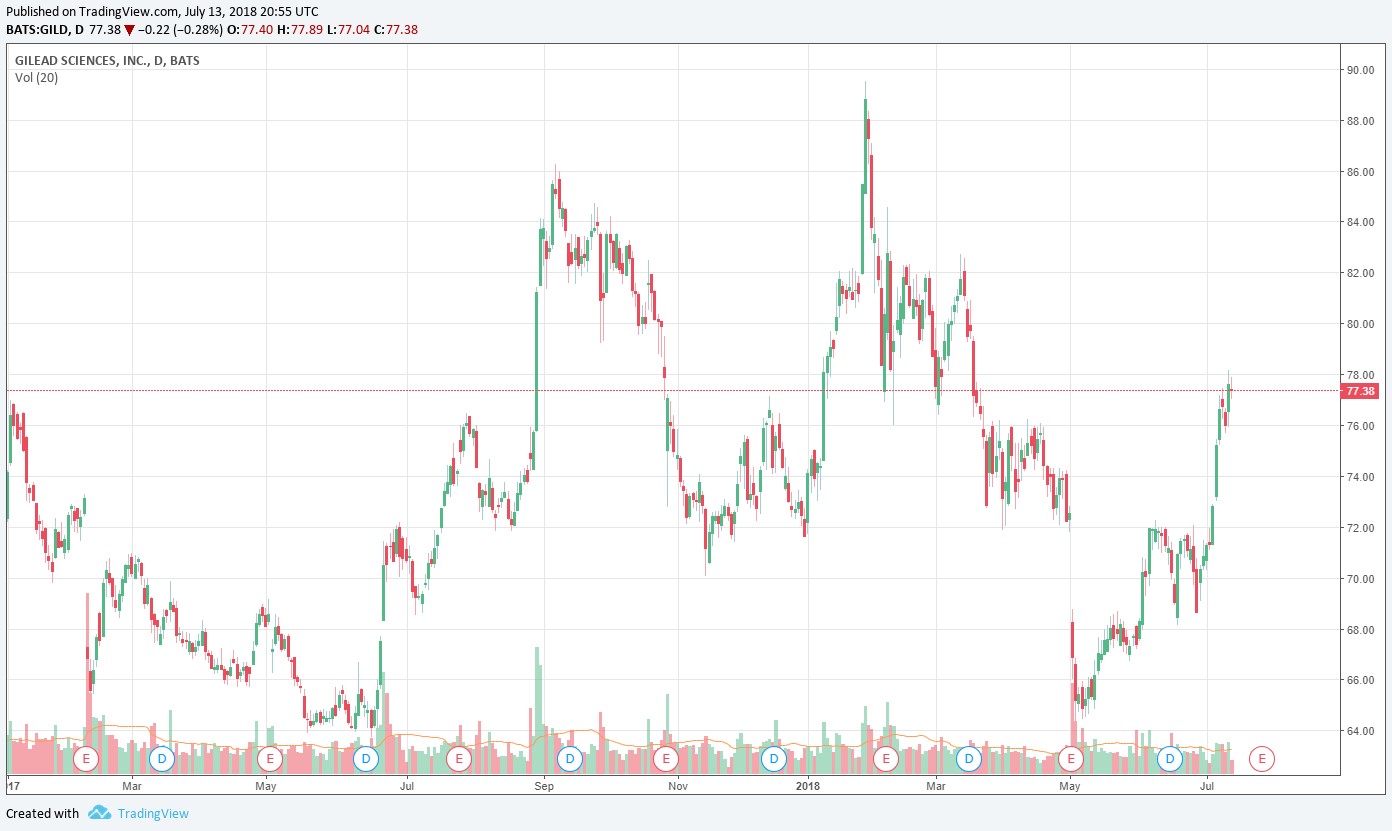
We think the risk-reward at Gilead remains positively skewed in investors’ favor, but let’s examine the downside case for Gilead Sciences so there are no surprises. It’s always a good approach to evaluate where an investor may go wrong with an investment idea, and assessing upside and downside cases, as in a fair value range, remains par for the course.
By Alexander J. Poulos
Key Takeaways
We wanted to highlight a few key points on what could go wrong on our bullish thesis on Gilead Sciences.
We believe the HCV market is stabilizing with Gilead on track to meet its dramatically-reduced revenue forecast.
Biktarvy–Gilead’s next-gen HIV product–is poised to steal significant market share.
Yescarta, the recently-acquired CAR-T treatment, should generate the lion’s share of revenue in this segment, as the product, in our view, remains the most efficacious one, but its side-effect profile is less than ideal.
Gilead needs Yescarta to become a blockbuster product to offset the loss of HCV revenue. Any disruption to this part of our thesis would have negative implications on Gilead’s intrinsic value and share price.
We value Gilead in the high-$90s per share at the time of this writing, with downside risk to the low-$70s and upside potential to $120+ per share as a reasonable range of fair value outcomes.
Downside Case #1 – HCV Revenue Cliff Accelerates
The Hepatitis C franchise, which vaunted Gilead Sciences (GILD) squarely into the fray concerning excessive drug prices, continues to bleed market share in large part due to the curative nature of the product. Once the 8-12-week course of therapy is complete, the patient is considered “cured,” thus depriving Gilead of a rich source of recurring revenue. The decline in the HCV franchise has now hastened with the competitive entry of Mavyret, which continues to steal market share thanks in large part to its shorter course of overall therapy.
We have written many pieces regarding the fading nature of HCV revenue at Gilead, but it seems as though the share price of Gilead remains highly sensitive to the erosion of the HCV market for now. In the first quarter of 2018, HCV revenue came in at $1.046 billion for an annual run rate of $4.184 billion, on pace to be significantly better than magnitude of the drop expected by management. Let’s keep in mind, too, that the HCV franchise generated $9.137 billion in sales for calendar year 2017, with peak sales occurring in the second quarter and a sharp decrease in the fourth quarter, as governmental budgets earmarked for HCV treatment were exhausted earlier than expected.
Thus far for the second quarter from the prescription data we track, the HCV franchise seems to be leveling off, but we are not privy to institutional numbers such as prescription trends in the VA, which may mask the overall trend. The fear is that Mavyret will steal additional market share above what we are currently forecasting as a decline, leaving Gilead an even deeper revenue cliff. We’re monitoring the HCV decline closely, but its fade seems to be coming in better than expectations.
Downside Case #2 – The HIV Market does not evolve as Expected.
Prior to the HCV franchise, Gilead rose to prominence thanks to a tremendous amount of innovation that sprung forth from its clinical labs in the field of infectious disease, namely the treatment of HIV. Gilead retains its leadership position in HIV with a host of new innovative products, the most notable is the recent approval of Biktarvy, which contains the new unboosted integrase inhibitor Bictegravir along with the components of already marketed top-selling treatment Descovy to form this powerful new treatment.
The goal at Gilead is to design a novel new product that is more resistant to the virus while maintaining a favorable side-effect profile. To do so, Gilead is engaging in a bit of creative destruction that is normally witnessed in the high-tech field as Gilead consistently works to disrupt its leading treatments in order to improve patient outcomes. The continuous level of innovation has allowed the company to maintain nearly 75% market share in the HIV space thanks to the sudden boost in prescriptions written for Bictegravir.
Gilead’s primary rival remains GlaxoSmithKline (GSK) with its new treatment Juluca, which it hopes will allow it to steal market share. Juluca remains at a competitive disadvantage as most clinicians fear the doublet design (combo of two products) opens the door for potential resistance, which would not be met kindly by the HIV community. GSK has its work cut out for it with recent data providing little evidence to quell the fears of potential resistance. In our view, the greatest downside risk for Gilead in this area is if GSK can produce conclusive clinical data to allay the fears of resistance, opening the door for GSK to steal share. The HIV franchise is critical for Gilead as it remains an area of growth versus the decline in HCV, even though the HCV franchise seemingly continues to draw the bulk of the market’s attention.
Downside Risk Number #3 – Yescarta fails to Gain Traction
The Oncology space remains an area of intense focus with the recent CAR-T treatments offering a substantial advance in a host of cancers, which were once through to have a dismal prognosis. Thanks in large part to a wide swath of stellar data provided by the three main players–Novartis (NVS), Kite Pharma, a division of Gilead Sciences, and Juno Therapeutics, a division of Celgene (CELG)–we can gain a handle on the prospects of each as they enter the highly-innovative yet expensive treatment paradigm.
Based on published data at the time this article was composed, the most effective treatment remains Kite’s Yescarta, though the instance of Cytokine Release Syndrome (CRS) remains the treatment’s Achilles heel. Juno’s CAR-T, which remains the third horse in the race, has the most benign side-effect profile, but the overall response rate is nowhere near as robust, which in our view, will galvanize clinicians to opt for Yescarta, as it offers patients the best chance for survival, in our view. We are heartened by additional studies focusing on the way Yescarta is infused to help mitigate CRS, but we can’t help but caution if a new entrant emerges with a cleaner side-effect profile. Yescarta’s market share may evaporate rapidly in such a case.
We remain in the initial stages of the roll out of these products as Gilead looks to build up its network of treatment facilities along with lining up reimbursement for the treatment. We feel the product will ramp rather quickly, more-than-likely in the fourth quarter of 2018 at the earliest. We anxiously await for additional color in the upcoming call to gauge the level of progress in the rollout of Yescarta, but investors should be aware of downside risks.
Downside Risk #4 – The pipeline does not produce any near-term hits
A portion (a slice of the Stage II value and the perpetuity value) of our fair value estimate encompasses the value of the clinical pipeline. We factor in the potential of the near-term pipeline within discounted cash-flow models, but any value in the latter phases of stage II or in the perpetuity is largely attributable to the pipeline, almost by definition given existing patent life cycles. Said differently, within our valuation model, we assume Gilead will continue to develop a lasting portfolio of effective therapies.
In the case of Gilead, more specifically, there is another product we remain positive on–the JAK-1 inhibitor Filgotinib. Gilead stepped in when AbbVie (ABBV) decided to develop its internal candidate with a cash infusion, allowing the product to continue full clinical development. Thus far, we have reviewed the phase 2/3 clinical data and have come away very impressed, though risks remain, of course. We feel Gilead may have the best-in-class molecule thanks to Filgotinib’s high selectivity, which helps mitigate the potential for hematological disturbances, most notably blood clots.
We feel the combination of Yescarta and Filgotinib for inflammatory disease would serve as a bookend for the stellar HIV franchise, thus allowing Gilead to return to top-line growth. An unforeseen clinical misadventure such as a large swath of clinical deaths would torpedo the product, however, thus depriving Gilead of a key avenue of growth. Importantly, readers must understand that, for most pharma/biotechs, we are modeling them as going-concerns, meaning that we are assuming commercialized success beyond its existing product line-up.
Valuation
Our current fair value estimate for Gilead Sciences is $98 per share with a range of $74-$123, accounting for some of the risks outlined in this note. Gilead is trading towards the bottom end of our fair value estimate band as a great deal of skepticism is built into the share price, likely in large part due to many having been “burned” by the name in the past, as Gilead was a market darling a few years back.
Gilead remains exposed to the dynamics of the HCV market, which continues to roil the equity, but we feel HCV will become less important as time goes on, especially once Yescarta begins to ramp. We would like to emphasize, however, that, while we believe Yescarta is a revolutionary treatment, if Gilead is unable to duplicate the results in additional forms of cancer, it will limit the upside of the product, perhaps making the high end of our fair value estimate out of reach.
Yescarta and Biktarvy are the two most important assets in Gilead’s arsenal, and any sort of setback with either product would have a severely direct impact on the share price, ultimately leading to market price weakness–arguably well below the bottom end of our fair value estimate range. We are not accounting for a “doomsday” scenario in our base-case point fair value estimate, nor is one captured in our range of fair value estimate outcomes.
—–
Valuentum members have access to our 16-page stock reports, Valuentum Buying Index ratings, Dividend Cushion ratios, fair value estimates and ranges, dividend reports and more. Not a member? Subscribe today. The first 14 days are free.
Heathcare and biotech contributor Alexander J. Poulos is long Gilead Sciences. Some of the companies written about in this article may be included in Valuentum’s simulated newsletter portfolios. Contact Valuentum for more information about its editorial policies.