
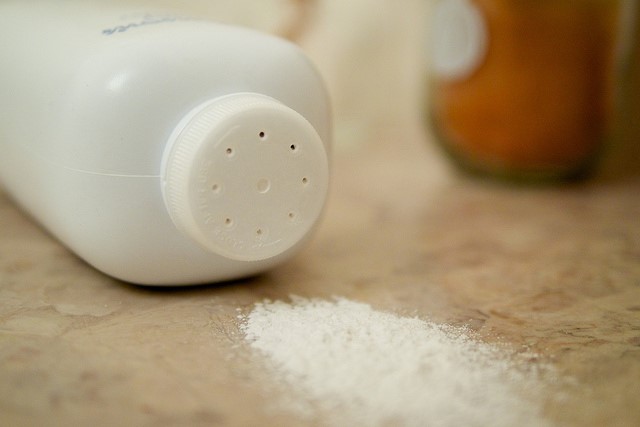
Image Source: Austin Kirk
This article was previously published June 6, 2018.
Let’s talk about how to think about the impact of one-time events on intrinsic value estimates. The magnitude of damages against J&J with respect to its talcum-powder products could be large, but we think the market has slowly factored in the risk of legal liabilities. Once J&J puts these troubles behind it, we think the market may once again warm up to the equity. Shares are trading at only a modest discount to our intrinsic value estimate, however.
By Brian Nelson, CFA
A member of ours passed along a number of articles discussing litigation risk at Johnson & Johnson (JNJ) with respect to the company’s talcum powder products, primarily JOHNSON’S Baby Powder. You can view those articles here, here, here and here. It’s always very sad to hear of cases of cancer caused by anything, and it would be premature for us to gauge with certainty the magnitude of potential legal liabilities that J&J may encounter. To put it bluntly, it’s unknowable at this time. According to Mesothelioma.com, there are ~6,600 talc-related claims against the pharma and consumer-products giant (~6,610 according to J&J’s latest 10-K).
Legal liabilities are a big risk for any company, big or small, and J&J is no exception. Johnson & Johnson maintains that its talcum powder products have been asbestos-free for decades, and while talcum powder products that contain asbestos are believed to be carcinogenic by the International Agency for Research on Cancer (IARC), it’s unclear whether inhaled talc (not containing asbestos) could lead to lung cancer, or if talc-based baby powder (not containing asbestos) for genital use is carcinogenic. The American Cancer Society may say it best: “The evidence about asbestos-free talc, which is still widely used, is less clear.”
Whether J&J’s talcum-powder products contained asbestos and whether talc not containing asbestos causes cancer are two big questions on the minds of Johnson & Johnson investors. Though it’s nearly impossible to answer these questions, and if both are yes, how much J&J would be at fault and the magnitude of damages, we can probably attach a contingent liability figure to it, even if it may be nothing more than an educated guess. Complicating matters is that the magnitude of damages per case have been all over the place–a couple million in some cases, for example, and as much as $417 million in another case in August 2017, a verdict that was subsequently tossed out. J&J is vigorously defending itself against all claims, winning in some trials and getting other verdicts thrown out or reduced, further complicating the analysis.
We simply cannot handicap the outcome of thousands of jury trials, but we think if J&J is found liable for damages, it’s likely it may amount to a few million dollars in each case, on average. The range of outcomes, however, is still rather large. In a verdict in April and another in May, damages were pegged at $37 million and ~$22 million, respectively. Just for perspective, and just to give an idea of how to think about one-time legal settlements in the context of equity valuation, let’s throw out a few numbers. If we assume J&J loses half of its cases, but it is able to reduce the verdicts for the cases it loses to an average ~$5 million settlement, J&J could be on the hook for $16.5 billion (3,300 cases x $5 million). If we assume J&J loses all its outstanding cases at ~$10 million per settlement, on average, the company could be on the hook for $66 billion (6,600 cases x $10 million).
J&J’s market capitalization is ~$330 billion at the time of this writing, so we’re talking about a 5% baseline one-time impact to equity value under the first scenario and a 20% impact in the more-punitive latter scenario. It’s probably most likely that any legal fees end up somewhere between these two numbers ($16.5-$60 billion), but again, the answer is unknowable at this time, and only presented if we had to peg an estimate. J&J’s share price has fallen 15%-20% since the peak in early January this year, and while broader market concerns aided in the weakness, to a large degree, we think risks related to talcum powder products are already largely factored in, under the two reasonable base-case scenarios we’ve outlined.
It’s important to differentiate one-time legal exposure such as talcum product liability from events that permanently increase continuing operating expenses, the latter having cascading implications on the company’s value into perpetuity. Said another way, one-time impacts are generally one-for-one reductions to the company’s equity value and are different than increased operating expenses, which can have a greater impact by reducing forward-looking free cash flows for years and years into the future. It’s certainly not a good situation for J&J to be in, but its legal exposure to claims regarding its talcum powder products, including potential securities class action lawsuits, appear to be manageable.
This article was previously published June 6, 2018.
—–
Valuentum members have access to our 16-page stock reports, Valuentum Buying Index ratings, Dividend Cushion ratios, fair value estimates and ranges, dividend reports and more. Not a member? Subscribe today. The first 14 days are free.
Brian Nelson does not own shares in any of the securities mentioned above. Some of the companies written about in this article may be included in Valuentum’s simulated newsletter portfolios. Contact Valuentum for more information about its editorial policies.