
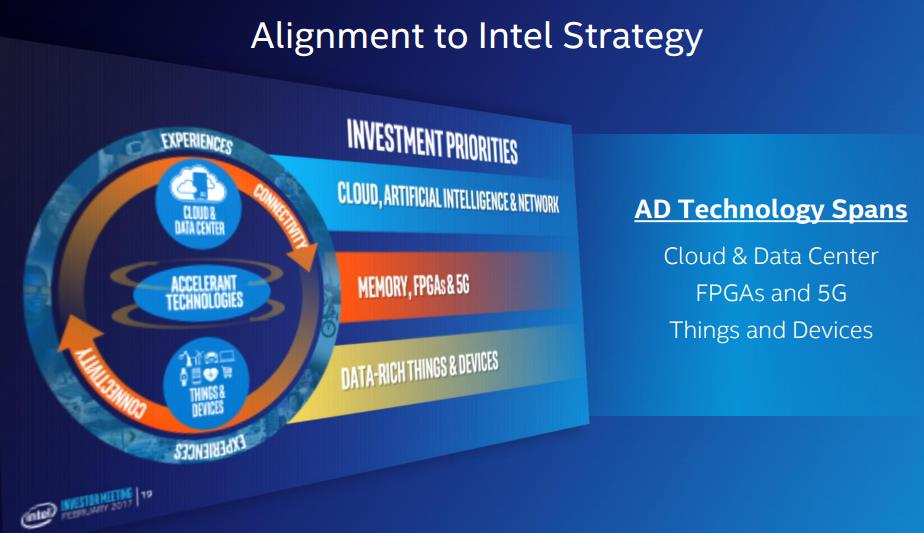
Image Source: Intel
Newsletter portfolio holding Intel has agreed to acquire Mobileye, a leading provider for computer vision for Advanced Driver Assistance Systems (ADAS), for $15.3 billion in cash.
“…we like what the deal brings for Intel. The company has effectively cut ties with its history as a PC chip behemoth, and is driving ahead full force into the broader connected devices market. The acquisition puts Intel at the forefront of the autonomous driving market, and its ownership of end-to-end solutions in the space not only gives it competitive advantages in the driverless car market, but also in the adjacent data center market.” — Kris Rosemann
By Kris Rosemann
Fresh off of a fourth quarter that its CEO called “a terrific finish to a record-setting and transformative year for Intel,” newsletter portfolio holding and chip giant Intel (INTC) has announced an agreement to acquire Mobileye (MBLY), a leading provider in computer vision for Advanced Driver Assistance Systems (ADAS), for $15.3 billion. The deal brings Mobileye’s computer vision expertise (the eyes of the vehicle) to Intel’s high-performance computing and connectivity expertise (the intelligent brain of the vehicle) to create end-to-end automated driving solutions from the cloud to the car. Mobileye holds ~70% share in the global driver-assistance and anti-collision systems market.
Intel projects the in-car automated driving market, made up of systems, data, and services, will grow to ~$70 billion by 2030, with another ~$40 billion in the adjacent data center market. According to Intel CEO Bryan Kraznich, one autonomous car will put out the data equivalent of roughly 3,000 people, or four terabytes per day, which will require the cost-effective, high-performance solutions Intel is targeting with its purchase of Mobileye.
The expectation for such a massive amount of data to come from this market is a core piece in Intel’s rationale in this acquisition, but perhaps the most important question for the long-term success of this deal may not be answered for some time as the industry continues to evolve as it grows rapidly. For one, who will own those massive troves of data, which will enable companies to better understand how to improve the driving experience and learn what consumers demand from their transportation products and services? Automakers will be looking to avoid the fate of hardware makers in the shrinking PC market, and access to data from increasingly-connected vehicles would be a great way to help steer clear of such an outcome. A battle for control may be on the horizon.
The Intel-Mobileye combination is already working together with BMW (BMWYY) on a project that is expected to deliver approximately 40 self-driving test vehicles in the back half of 2017, and the two firms have a partnership to create Mobileye’s fifth generation of chips to be used in fully autonomous vehicles with a projected completion date of 2021. The acquisition would create the most complete compilation of driverless vehicle solutions in one product portfolio, from cameras to machine learning and cloud software to data centers necessary to store the tremendous amount of data involved.
Though the autonomous driving industry may still be several years away from becoming mainstream, the revolution continues to gather steam, and Intel throwing the weight of its resources behind what we previously viewed as a speculative idea in Mobileye confirms that trend. The state of California will be the first to allow self-driving cars to be tested without a human backup driver in the vehicle, which could begin later this year. Included in the companies that are licensed to test such cars in California is BMW.
Intel expects the deal to be accretive to non-GAAP earnings per share and free cash flow immediately after closing, expected before the end of 2017. We like Mobileye’s free cash flow generating ability, made possible by its capital-light business model, and its balance sheet is flush with cash and no debt, features that bode well for income-oriented investors holding Intel. Annual cost synergies are being targeted at ~$195 million by 2019.
Intel plans to use offshore cash held on its balance sheet to finance the deal, which will result in the firm holding a far more significant net debt position than what it had on the books at the end of 2016. However, the chip giant’s strong free cash flow generating ability gives us confidence in the ongoing strength of its dividend payout, despite the deal making. Even assuming a net debt position of $20+ billion, a conservative estimate in this instance, would result in a Dividend Cushion ratio of roughly 1.6, a solid level for a company with a dividend yield of 2.9%. At any rate, we will be closely monitoring the integration process and potential future deal activity as they relate to the health of the payout.
Though we have reasonable confidence in Intel’s dividend strength following the deal, the level of value creation in the deal is more convoluted. From our estimates, a deal price of $15.3 billion implies Mobileye’s free cash flow stream will grow by more than 8% per year from a base of just over $150 million in 2016 for many, many years to come. Such a level of growth is achievable in the fast-growing autonomous driving industry, but it won’t be easy. Competition is only beginning to heat up, and obsolescence risk is as present as in any other emerging technology market. Cost synergies will certainly help, and recent growth at the standalone Mobileye, one with far fewer resources and scale benefits, has been impressive–free cash flow has roughly tripled from just over $50 million in 2014. The potential for material value creation is present, but integration and execution risks are equally prevalent.
All things considered, we like what the deal brings for Intel. The company has effectively cut ties with its history as a PC chip behemoth, and is driving ahead full force into the broader connected devices market. The acquisition puts Intel at the forefront of the autonomous driving market, and its ownership of end-to-end solutions in the space not only gives it competitive advantages in the driverless car market, but also in the adjacent data center market. If the firm is able to take ownership of the data extracted from the vehicles and potentially stored in its data centers in addition to executing its integration and strategic plans effectively, the deal looks to have home run potential.
Related Companies: GOOG, GOOGL, DLPH, NSANY, BSWQY