
Many seeking ideas to generate dividend income may be drawn to slow-growing entities with large dividend yields. However, without proper examination of the balance sheet and competitive position, an investor may enter a position banking on a steady dividend stream only to be caught by a sudden cut in the dividend. It is growing increasingly likely that GlaxoSmithKline may be ready to sacrifice the dividend on the altar in the name of additional M&A, in our view.
By Alexander J. Poulos
GSK Overview
GlaxoSmithKline (GSK) remains a venerable European entity with a number of business lines similar to its US rivals such as Pfizer (PFE). At GSK’s core is its heavy reliance on research to bring forth additional novel branded treatments. We tend to group the research-based entities such as GSK into areas where they have a dominant franchise. In GSK’s case, this would amount to its Respiratory and HIV franchises. Let’s examine the unique aspects of each franchise to gain further insight into its growth prospects.
Respiratory Franchise
GSK remains a leader in the respiratory space due to its reliance on Advair for the treatment of asthma. The challenge that faces all research-based entities is the loss of patent exclusivity–the loss of protection is what fuels the need for constant innovation to the benefit of patients. GSK is not immune to the industry patent challenge as Advair’s patent protection has lapsed–in our view due to the difficulty in replicating the dispensing mechanism a generic challenger has yet to emerge–a temporary phenomena.
We were struck on the recent conference call by CEO Emma Walmsley’s forecast of a 15-20% worldwide decline in sales of Advair for 2017 even though a generic competitor in the US has not emerged. In the third quarter of 2017, the overall respiratory franchise posted flat revenue performance on a constant-exchange-rate basis thanks in large part to the continued growth of Breo, Anoro and the introduction of Nucala. We had been optimistic the bulk of the decline was behind the franchise but by Walmsley’s admission, it seems we have not seen the bottom yet.
HIV Franchise
The HIV franchise continues to perform admirably with a stellar jump of 13% on a constant currency basis in the third quarter fueled in large part to the growth of Tivicay and Triumeq as GSK attempts to gain ground on its primary rival Gilead Sciences (GILD). Just when things are beginning to look up, however, a further review of the numbers paints a far different picture as nearly 40% of the Tivicay Rx’s may be at risk as they are prescribed with Gilead’s Descovy, thus generating two co-payments.
The fear is that once Bictegavir gains approval in mid-February, prescribers will switch patients off the Descovy-Tivicay combo onto the Bictegavir-Descovy single dose product. The new single dose product would only generate a monthly co-payment versus the two co-payments for the current Descovy-Tivicay regiment, thus adding compliance while saving the patient some money.
We feel the growth of the HIV franchise may be at risk once Gilead launches its next-generation product containing Bictegavir. GSK is attempting to stave off the competition with its doublet Juluca which combines GSK’s Tivicay and Johnson and Johnson’s (JNJ) Endurant into a single once-a-day dosage, but we believe there is nothing new, whereas Gilead is coming to market with a novel market that is poised to steal share.
Vaccines
To GSK’s credit, it has built a formidable vaccine franchise through internal development and timely exchange of assets with Novartis (NVS). Our issue with the franchise is the initial decision to swap oncology assets with Novartis to gain vaccine assets only to pivot, and now state Oncology is an area of focus. We are amazed at the disjointed effort at GSK which culminated with the “retirement” of Andrew Witty in March of 2017.
The Vaccine division remains GSK’s fastest-growing segment posting a 5% revenue growth at a constant currency rate for the nine months ending September 2017. Further parsing of the data reveals a slowdown in the group’s growth to a flat year over year figure in the third quarter of 2017—we suspect the stockpiling of vaccine by the US CDC may have led to an unsustained advance.
GSK hopes to revive the fortunes of the vaccine division with its breakthrough vaccine for Shingles. We are impressed with the initial data read and expect Shingrix to gain favor over Merck’s (MRK) Zostavax rapidly. We view the vaccine business as a complementary business but it is not able to steer the giant ship that is GSK by itself. For this to occur, additional breakthrough treatments in the pharmaceutical division will need to be brought to market.
Consumer Health Division
CEO Walmsley’s background as the head of the Consumer Health Division before ascending to the role of CEO, in our opinion, will allow this Division to become a priority for additional resources. We suspect Walmsey may look to radically transform GSK to a more consumer-oriented company with a few key acquisitions.
The primary acquisition we suspect the company will undertake is the acquisition of Novartis’ portion of the current consumer healthcare JV venture. Walmsley was in charge upon the consummation of the venture. She is intimately aware of the results, and we suspect she remains very inclined to bring it entirely into the fold for GSK.
The second potential acquisition revolves around Pfizer’s mention of its willingness to explore options for its consumer health division, which contains such well-known brands as Advil under its corporate umbrella. We think GSK would be a very-willing buyer but such audaciousness carries a very heavy price.
To fund such a lavish slate of acquisitions, GSK would need to leverage up its balance sheet further which, in our view, would place the dividend into further danger. Walmsley did not win any fans from the dividend growth crowd with her commentary of a flat dividend for 2017 and 2018. For US-based investors the actual dividend received will be lower than last year due to the weakening of the British Pound.
The Dividend
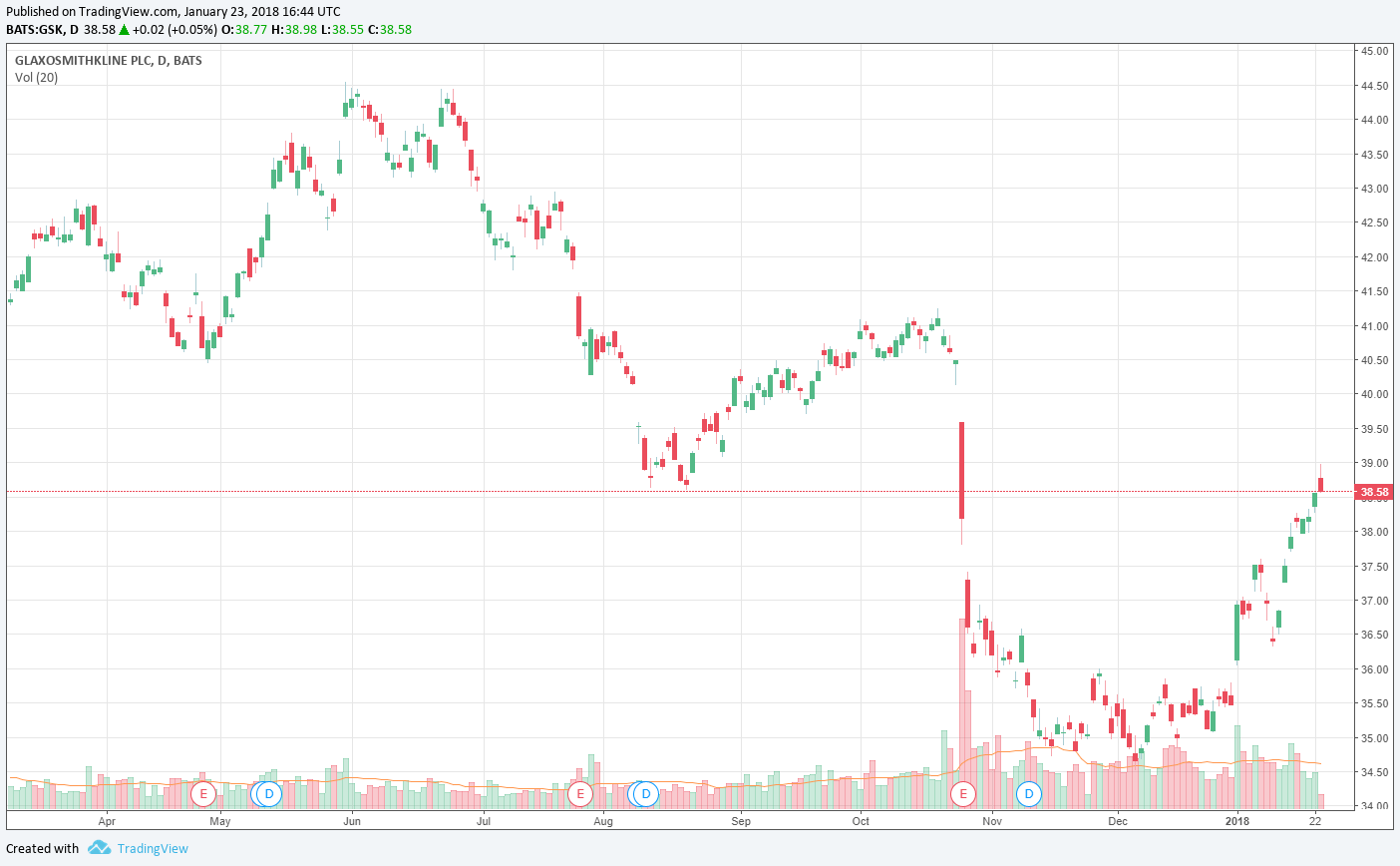
The role of the dividend plays an increasingly important role for those investing in GSK. The past few years have not been kind as the equity has managed to lose ground since peaking in the $50 range at the beginning of 2014. At the current quote of $37 per share at the time of this writing, GSK is trading at a level last seen in early 2011.
GSK is not faced with an unenviable decision—does it attempt to jumpstart growth by bulking up the consumer health division while allowing ample time for the clinical pipeline to develop? The choice seems clear-cut but overlay the increase in leverage, and interest payments will constrain GSK’s ability to continue to pay its dividend, and the quandary becomes readily apparent. In our view, the choice is clear–shave the dividend to a more-manageable level and reset the company to become a viable competitor going forward. The fear of a dividend cut was the highlight of the Q&A session post the recent earnings release.
Conclusion
We feel there are far better opportunities in the market from a capital gain and income producing perspective than GSK. Until we have a definitive handle on the impact of Gilead’s launch in the first quarter of 2018 of a competing product coupled with the timing of a generic Advair entry into the US market, we maintain very cautious on GSK’s fundamentals at this time. As part of our overall view of the US tax law change, we feel it will unleash a torrent of M&A activity, and we would not be surprised if GSK makes one or two acquisitions in consumer health, thus further constraining the balance sheet and placing the dividend at risk. Buyer beware.
Independent Contributor Alexander J. Poulos is long Gilead Sciences.