
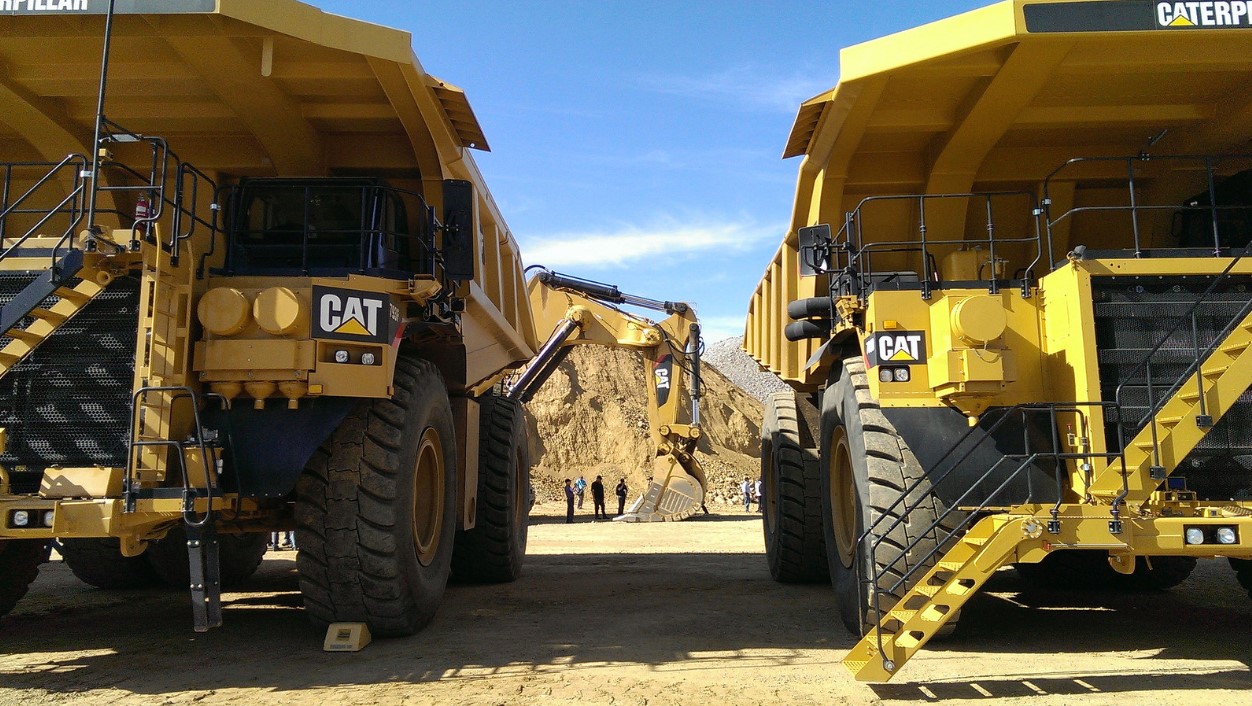
Image Source: Mining.com
Heavy equipment giant Caterpillar saw its share price drop significantly following its fourth quarter report January 28 as it reported disappointing bottom-line results for the quarter and announced expectations for softness in China.
By Kris Rosemann
Concerns regarding macroeconomic uncertainty and the impact of the ongoing trade dispute between the US and China have dominated headlines of late, and these areas, as expressed through notable company outlooks, will remain in focus throughout this earnings season. Caterpillar’s (CAT) fourth quarter report, released January 28, was no exception as its comment on the recent demand environment and forward-looking expectations were closely dissected. The market was significantly disappointed with what it found, particularly as it relates to the company’s operating margin and what it expects to see in China (FXI), which accounts for 5%-10% of its annual sales and revenues in a given year.
Sales and revenues in Caterpillar’s fourth quarter rose 11% on a year-over-year basis, with increases across all regions and all three major segments, and key drivers included higher demand for ‘Resource Industries’ machines, higher sales of construction equipment in North America, and higher demand for reciprocating engines, which support well servicing and gas compression applications, in North America. However, sales in the ‘Construction Industries’ segment in China declined from the year-ago period as a result of an unusual comparable segment in 2017.
Higher than expected material and freight costs weighed on Caterpillar’s fourth quarter adjusted operating margin of ~13.8%, as did write-offs at Cat financial, and the measure came in below expectations and company performance in the first three quarters of the year. Steel prices, tariffs, and supply chain inefficiencies are weighing on margin performance despite higher sales volume and higher price realization working in its favor. Adjusted profit per share came in at $2.55 in the fourth quarter, an 18% increase over the year-ago period, but a significant shortfall compared to consensus expectations.
Free cash flow on a consolidated basis in the year was pressured by rising capital spending levels, which leapt ~25% from 2017 when including expenditures for equipment leased to others, but still came in at $3.6 billion in 2018, 8% higher than 2017. However, the company’s non-financial operations (Machinery, Energy, & Transportation) turned in nearly 13% year-over-year growth in free cash flow generation in 2018, and the measure came in $5.1 billion, easily covering cash dividends paid in the year of $1.95 billion.
We like the free cash flow generating potential of Cat’s non-financial operations, but as a result of its captive finance arm, we calculate two Dividend Cushion ratios for the company. Its adjusted Dividend Cushion ratio currently sits at 2.5 and reduces the impact financial services-related debt has on the ratio, and its unadjusted Dividend Cushion ratio currently sits at 1.07 and does not mitigate the impact of financial services-related debt. As of the end of 2018, Caterpillar held roughly $8 billion in total debt related to its non-financial operations, but it also held more than $28.5 billion in debt related to financial products. Cash and short-term investments sat just under $7.9 billion at the end of the year.
We’re sticking with our fair value estimate for Caterpillar of $134 per share for the time being, though the lower half of our fair value range, which is where shares are currently changing hands, may be more appropriate given some of the caution emanating from management during its quarterly earnings call. Looking ahead to the rest of 2019, the company does see some pockets of strength, and it expects the year to bring a company record in terms of adjusted profit per share, as guidance came in a range of $11.75-$12.75.
In its ‘Construction Industries’ segment, it expects a healthy economy, pipeline construction, and local infrastructure funding to help drive demand in the US, but demand will likely remain slow in Latin America. The Europe, Africa, and Middle East (EAME) region is marked by political and economic uncertainty, and the Asia-Pacific region is being impacted by a lack of growth in China, which is a significant change from prior years. In 2018, construction industry demand in China was up 40% on a year-over-year basis after doubling in 2017, but management expects sales in ‘Construction Industries’ in China to be roughly flat in 2019.
As it relates to its ‘Resource Industries’ segment, Cat expects commodity prices to remain at levels to support investment, and mining companies are expected to increase capital spending budgets in 2019. Heavy construction demand in quarry and aggregate equipment are projected to remain strong in the year as well, but in its ‘Energy and Transportation’ segment, oil price volatility and transportation bottlenecks in the Permian are expected to weigh on demand for well servicing equipment in the early part of 2019. Gas compression and power generation equipment should continue to experience positive demand, and the US economy remains a positive for industrial engine demand, but some headwinds are expected in the EAME region.
Though the developments related to China do little to change our opinion of Caterpillar and the cyclical end markets it serves, market observers continue to piece together data points coming from quarterly reports similar to Cat’s. Apple (AAPL) may have been the first to fire a warning shot, “Here It Comes… Apple’s Shot Across the Bow,” but others have followed suit. Chip-maker Nvidia (NVDA) released a gloomy outlook January 28 as well that included a citation of deteriorating macroeconomic conditions, particularly in China.
Caterpillar’s outlook impacted shares of a number of industrial entities with exposure to the potentially slowing of construction activity and overall economic growth in China, but it continues to expect modest sales growth in 2019 thanks to its exposure to a diverse range of end markets and geographies. Nevertheless, the outlook is an important reminder of increasing levels of concern over the health of the global economic environment as geopolitical uncertainty persists for a notable part of the world, as evidenced by Cat’s apprehensions over political and economic uncertainty in the EAME region, and growth in the world’s second largest economy continues to slow. China recently lowered its target for 2019 GDP growth to a range of 6%-6.5%, and preliminary readings suggest the country’s economy grew at ~6.6% in 2018, the lowest mark since 1990.
We’re not making any changes to the simulated newsletter portfolios as a result of the tepid outlook from Caterpillar, but the developments are important to note as they relate to the formulation of a broader picture of the state of the end markets it serves.
Agricultural Machinery: AGCO, CAT, CNHI, DE, HEES, MTW, RBA, TEX
Truck Machinery: CMI, CVGI, NAV, OSK, PCAR, WNC
—–
Valuentum members have access to our 16-page stock reports, Valuentum Buying Index ratings, Dividend Cushion ratios, fair value estimates and ranges, dividend reports and more. Not a member? Subscribe today. The first 14 days are free.
Kris Rosemann does not own shares in any of the securities mentioned above. Some of the companies written about in this article may be included in Valuentum’s simulated newsletter portfolios. Contact Valuentum for more information about its editorial policies.