
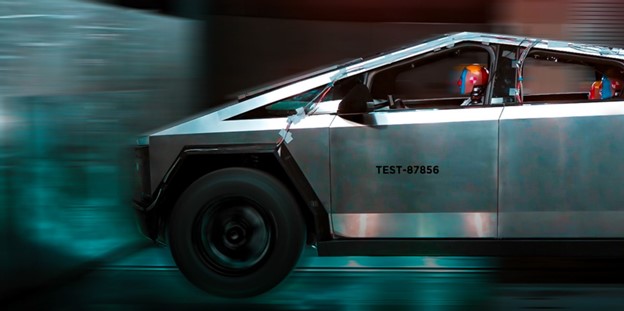
Image Source: Tesla
By Brian Nelson, CFA
On April 22, Tesla (TSLA) reported dismal first quarter results with revenue and non-GAAP earnings per share coming in below expectations. Total revenue fell 9% in the period, as total automotive revenues dropped 20%, while energy generation and storage revenue increased 67%. Services and other revenue increased 15%. Income from operations fell 66%, while adjusted EBITDA slid 17%. Adjusted EBITDA fell 17% in the quarter on a year-over-year basis.
Management spoke of uncertainty in the quarterly update:
In Q1, we accomplished an industry first: simultaneously changing over production lines across all factories for the world’s best-selling vehicle4 – the Model Y. The Tesla team successfully ramped our production lines across four factories while managing supply chains across three continents without any major disruptions, demonstrating the advancement of our operational and supply chain management capabilities.
AI is a major pillar of growth for Tesla and the broader economy and key to our pursuit of sustainable abundance. Furthermore, AI infrastructure is driving rapid load growth, which, along with traditional utility customer applications, is creating an outsized opportunity for our Energy storage products to stabilize the grid, shift energy when it is needed most and provide additional power capacity. While the current tariff landscape will have a relatively larger impact on our Energy business compared to automotive, we are taking actions to stabilize the business in the medium to long-term and focus on maintaining its health.
Uncertainty in the automotive and energy markets continues to increase as rapidly evolving trade policy adversely impacts the global supply chain and cost structure of Tesla and our peers. This dynamic, along with changing political sentiment, could have a meaningful impact on demand for our products in the near-term. We remain committed to expanding our business model to include delivering autonomous robots across multiple form factors and use cases – powered by our real-world AI expertise – to our customers and for use in our factories, as we navigate these headwinds.
In the face of near-term profitability hurdles, the low-cost, localized manufacturing base that we have built provides advantages in delivering the best products at the right price to our customers globally. We continue to make critical, high-value investments while maintaining a strong balance sheet during this uncertain period.
Tesla’s non-GAAP net income attributable to common shareholders dropped 39% in the first quarter, while non-GAAP earnings per share fell 40%. Net cash provided by operating activities increased to $2.2 billion in the first quarter, while capital expenditures fell 46%, to $1.5 billion, resulting in free cash flow of $664 million in the period. Tesla’s cash and investments balance increased $0.4 billion at the end of the quarter, to $37 billion. Due to “the impacts of shifting global trade policy on the automotive and energy supply chains,” management pulled its 2025 guidance, noting that it will revisit it in its second quarter update. CEO Elon Musk said that his DOGE work is mostly done and beginning in May, his time allocated to DOGE will drop significantly. We like Tesla, but don’t include it in any newsletter portfolio.
—–
Brian Nelson owns shares in SPY, SCHG, QQQ, QQQM, DIA, VOT, RSP, and IWM. Valuentum owns SPY, SCHG, QQQ, QQQM, VOO, and DIA. Brian Nelson’s household owns shares in HON, DIS, HAS, NKE, DIA, RSP, SCHG, QQQ, QQQM, and VOO. Some of the other securities written about in this article may be included in Valuentum’s simulated newsletter portfolios. Contact Valuentum for more information about its editorial policies.
Valuentum members have access to our 16-page stock reports, Valuentum Buying Index ratings, Dividend Cushion ratios, fair value estimates and ranges, dividend reports and more. Not a member? Subscribe today. The first 14 days are free.