
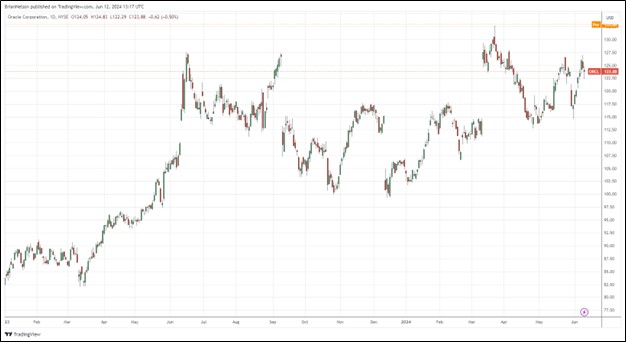
Image: Oracle’s shares have done quite well since the beginning of 2023, and management’s outlook speaks to continued strength.
By Brian Nelson, CFA
On June 11, Oracle (ORCL) reported fourth quarter fiscal 2024 results that missed expectations on the top and bottom line, but the company’s total remaining performance obligations increased a whopping 44% on a year-over-year basis, to $98 billion–up $18 billion from the fiscal third quarter. Total quarterly revenue advanced 4% in constant currency, while non-GAAP operating income jumped 9% in constant currency. Management commented positively in the quarterly earnings press release about the pace of orders and the visibility it provides into the coming fiscal years:
In Q3 and Q4, Oracle signed the largest sales contracts in our history—driven by enormous demand for training AI large language models in the Oracle Cloud. These record level sales drove RPO up 44% to $98 billion. Throughout fiscal year 2025, I expect continued strong AI demand to push Oracle sales and RPO even higher—and result in double-digit revenue growth this fiscal year. I also expect that each successive quarter should grow faster than the previous quarter—as OCI capacity begins to catch up with demand. In Q4 alone, Oracle signed over 30 AI sales contracts totaling more than $12.5 billion—including one with Open AI to train ChatGPT in the Oracle Cloud.
Our multicloud cooperation with Microsoft expanded significantly in Q4, as we agreed to work together to support Open AI and ChatGPT—and 11 of the 23 OCI datacenters we are building inside Azure went live. As this Azure/OCI cloud capacity becomes available to the large installed base of Microsoft and Oracle customers, it will turbocharge our cloud database growth. Now customers can run any and every version of the Oracle database—Autonomous, 23ai Vector DB, etc.— in both the Azure and the Oracle Clouds. As customers continue to choose and use multiple clouds, Hyperscalers like Microsoft and Google are responding by interconnecting their clouds. Oracle recently signed an agreement with Google to interconnect our clouds—and initially build 12 OCI datacenters inside the Google Cloud. We expect the Oracle database to be available within the Google Cloud in September this year.
Oracle ended its fiscal year with $86.9 billion in short- and long-term debt versus cash and marketable securities of $10.7 billion. For fiscal 2024, net cash provided by operating activities jumped to $18.7 billion from $17.2 billion in fiscal 2023, while capital spending fell to $6.9 billion from $8.7 billion. Free cash flow for fiscal 2024 came in at $11.8 billion, which comfortably covered cash dividends paid of $4.4 billion in the fiscal year. Management expects strong cloud infrastructure growth for fiscal 2025, while capital spending will “probably be double” what it was in fiscal 2024.
For the first quarter of fiscal 2025, total revenue is expected to advance between 6%-8% in constant currency propelled by total cloud revenue growth of 21%-23% in the quarter. Non-GAAP earnings per share in constant currency are targeted to grow 11%-15%, to $1.33-$1.37. Looking all the way out to fiscal 2026, management noted that it is “firmly committed” to its financial goals for revenue, operating margins and EPS growth, but given the strength in bookings in the quarter, its guidance may “prove to be too conservative given…momentum.”
All things considered, we liked Oracle’s cash flow performance for fiscal 2024 and outlook for not only fiscal 2025 but also its positive commentary associated with the momentum it has built for fiscal 2026. We continue to like Oracle as an idea for the Dividend Growth Newsletter portfolio and ESG Newsletter portfolio. Shares yield ~1.3% at the time of this writing.
—–
NOW READ: 12 Reasons to Stay Aggressive in 2024
NOW READ: 2023 Was a Fantastic Year! Are You Ready for 2024?
Brian Nelson owns shares in SPY, SCHG, QQQ, DIA, VOT, RSP, and IWM. Valuentum owns SPY, SCHG, QQQ, VOO, and DIA. Brian Nelson’s household owns shares in HON, DIS, HAS, NKE, DIA, RSP, SCHG, QQQ, and VOO. Some of the other securities written about in this article may be included in Valuentum’s simulated newsletter portfolios. Contact Valuentum for more information about its editorial policies.
Valuentum members have access to our 16-page stock reports, Valuentum Buying Index ratings, Dividend Cushion ratios, fair value estimates and ranges, dividend reports and more. Not a member? Subscribe today. The first 14 days are free.