
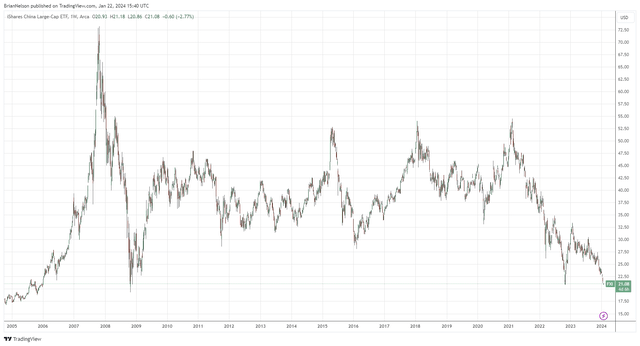
Image: Large cap Chinese equities are back to levels first reached in 2005, almost two decades ago.
By Brian Nelson, CFA
Chinese equities (MCHI) used to be praised for their diversification benefits in a global portfolio, but over the past 20 years, they haven’t done much. The iShares China Large-Cap ETF (FXI) is now back to levels first reached in 2005, and we see little reason why Chinese equities will catch a bid given the strength in other alternatives, namely U.S. indices, particularly the Nasdaq (QQQ), and in risk-free assets, including certificates of deposit at local and online banks.
On January 22, Reuters reported that China’s major state-owned banks are working to support the yuan, while selling U.S. dollars, so as to prop up its currency, all the while Chinese equities remain under pressure. Though China’s GDP growth of 5.2% in 2023 wasn’t bad, investors had been expecting that growth would be much stronger given the recovery following the COVID-19 pandemic. According to Reuters, China continues to experience “a deepening property crisis, mounting deflationary risks and tepid demand.”
For U.S. investors, investing in Chinese equities is perilous. Many Chinese ADR’s often trade at permanent discounts to their intrinsic values, because of a structure that, in the case of Alibaba (BABA), for example, “is actually stock in a Cayman Islands-based holding company that issues legal certificates representing an interest” in the company. Since shareholders in Chinese stocks don’t have much sway over the company’s goings-on under these equity arrangements, when combined with the geopolitical tensions between the U.S./China, investing in Chinese equities becomes less than interesting.
Things have been so bad in Chinese equities that China’s largest broker has even taken steps to curb short sales. For the past 52 weeks, Alibaba’s shares have fallen more than 41%, Baidu’s (BIDU) shares have dropped more 22%, JD.com’s (JD) shares are off more than 63%, Bilibili’s (BILI) shares are down more than 65%, while Tencent Holdings’ (TCEHY) has fallen more than 30%. Though the steep declines in shares of Chinese equities may attract some bottom fishing, we’re not interested in any Chinese exposure at this time. We continue to like ideas in the newsletter portfolios.
—–
NOW READ: 12 Reasons to Stay Aggressive in 2024
NOW READ: 2023 Was a Fantastic Year! Are You Ready for 2024?

Brian Nelson owns shares in SPY, SCHG, QQQ, DIA, VOT, RSP, and IWM. Valuentum owns SPY, SCHG, QQQ, VOO, and DIA. Brian Nelson’s household owns shares in HON, DIS, HAS, NKE, DIA, RSP, SCHG, QQQ, and VOO. Some of the other securities written about in this article may be included in Valuentum’s simulated newsletter portfolios. Contact Valuentum for more information about its editorial policies.
Valuentum members have access to our 16-page stock reports, Valuentum Buying Index ratings, Dividend Cushion ratios, fair value estimates and ranges, dividend reports and more. Not a member? Subscribe today. The first 14 days are free.