
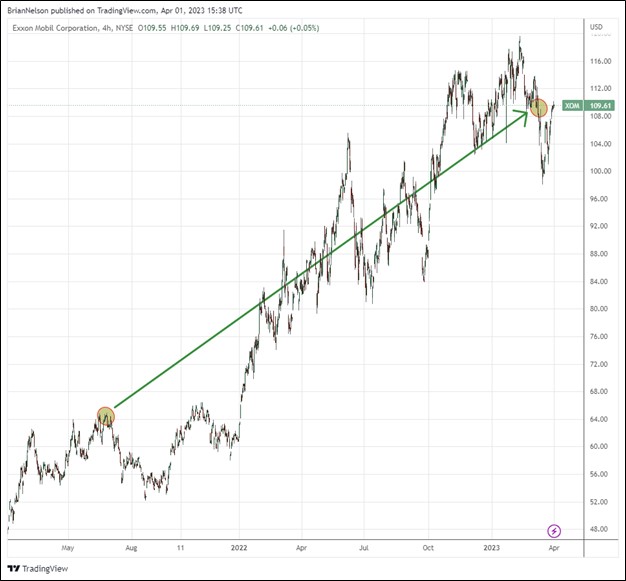
Image: Shares of Exxon Mobil were added to the newsletter portfolios in mid-June 2021 and rocketed higher for some huge “gains” over the past year or so. We still expect upside potential at both Exxon Mobil and Chevron on the basis of our fair value estimate ranges, but we removed shares of both on March 13, 2023.
By Brian Nelson, CFA
We received a number of questions about why we removed Exxon Mobil Corp. (XOM) and Chevron Corp. (CVX) from the newsletter portfolios, despite our point estimate of their intrinsic values being higher than where their share prices are trading. As of the end of the first quarter of 2023, March 31, for example, shares of Exxon Mobil are trading at $109.66 per share with a fair value estimate of $133 per share, while shares of Chevron Mobil are trading at $163.16 per share with a fair value estimate of $198 per share. Exxon Mobil has a Dividend Cushion ratio of 2.8, while Chevron has a Dividend Cushion ratio of 2.4.
The Fair Value Estimate Range
Both Exxon Mobil and Chevron remain strong investment considerations, not only as it relates to valuation but also as it relates to the strength of their respective dividends. However, we don’t want to be too greedy with these “winners,” particularly as both commodity-producers have now entered “fair value” territory. The bottom rung of the fair value estimate range of Exxon Mobil is $94, while the bottom rung of the fair value estimate range of Chevron is $149, the latter shown in the image below. Valuation should always be viewed as a range of potential outcomes on the basis of scenario and sensitivity analysis performed on the future expectations within the discounted cash-flow construct, inclusive of the risk-free rate.

Image: The fair value estimate range of Chevron. Image Source: Valuentum
Our discounted cash flow (DCF) process values each company on the basis of the present value of the future free cash flows we expect them to generate. For example, we estimate Chevron’s fair value at about $198 per share, as shown as the highest point on the probability distribution above, but every company has a range of probable fair values that’s created by the uncertainty of key valuation drivers from future revenue and earnings expectations to the discount rate, itself, and beyond. After all, if the future were known with certainty, we wouldn’t see much volatility in the stock market as stocks would trade precisely at their known fair values.
Nobody can know the future for certain, however, which is why we have other checks and balances in our process. Our ValueRisk™ rating, which is derived by assessing the potential variability of key valuation drivers in the future, sets the margin of safety or the fair value estimate range we assign to each stock. In the image above, we show this probable range of fair values for Chevron. We think the energy giant is attractive below $149 per share (at prices along the green line), but quite expensive above $248 per share (at prices along the red line). The prices that fall along the yellow line, which includes our fair value estimate of the company, represent a reasonable valuation for the stock, in our opinion.
Difficult to Predict Commodity Prices
When it comes to the energy complex, it’s fair to say that crude oil prices are notoriously difficult to predict, and we’ve generally shied away from commodity producers across our newsletter portfolios. The reason is rather simple. Most commodity producers are heavily tied to the vicissitudes of the economic cycle, and while many can carve out some competitive advantage whether through a low-cost site or drive some comparative efficiency through operational excellence, their return on invested capital remains largely a function of the prices of the commodities they produce. Quite simply, Exxon Mobil and Chevron would be absolute bargains if we knew that crude oil prices would stay at $150+ long into perpetuity, but they may not be good ideas at all if crude oil prices hovered near the $30 range over the next decade or two.
Predicting the future direction of crude oil prices is not an area that anyone can be good at consistently, in our view. How many, for example, predicted that the spot price of crude oil would reach -$37 per barrel (negative $37 per barrel) on April 20, 2020, near the height of the COVID-19 meltdown? We would say not many, if any at all, saw that coming. Though crude oil prices didn’t stay at those negative levels for long, it just goes to show that many commodity producers are tied to dynamics that are very hard to predict, especially in the long run. When we added Exxon Mobil and Chevron back in 2021, it was a smart move to diversify the newsletter portfolios at that time, especially while both XOM and CVX were sporting some very attractive dividend yields.
New Risks on the Horizon
However, much has changed since then. Shares of Exxon Mobil and Chevron have soared, and their dividend yields, while still very nice, now pale in comparison to those on short-term risk-free government bonds. Further, with a hot war raging in Ukraine, geopolitical tensions rising in China, an ongoing regional bank crisis occurring in the U.S., inflation continuing at an elevated pace, sovereign debt levels remaining elevated, and a wealth effect from increased interest rates yet to be felt by the consumer from a weakening housing market, taking “some profits” on a couple huge “winners” of last year seems like a prudent move for now, in our view.
That said, we still retain some exposure to these two ideas via the Energy Select Sector SPDR (XLE), but the long and short of why we removed Exxon Mobil and Chevron from the newsletter portfolios is that: 1) Things simply have worked out great for such ideas since we added them to the newsletter portfolios, and 2) New risks to the broader economic environment and demand for energy resources have come to light, including a regional banking crisis in the US, which has likely served to tighten monetary policy even more (as lending activity was likely curbed as many smaller banks hunkered down to improve their liquidity and capital positions).
Please let us know if you have any additional questions.
NOW READ: The Real Reason Why Moats Matter
—–
Did You Know? The Dividend Cushion ratio has done a fantastic job both in identifying strong dividend paying companies and anticipating dividend cuts, “Efficacy of the Dividend Cushion Ratio.
Energy pipeline MLPs have significantly reduced their capital-market dependency risks during the past several years. Read more here: Energy Pipelines: What a Difference A Few Years Have Made!
———-
Brian Nelson owns shares in SPY, SCHG, QQQ, DIA, VOT, BITO, RSP, and IWM. Valuentum owns SPY, SCHG, QQQ, VOO, and DIA. Brian Nelson’s household owns shares in HON, DIS, HAS, NKE, DIA, and RSP. Some of the other securities written about in this article may be included in Valuentum’s simulated newsletter portfolios. Contact Valuentum for more information about its editorial policies.
Valuentum members have access to our 16-page stock reports, Valuentum Buying Index ratings, Dividend Cushion ratios, fair value estimates and ranges, dividend reports and more. Not a member? Subscribe today. The first 14 days are free.