
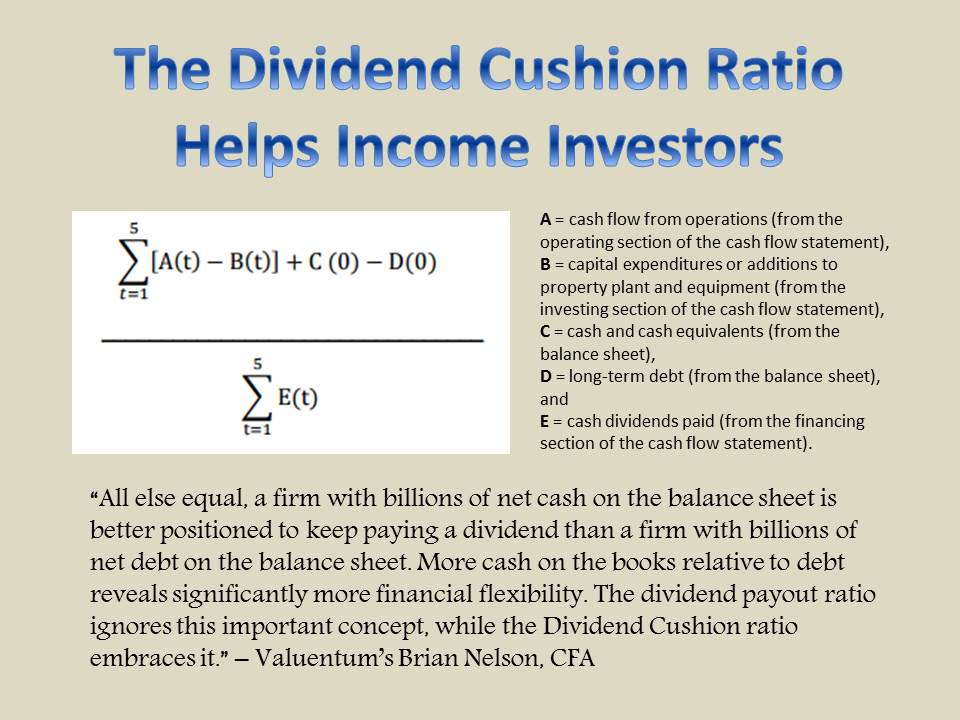
Image: The Dividend Cushion ratio is one of the most powerful financial tools an income or dividend growth investor can use in conjunction with qualitative dividend analysis. The ratio is one-of-a-kind in that it is both free-cash-flow based and forward looking. Since its creation in 2012, the Dividend Cushion ratio has forewarned readers of approximately 50 dividend cuts. We estimate its efficacy at ~90%.
By Brian Nelson, CFA
V.F. Corp (VFC) cut its quarterly dividend by more than 40% on February 7, to a quarterly rate of $0.30 per share from $0.51 per share previously. The cut is yet further evidence of the importance of paying attention to the cash-based sources of intrinsic value–net cash on the balance sheet and future expected free cash flow–when it comes to evaluating dividend health.
For example, V.F. Corp’s total debt load grew substantially in the wake of its ~$2.1 billion acquisition of Supreme in December 2020, and its net debt position weighed heavily on its Dividend Cushion ratio, which stood at 0.1 (VERY POOR) as of its latest update. Anything below 1 is risky and anything below 0 or near 0 is quite concerning.
We tend to like dividend growth stocks with Dividend Cushion ratios significantly greater than 1, as this implies a company that either has a huge net cash position on the balance sheet to support the dividend, one that has substantial free cash flow generation far in excess of expected cash dividends to be paid, or both.

Image: Valuentum’s Dividend Growth Newsletter portfolio. Portfolio information as of published date in top, left corner of table. The Dividend Growth Newsletter portfolio is not a real money portfolio. Past results are not a guarantee of future performance, and actual results may differ from simulated information provided. There is substantial risk associated with investing in financial instruments.
A few of our favorite dividend growth companies have meaningfully elevated Dividend Cushion ratios. For example, Apple (AAPL) has a Dividend Cushion ratio of 7.35, Dick’s Sporting Goods (DKS) has a Dividend Cushion ratio of 4.37, while UnitedHealth Group (UNH) has a Dividend Cushion ratio of 3.52. For entities with ratios this high, we expect substantial dividend growth in coming periods.
All told, please be sure to pay attention to the Dividend Cushion ratios of firms that you follow. Even if you are not an income or dividend growth investor, the Dividend Cushion ratio provides an assessment of the cash-based sources of intrinsic value relative to future potential outlays in the form of the dividend. We expect to update our reports on V.F. Corp. soon.
More reading:
Dividend Cushion Efficacy Examples >>
Dividend Cushion Methodology Calculation >>
Tickerized for VFC, AAPL, DKS, UNH
———-
Brian Nelson owns shares in SPY, SCHG, QQQ, DIA, VOT, BITO, RSP, and IWM. Valuentum owns SPY, SCHG, QQQ, VOO, and DIA. Brian Nelson’s household owns shares in HON, DIS, HAS, NKE, DIA, and RSP. Some of the other securities written about in this article may be included in Valuentum’s simulated newsletter portfolios. Contact Valuentum for more information about its editorial policies.
Valuentum members have access to our 16-page stock reports, Valuentum Buying Index ratings, Dividend Cushion ratios, fair value estimates and ranges, dividend reports and more. Not a member? Subscribe today. The first 14 days are free.