
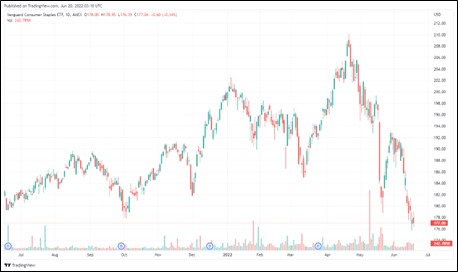
Image: The Vanguard Consumer Staples ETF (VDC) has notched a new 52-week low, and investors should note that we don’t think consumer staples entities are immune to an environment of higher inflation, where their price increases may not be fully absorbed by the consumer. Due to the commoditization of many of the goods produced in the consumer staples space, we think the consumer may instead trade down to off-brands or white label (“store brand”) products than pay up for branded merchandise.
By Brian Nelson, CFA
On June 10, the U.S. Bureau of Labor Statistics released its Consumer Price Index Summary for May showing inflation continues at an elevated pace, “with the indexes for shelter, gasoline, and food being the largest contributors.” According to the survey, the “all items index increased 8.6 percent for the 12 months ending May, the largest 12-month increase since the period ending December 1981.” In particular, “the food index increased 10.1 percent for the 12-months ending May, the first increase of 10 percent or more since the period ending March 1981.”
With food inflation increasing at a double-digit pace, we’re growing more and more skeptical that the consumer, which may already be stretched by rising rent and gas prices, will willingly pay up for branded food and household products. Instead, we think it is more likely that the consumer staples sector may experience demand (volume) destruction as consumers look to trade down to off-brands or white label (“store brand”) products, damping both the top lines and gross margins of branded giants. Furthermore, we believe pricing actions will not be enough to fully offset gross margin pressure across the consumer staples arena in the coming quarters.
Procter & Gamble Hits 52-Week Low
In consumer staples bellwether Procter & Gamble’s (PG) calendar first-quarter earnings report, released April 20, the company’s gross margin fell 400 basis points, despite price increases and organic sales expansion. The firm noted that the “decline was driven by 410 basis points of increased commodity costs, 80 basis points of higher freight costs, 30 basis points of product/package reinvestments and 130 basis points of negative product mix.” P&G raised its top-line outlook for its fiscal year thanks to pricing actions, but such pricing strength won’t translate to incremental improvements on the bottom line, as P&G held its earnings per share outlook steady calling for 6-9% growth for the fiscal year.
The market is getting more and more cautious on the consumer staples sector, with P&G’s share price falling to the low $130s per share and notching a 52-week low. Though the consumer staples sector has held up better in 2022 than any other major sector except for the energy (XLE) and utilities (XLU) spaces, we think the consumer staples group may be in for some tough sledding in the coming quarters, with the group trading at a full forward multiple of 19.3x versus the S&P 500 multiple of ~16x, according to data from FactSet. Many consumer staples entities have huge net debt positions and hefty dividend obligations, too, so their premium multiple relative to the market multiple makes little sense in our view. Our fair value estimate for P&G stands at ~$120, so more downside in the bellwether’s equity price could be in store, leading the entire sector lower.
Gross Margin Pressures Apparent at Household Product Makers, Price Increases Coming Up Short
P&G isn’t the only bellwether encountering pain with respect to rising input costs. In many ways, Colgate-Palmolive (CL) may fare worse than Procter & Gamble in this inflationary environment. The toothpaste maker released its calendar first-quarter report April 29, and while Colgate Palmolive revealed 4% organic growth in the period, GAAP earnings per share declined a whopping 18%, with earnings per share falling 8% for its core business. The culprit? 220 basis points of pressure on its gross margin from the same period a year ago due to inflationary pressures. Here’s what management had to say in the first-quarter 2022 earnings press release:
While our growth continued on the top line, our profitability was impacted by significant increases in raw material and logistics costs worldwide, and we expect the difficult cost environment to continue for the next several quarters. We remain sharply focused on our revenue growth management, including additional pricing, and funding-the-growth and other productivity initiatives. As we manage through this difficult time, we are committed to executing our plans with the right balance of pricing, productivity and brand support.
As we look around the world, there is still much uncertainty stemming from the COVID-19 pandemic, supply chain disruptions, the war in Ukraine and volatility in consumer demand and currencies. Despite this environment, we are encouraged by our growth momentum, the strength of our innovation pipeline and the progress we are making on our digital transformation, all of which add to our confidence that we have the right strategies in place to continue to deliver sustainable, profitable growth over the long term.
Colgate-Palmolive recently hit a 52-week low, too, now trading in the mid-$70s, just a bit higher than our $70 per-share fair value estimate at the time of this writing. Procter & Gamble and Colgate-Palmolive aren’t the only ones in the consumer staples space that are feeling the pinch from higher inflationary pressures either. It’s clear that pricing increases aren’t preserving the gross margins of many consumer staples names, by any stretch, indicating that the worst of gross margin pressure may still be ahead, especially as consumers may balk at price increases that still fall short of offsetting higher input costs. Price-driven revenue expansion, as many in the consumer staples arena are experiencing, should translate into higher gross margins, but that’s just not happening.
Within Clorox’s (CLX) calendar first-quarter report, released May 2, the cleaning products maker noted that, while net sales increased in the calendar first quarter, its gross margin fell a whopping 760 basis points “due mainly to higher manufacturing and logistics and commodity costs, partially offset by the benefits of pricing and cost savings initiatives.” Church & Dwight (CHD), which owns the ARM & HAMMER brand, experienced volume declines of 5.1% in the first-quarter 2022 period pointing to “continued supply chain disruption and pricing elasticities.” The company’s gross margin fell 190 basis points in its most recently reported quarter, despite its pricing actions, and the company noted that it expects “to experience higher inflation at a faster rate than (its) price increases take effect.”
Kleenex maker Kimberly-Clark (KMB) also spoke of higher costs that will threaten the pace of profitability growth. In its first-quarter 2022 earnings press release, issued April 22, the company noted that “key cost inputs (are) expected to increase $1.1 to $1.3 billion” versus a prior estimate in the range of $750 to $900 million. Management spoke of pricing actions that will help organic sales growth performance, but adjusted operating profit is still expected to be down in the low-to-mid single-digits percent for its fiscal year. Further, Kimberly-Clark noted that “costs are projected to increase or remain elevated for most inputs including polymer-based materials and pulp as well as distribution and energy.” Branded household products companies are feeling the pain of rising costs.
Food Stocks Failing to Raise Bottom Line Guidance Despite Higher Expected Sales
In late March, General Mills (GIS) reported its fiscal 2022 third-quarter results for the period ending February 27, 2022, noting that it had experienced pressure on gross margins to the tune of 350 basis points, pointing to “higher input costs and unfavorable mark-to-market effects, partially offset by favorable net price realization.” General Mills did raise its outlook for organic sales and constant currency adjusted operating profit when it released its latest results, but the market will get a better read on just how painful input cost inflation has been to the firm when it reports its fiscal fourth quarter performance June 29. The company’s fiscal fourth quarter results will cover the months March through May.
Campbell Soup’s (CPB) third-quarter fiscal 2022 results, released June 8, were a mixed bag, as the company’s fundamental business had been struggling prior to the recent levels of heightened inflation. Still, while Campbell Soup fared better than what one might have expected, the company failed to raise its adjusted EBIT and adjusted EPS commensurate with its increased full-year fiscal 2022 net sales guidance. Management noted “the operating environment remains challenging” and that they “continue to expect significant inflation.” During the quarter, its gross margin fell roughly 50 basis points.
The story at cereal maker Kellogg (K) is similar. The company reported first-quarter 2022 results May 5, and while management noted that it “mitigated the profit impacts of high-cost inflation,” it, too failed to increase full-year guidance for operating profit, earnings per share, and cash flow, despite upping its full-year guidance for organic-basis net sales growth. Importantly, management noted that “the outlook has worsened for cost inflation,” and in our view, one might expect more of the same from Kellogg in coming quarters with the press release emphasizing that it is experiencing “incremental pressures from accelerated cost inflation.” We don’t think investors should take the word “accelerated” lightly, as price increases by Kellogg may eventually lead to demand destruction as consumers look trade down.
Kraft Heinz’s (KHC) first-quarter 2022 results, released April 27, fit the mold, too. The company raised its outlook for organic net sales expansion, but it didn’t hike its adjusted EBITDA guidance with the company noting “ongoing efforts to manage inflationary pressures.” McCormick’s (MKC) latest quarterly results for the quarter ended February 28, 2022, also showed a firm that spoke positively about being able to price higher in order to offset rising costs, but the numbers told a different story. Pricing actions are only offsetting part of inflationary pressures, by our assessment, as McCormick experienced a gross profit decline of “260 basis points, excluding transaction and integration expenses” in its most recently-reported quarterly results.
J.M. Smucker (SJM) had a messy quarterly report for the period ending April 30, 2022, results released June 7, as it had a recall of its Jif peanut butter due to potential salmonella contamination, but management echoed similar concerns as its consumer staples peers, though it did note that higher costs in the form of “commodity and ingredient, packaging, and manufacturing costs were offset by higher net price realization.” In light of the many moving parts in the quarter, particularly the Jif peanut butter recall, we don’t think Smucker did as well with its pricing actions as reported, and we think management could be setting investors up for disappointment. In the press release, the firm emphasized that “ongoing cost inflation and volatility in supply chains continue to impact financial results and cause uncertainty and risk.” We would not be surprised to see J.M. Smucker guide down profitability in coming quarters.
Concluding Thoughts
From where we stand, bellwethers in the consumer staples sector can’t price successfully ahead of inflationary headwinds, and many are experiencing tremendous gross margin pressure. Not only this, but in many cases, we think branded staples are experiencing demand (volume) destruction as consumers balk at price increases that still fall short of offsetting the heightened cost environment.
Many consumer staples equities have huge net debt positions and hefty dividend obligations, and while many of the types of products they produce consumers cannot do without, we think we might see the consumer staples group’s share prices come under continued pressure in this market environment and eventually fetch what we think would be a market multiple (roughly three turns of earnings lower, or ~19x earnings to ~16x earnings).
Even if this may not happen, however, there still appears to be some tough sledding ahead on a fundamental basis given report commentary, and we’ll look to evaluate our newsletter portfolios and their exposure to the consumer staples arena in the coming weeks to months. What remains clear is that the outlook for many consumer staples entities is not pretty.
———-
Other: REV, NWL, ELF, SPB, COTY, BYND, UL, HSY, NSRGY, TGT, WMT, CAG, HAIN, TWNK, STZ, REYN, CCEP, BGS, STKL, THS, BTI, NGVC, SFM, BJ, PRMW, NAPA, OLPX, CHWY, TACO, JACK, EL
Brian Nelson owns shares in SPY, SCHG, QQQ, DIA, VOT, BITO, and IWM. Valuentum owns SPY, SCHG, QQQ, VOO, and DIA. Brian Nelson’s household owns shares in HON, DIS, HAS, NKE. Some of the other securities written about in this article may be included in Valuentum’s simulated newsletter portfolios. Contact Valuentum for more information about its editorial policies.
Valuentum members have access to our 16-page stock reports, Valuentum Buying Index ratings, Dividend Cushion ratios, fair value estimates and ranges, dividend reports and more. Not a member? Subscribe today. The first 14 days are free.