
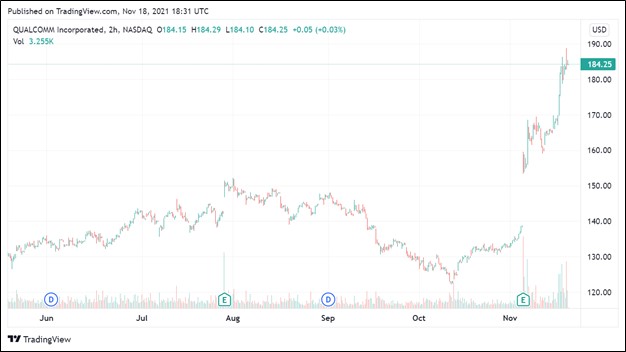
Image Shown: Shares of dividend growth idea Qualcomm Inc have skyrocketed since the start of November in the wake of its latest earnings update and favorable guidance put out during a recent investor day event.
By Callum Turcan
Over the next decade, dividend growth idea Qualcomm Inc (QCOM) expects its addressable market opportunity will grow by $100 billion, reaching $700 billion, according to guidance put out during a big Investor Day event held on November 16. We appreciate Qualcomm’s ever-expanding growth runway and include shares of QCOM as an idea in the Dividend Growth Newsletter portfolio. On November 3, Qualcomm reported fourth-quarter fiscal 2021 earnings (period ended September 26, 2021) that beat both consensus top- and bottom-line estimates. Additionally, Qualcomm provided strong guidance for its first-quarter fiscal 2022 in conjunction with that report. Shares of Qualcomm have been off to the races since then, and as of this writing, shares of QCOM yield ~1.5%.
Automotive Growth
Qualcomm provided some ambitious goals during its November 2021 Investor Day event. The company aims to grow its automotive revenues from just under $1.0 billion in fiscal 2021 to ~$3.5 billion in five years and ~$8 billion in ten years. Qualcomm is working with investment partnership SSW Partners to acquire the Swedish automotive technology firm Veoneer Inc (VNE) through a deal with an equity transaction value of $4.5 billion. That deal will see SSW Partners acquire Veoneer and then sell the Swedish firm’s Arriver business unit to Qualcomm, with Arriver focused on automotive automation technology according to its website. SSW Partners will retain Veoneer’s Tier-1 supplier businesses.
Back in January 2020, Qualcomm launched Snapdragon Ride, which represents its self-driving technology platform for vehicles, and the acquisition of Veoneer’s Arriver unit will support its efforts on this front. By 2023, Qualcomm aims to have its Snapdragon Ride system available in cars on the road. Also in January 2020, Qualcomm and General Motors Co (GM) announced an expansion of their existing partnership in the realm of automotive technology–which covers “digital cockpits, next generation telematics systems and future advanced driver assistance systems (‘ADAS’)–to meet the evolving needs of providing best-in-class experiences for consumers” according to the press release.
Next-generation ADAS offerings are a big part of Qualcomm’s growth strategy in the automotive realm along with self-driving technology, and there is ample room for Qualcomm to differentiate its offerings from the competition on these fronts. On November 16, Qualcomm announced a collaboration with Bayerische Motoren Werke AG (BMWYY), otherwise known as BMW. The press release noted (lightly edited):
“[Qualcomm] announced a collaboration to bring the latest advancements in driver assistance technologies, and products of its Snapdragon Ride Platform, to BMW Group’s next generation of advanced driver-assistance systems and automated driving platforms. Leveraging both companies’ expertise in core innovation, BMW Group and Qualcomm Technologies will extend their long-standing relationship to deliver safe, smart and sophisticated driving experiences to BMW Group vehicles. BMW’s next generation Automated Driving stack will be based on the Snapdragon Ride vision system-on-chip (‘SoC’), vision perception and ADAS central compute SoC controllers managed by Qualcomm Car-2-Cloud services platform.
We are excited about Qualcomm’s upside in the automotive industry.
Long Growth Runway Elsewhere
Qualcomm also aims to grow its Internet of Things (‘IoT’) revenues to ~$9 billion in fiscal 2024 from just under $5.1 billion in fiscal 2021. As everything from appliances to wearable devices are now getting connected to the Internet and requiring increased computing power as a result, Qualcomm is well-positioned to capitalize on this trend. The company already has a sizable footprint in this arena.
As it concerns Qualcomm’s historical bread-and-butter, its handset business, the company is positioning itself for a future where Apple Inc (AAPL) makes an increasing amount of its own “chips” (semiconductor components). In July 2019, Apple announced an agreement to buy Intel Corp’s (INTC) fledgling smartphone modem business through a deal with a transaction value of approximately $1 billion. Apple already designs and supplies some of its own chips for its hardware (the chips are made by third-parties in most instances) such as the A15 Bionic that is used in its newest iPhone lineup and the M1 Pro and M1 Max which is used in its newest MacBook Pro laptops.
Going forward, Apple intends to continue bulking up its chip design capabilities, and it has the financial firepower to do so. Executives at Qualcomm are forecasting that when Apple launches the 2023 iteration of its iPhone lineup, Qualcomm will supply just ~20% of Apple’s modem chips. We appreciate that Qualcomm is adapting to the changing landscape while locating new growth opportunities.
For Qualcomm, the company intends to grow its handset and radio frequency front-end (‘RFFE’) business by ~12% CAGR by fiscal 2024, in-line with growth at its serviceable available market (‘SAM’). Please note that SAM indicates the part of the market that a firm, such as Qualcomm, is actively targeting with its products and services (considering Apple is pivoting towards its own chip designs). Qualcomm is targeting opportunities at higher-end smartphones powered by Alphabet Inc’s (GOOG) (GOOGL) Google unit’s Android mobile operating system. We are impressed with the resilience of this business and its promising growth outlook, keeping Apple’s pivot towards its own chip designs in mind. In fiscal 2021, Qualcomm’s handset busienss generated $16.8 billion in revenues and its RFFE business generated $4.2 billion in revenues.
Financial Overview
Qualcomm’s automotive, IoT, handset, and RFFE businesses are part of its Qualcomm CDMA Technologies (‘QCT’) segment. In fiscal 2021, its QCT segment generated $27.0 billion in revenues and $7.8 billion in earnings before taxes (‘EBT’), good for an EBT margin of 29%. Growth across all four of its core businesses that make up its QCT segment should drive Qualcomm’s financials higher in the coming fiscal years.
Pivoting here, its licensing business, Qualcomm Technology Licensing (‘QTL’), is “expected to maintain its current revenue scale and margin profile” according to its November 2021 press release covering its big investor day event. In fiscal 2021, QTL generated $6.3 billion in licensing revenues and $4.6 billion in EBT, good for an EBT margin of 73%. Maintaining its strength would be a boon for Qualcomm, aided by its leadership position in the realm of 5G technology. In fiscal 2021, Qualcomm spent $7.2 billion on R&D expenses, equal to over 21% of its revenues, highlighting its focus on innovation.
Qualcomm is a cash-flow generating powerhouse. In fiscal 2021, Qualcomm generated $8.6 billion in free cash flow and spent $3.0 billion covering its dividend obligations along with another $3.4 billion buying back its stock. Qualcomm exited fiscal 2021 with a relatively modest net debt load of $3.3 billion (inclusive of short-term debt) and ample liquidity on the books in the form of $12.4 billion in cash, cash equivalents, and current marketable securities on hand. Qualcomm’s financials are rock-solid.
Concluding Thoughts
We are huge fans of Qualcomm, and the company has not disappointed. Qualcomm’s growth outlook is incredibly bright, and we continue to like shares of QCOM as an idea in the Dividend Growth Newsletter portfolio. The company has a concrete plan in place for a future where Apple represents a much smaller part of its business, and we appreciate Qualcomm communicating that plan to investors. Clearly, the market has liked what Qualcomm has had to say as its shares have simply skyrocketed since the start of November 2021.
We recently updated our cash flow models covering the technology industry. The updated top end of our fair value estimate range for Qualcomm sits at $206 per share, indicating that there is room for shares of QCOM to climb higher still from current levels. Qualcomm’s Dividend Cushion ratio sits at a stellar 3.8 highlighting its dividend strength, and its Dividend Safety rating is “EXCELLENT.” We expect Qualcomm will steadily grow its dividend going forward at a decent clip and give the firm a “GOOD” Dividend Growth rating. Share repurchases weigh negatively on Qualcomm’s dividend growth trajectory, though given the company’s stellar financial position and promising growth outlook, we see Qualcomm being able to walk and chew gum at the same time (i.e., simultaneously buyback its stock while growing its dividend).
Downloads
Qualcomm’s 16-page Stock Report (pdf) >>
Qualcomm’s 2-page Dividend Report (pdf) >>
—–
Technology Giants Industry – FB, AAPL, GOOG, AMZN, MSFT, CSCO, V, MA, PYPL, INTC, ORCL, QCOM, TWTR, IBM, ADBE, NVDA, CRM, AMD, AVGO, BABA, BKNG, BIDU, TSM, FFIV, TXN, EBAY, ADP, PAYX, MU, KFY, MAN, KLAC, LRCX, AMAT, ADI, SIMO
Tickerized for QCOM, VNE, BMWYY, GM, AVGO, QRVO, CRUS, SWKS
Valuentum members have access to our 16-page stock reports, Valuentum Buying Index ratings, Dividend Cushion ratios, fair value estimates and ranges, dividend reports and more. Not a member? Subscribe today. The first 14 days are free.
Callum Turcan does not own shares in any of the securities mentioned above. Apple Inc (AAPL), Cisco Systems Inc (CSCO), and Microsoft Corporation (MSFT) are all included in both Valuentum’s simulated Best Ideas Newsletter portfolio and simulated Dividend Growth Newsletter portfolio. Alphabet Inc (GOOG) Class C shares, Facebook Inc (FB), Korn Ferry (KFY), PayPal Holdings Inc (PYPL) and Visa Inc (V) are all included in Valuentum’s simulated Best Ideas Newsletter portfolio. Oracle Corporation (ORCL) and Qualcomm Inc (QCOM) are both included in Valuentum’s simulated Dividend Growth Newsletter portfolio. Facebook Inc, Oracle Corporation, and Taiwan Semiconductor Manufacturing Company Limited (TSM) are all included in Valuentum’s simulated ESG Newsletter portfolio. Some of the other companies written about in this article may be included in Valuentum’s simulated newsletter portfolios. Contact Valuentum for more information about its editorial policies.