
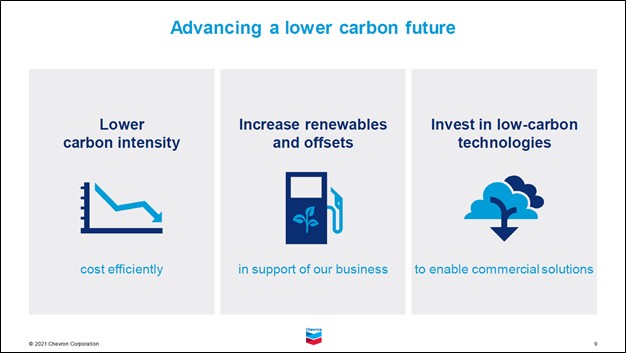
Image Source: Chevron Corporation – August 2021 IR Presentation
On June 27, 2021 (link here), we added Chevron Corporation (CVX) as an idea to both the Best Ideas Newsletter and Dividend Growth Newsletter portfolios. We are huge fans of the energy giant’s capital appreciation potential, with our fair value estimate standing at $115 per share of CVX, well above where Chevron is trading at as of this writing. Additionally, we are huge fans of Chevron’s dividend growth potential in the wake of the recovery seen in raw energy resources pricing year-to-date. Shares of CVX yield ~5.6% as of this writing, and we expect Chevron will steadily grow its payout going forward, aided by its promising free cash flow growth trajectory.
Energy Transition
Beyond its traditional fossil fuels business, which is and will remain Chevron’s bread-and-butter for a long time, Chevron is actively pushing deeper into the renewable energy realm. The “green energy” revolution is creating ample opportunities for Chevron where it has numerous competitive advantages. For instance, Chevron’s relatively low cost of capital, especially when compared to its smaller peers in this space, represents a big competitive advantage.
Additionally, Chevron’s global workforce and its partners have a lot of experience developing commercial-scale manufacturing facilities and the related infrastructure. Chevron has the marketing prowess required to buy and sell renewable electricity, biofuels, hydrogen, and other sources of power all over the world. Trading carbon emission credits and similar instruments could be a source of immense upside over the long haul, and other energy giants are stepping up their presence in this space.
Chevron has a partnership with Algonquin Power & Utilities Corp (AQN) to codevelop renewable energy projects (specifically, wind and solar) around the world including in New Mexico, Texas, Argentina, Kazakhstan, and Australia. In 2019, Chevron announced a power purchase agreement (‘PPA’) to supply its operations in the Permian Basin with power from a wind farm in West Texas. However, please note that these investments are relatively modest in scale as Chevron does not see itself having a competitive advantage in commercial-scale wind and solar projects.
Where Chevron does see itself having ample competitive advantages is in the realm of renewable fuels and hydrogen, something we will cover extensively in this article. To showcase its willingness to invest in low/no-carbon energy sources, Chevron made several big announcements in September 2021.
Sustainable Aviation Fuel
Chevron is partnering up with Delta Air Lines Inc (DAL) to test out sustainable aviation fuel (‘SAF’) that will be produced at the energy giant’s El Segundo Refinery in California and supplied to the airliner’s operations at Los Angeles International Airport (‘LAX’), a major hub for Delta. At the El Segundo Refinery, which has the capacity to process ~270,000 barrels of crude oil per day, Chevron intends to run biofuel feedstocks alongside other feedstocks through its fluid catalytic cracking (‘FCC’) unit.
For reference, the FCC unit is traditionally used to make gasoline. By utilizing its existing refining operations to grow its biofuels business, if successful, Chevron removes the need to spend handsomely to build a new biofuel production facility from scratch or convert an existing refinery to a biofuel facility.
These are early days, though we are intrigued by the possibilities in this area given Chevron’s extensive refining operations around the globe. Part of its partnership with Delta includes Alphabet Inc (GOOG) (GOOGL), via its Google Cloud division, committing to “build a data and analytics framework to securely ingest and analyze emissions data from Delta and Chevron related to the SAF test batch.” The three companies announced they had signed a memorandum of understanding (‘MOU’) on this project in September 2021, and we are keeping an eye on the endeavor.
For starters, Chevron will supply a “test batch of SAF” to Delta, and the consortium will go from there. Delta has committed to using SAF to replace 10% of its jet fuel needs by 2030. During Chevon’s second-quarter 2021 earnings call held in late-July 2021, management noted that “(it) started co-processing bio feedstock at (its) El Segundo refinery [in the second quarter], growing renewable diesel production in a capital-efficient manner by leveraging existing infrastructure.”

Image Shown: Chevron’s recent progress in the renewable energy realm. Image Source: Chevron – August 2021 IR Presentation
Additionally, Chevron noted it was going to sell SAF to United Airlines Holdings Inc (UAL) during the call. Chevron noted that it has sizable operations “in California, which has a lot of policy support in this area.” A combination of subsidies and regulatory hurdles are playing a meaningful role in the economics of Chevron’s renewable fuel projects. Here is some additional commentary from Chevron’s management team (emphasis added):
“Our downstream team is advancing renewable fuels, we’ve talked about renewable natural gas and renewable diesel previously. What we are trying to do around lower-carbon really is connected to our assets, capabilities, and customers. So one thing we’re not doing in lower-carbon is large scale wind and solar. We’re certainly having renewable power supply or operations again, part of lowering the carbon intensity, but not pursuing it as a standalone business.
That’s a decision that we’re making because we don’t feel like we have the competitive advantage. But when we get to renewable fuels, like renewable natural gas, renewable diesel, sustainable jet, hydrogen, carbon capture, these are areas that are adjacent to our business where, again, we have capability, we have customers, and we have assets that we can leverage. We sell to United Airlines. United Airlines is going to buy a sustainable jet. Sustainable jet is going to be a percentage of jet for some time period, 2%, 5%, 10% mix with conventional.” — Pierre Breber, Vice President and CFO of Chevron
We are intrigued by Chevron’s commentary on the issue of biofuels versus commercial-scale wind farms and solar plants. Chevron appears to be communicating to the investing community that while the energy giant is committed to investing in the fuels and energy sources of the future, it is not interested in simply throwing capital at green projects as a public relations stunt. Management is seeking out endeavors where Chevron has real competitive advantages and where Chevron can generate meaningful shareholder value (ROIC>WACC), a strategy we appreciate.
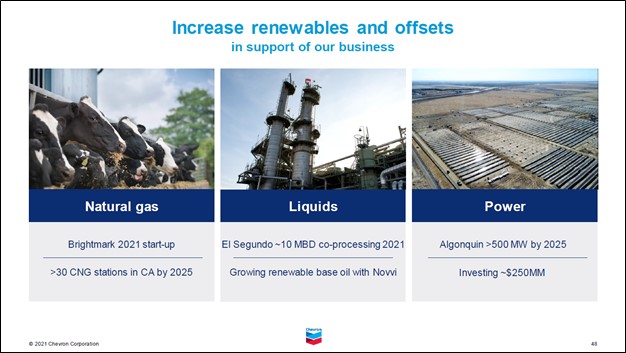
Image Shown: An overview of some of Chevron’s green energy initiatives. Image Source: Chevron – August 2021 IR Presentation
Other Biofuels
Chevron also announced it was teaming up with innovative biofuel player Gevo Inc (GEVO) in September 2021 through a venture that involves the duo committing to “jointly invest in building and operating one or more new facilities that would process inedible corn to produce sustainable aviation fuel, which can lower the lifecycle carbon intensity of fuels used in the aviation industry. The new facilities would also produce proteins and corn oil.” Gevo would contribute its “proprietary technology to produce sustainable aviation fuel and renewable blending components for motor gasoline to lower its lifecycle carbon intensity” while Chevron “would have the right to offtake approximately 150 million gallons per year to market to customers.” Chevron has ample expertise marketing fuels to buyers of all types across the globe and should be able to accelerate the rollout of Gevo’s ambitious biofuel production strategy.
Beyond biofuels, Gevo is focused on making plastics products in a more sustainable manner. Plastics products are primarily produced by petrochemical facilities using natural gas liquids (‘NGLs’) feedstocks such as ethane and propane to ultimately produce polyethylene and polypropylene. Naphtha and natural gas are also used as feedstocks by petrochemical facilities to produce plastics and various other products. Chevron has an expansive petrochemical footprint with operations across the world. By teaming up with Gevo on the biofuel front, Chevron is also opening the door to potentially partner with Gevo on making sustainable chemical products down the road.
Gevo’s manufacturing footprint is relatively modest as of today, given that it is a small firm attempting to punch its way into capital-intensive industries. That is where Chevron’s largess and operational prowess comes in handy. Currently, Gevo’s Luverne Facility in Minnesota represents its main production hub, though the firm is also expanding into the realm of producing renewable natural gas (‘RNG’) from dairy cow farms (capturing and processing biogas released from these agricultural facilities into biomethane or RNG).
Please note Chevron has a venture focused on capturing and processing biogas released from dairy cow farms into RNG in partnership with California Bioenergy LLC (‘CalBio’). Chevron has also partnered up with Brightmark RNG Holdings to produce and market biomethane (or RNG) from dairy farms across the US. Again, there is ample room for Chevron and Gevo to further expand their strategic partnership over the coming years.
Tying into Chevron’s RNG push, the company signed an agreement with the privately-held Cyprus-based company Mercuria Energy Trading in September 2021 to create a joint venture that would own and operate American Natural Gas (‘ANG’). For reference, ANG operates 60 compressed natural gas (‘CNG’) stations across the US and these facilities should get integrated with the RNG operations of Chevron and its various partners over the coming years. Andrew West, founder of ANG, will be teaming up with Chevron and Mercuria according to the press release announcing the dela.
The press release was light on details concerning which entity currently owns ANG, whether the joint venture is acquiring ANG outright, and financial terms of the deal. However, after doing some digging it appears Mercuria has an economic interest in ANG after acquiring a majority-stake in Beyond6 (which apparently used to operate ANG according to the details within the press release) from HC2 Holdings Inc (HCHC) through a deal announced in December 2020. Back in 2014, HC2 Holdings announced it was acquiring a majority stake in ANG (there was not much info readily available on the subject in HC2 Holdings’ latest annual report). We are keeping an eye out for additional information on this subject and expect Chevron will provide more details when it publishes its annual report covering 2021 sometime next year.
Chevron’s joint venture with Mercuria will help accelerate the energy giant’s plans to open 30 Chevron-branded CNG stations by 2025. In June 2021, the rebranding of the Allied Clean Fuels Plaza retail station located in Napa, California, represented Chevron’s first branded CNG station.
By 2025, Chevron aims to grow its RNG volumes by tenfold versus 2020 levels. We appreciate that Chevron is focused on both growing its RNG production volumes while simultaneously building out the necessary infrastructure to make its goals possible. This highlights one of the big advantages integrated energy companies have in the realm of renewable energy. Producing vast amounts of renewable energy and renewable fuels is one thing, supplying that energy and fuel to end customers is another. Investing in both sides of this business enhances Chevron’s upside over the long haul.
Hydrogen
In the realm of hydrogen, Chevron partnered up with Caterpillar Inc (CAT) in September 2021. The partnership aims “to develop hydrogen demonstration projects in transportation and stationary power applications, including prime power” for heavy-duty and industrial uses. Please note the venture is focused on operations that have been quite difficult to decarbonize in the past given the energy density requirements of the fuels needed to power such operations. That includes testing out whether hydrogen could be utilized “as a commercially viable alternative to traditional fuels for line-haul rail and marine vessels” and whether hydrogen would be suitable for prime power needs (meaning generators that supply a continuous source of power).
Caterpillar’s subsidiary Progress Rail will work with Chevron to develop a hydrogen powered locomotive and the related hydrogen refueling infrastructure required to support such an operation. The venture noted that “work on the rail demonstration will begin immediately at various locations across the United States.” Hydrogen power has been less of a focus in the US than elsewhere in the world, and Chevron aims to shine a spotlight on the potential domestic commercial opportunities in this realm. Back in July 2021, Chevron and Cummins Inc (CMI) signed a MOU to work on various hydrogen and other renewable energy projects, with an eye towards hydrogen fuel cell and electrolyzer developments geared towards industrial applications and commercial vehicles.
Concluding Thoughts
These ventures offer Chevron multiple ways to capitalize on the green energy revolution in the coming years and decades. On September 14, Chevron will host an event titled ‘2021 Energy Transition Spotlight’ that should provide more details on these efforts. Part of the impetus behind Chevron’s recent partnerships, beyond its upcoming investor event, is due to the activist fund Engine No. 1 agitating for change. The activist fund was able to win three board seats at ExxonMobil Corporation ( Categories Member Articles