
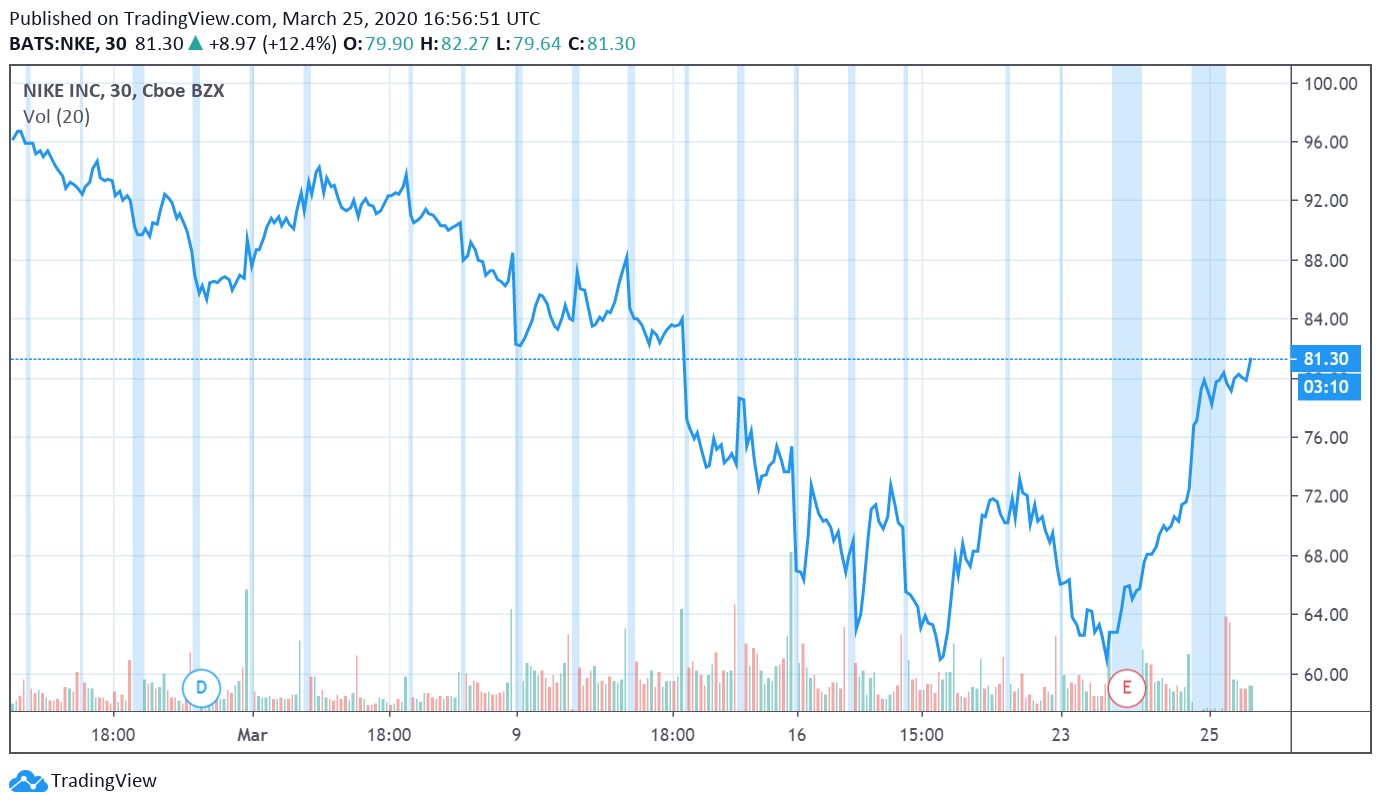
Image Shown: Shares of Nike Inc reclaimed some of their lost ground on March 25 after the sports apparel company reported a blowout earnings report.
By Callum Turcan
On March 24, Nike Inc (NKE) reported blowout earnings for its third quarter of fiscal 2020 (period ended February 29, 2020) with its revenues and non-GAAP EPS figures coming in well above consensus estimates. The sports apparel firm’s sales rose by 5% year-over-year on a GAAP basis, and 7% on a constant currency non-GAAP basis, due to strong growth at its Nike Direct offering (a digitally oriented direct to consumer distribution system) which helped drive 36% digital sales growth. Please note that Nike sold off its Hurley brand last fiscal quarter, which management noted shaved 100-200 basis points off Nike’s North American sales growth. This strength in the face of the ongoing novel coronavirus (‘COVID-19’) pandemic saw shares of NKE leap during the trading session on March 25.
Running a Business in the Face of a Pandemic
The firm’s GAAP diluted EPS came in at $0.53 in the fiscal third quarter, down 22% year-over-year. However, that included a $0.25 impairment charge related to its strategic maneuvers in South America. Nike transitioned to strategic distribution partnerships in several nations including Brazil, Argentina, Chile, and Uruguay resulting in an “anticipated release of associated cumulative foreign currency translation losses and could fluctuate due to changes in exchange rates up to the date of close” as Nike “classified the assets and liabilities of the entities to be sold as held-for-sale on [its] Unaudited Consolidated Balance Sheets and recognized a non-recurring, non-cash charge of $400 million” which is very much a one-time event.
Nike classifies its Latin American performance alongside its Asia Pacific performance within its financial statements (Nike classifies its Greater China segment as its own geographical operation), making it hard to ascertain the exact sales growth within the region. That said, Nike noted in the fiscal third quarter that sales in the ‘Asia Pacific & Latin America’ region were up 8% year-over-year (13% on a constant-currency basis) due to strength at its apparel and equipment product lines specifically (footwear sales were up decently as well).
While Nike’s Greater China sales were up 12% year-over-year (15% on a constant-currency basis) during the first nine months of fiscal 2020, in the fiscal third quarter, its sales dropped by 5% (4% on a constant-currency basis) due to containment efforts stemming from the need to limit the spread of COVID-19. Here’s what management had to say during Nike’s quarterly conference call (emphasis added):
“When COVID-19 began to aggressively spread across China in late January, our top priority was to protect the health and safety of our teammates and our consumers. We immediately began closing stores, and as of 45 days ago, we had closed more than 5,000 stores in Greater China while the remaining open doors were operating with severely reduced hours. Not surprisingly, retail volume in China plummeted. But we acted quickly and decisively, leveraging our diverse sourcing base and digital capabilities to manage the business with flexibility, while shifting our inventory to serve consumer digital demand.
At a time when people were confined to their homes, we moved swiftly to leverage our digital app ecosystem and Nike expert trainer network to inspire and support consumers across China to stay active and connected while at home. And as a result, our Nike Training Club workouts in China saw an extraordinary rise in sign-up and engagement. In fact, our weekly active users for all of our Nike activity apps were up 80% by the end of Q3 versus the beginning of the quarter. And here is what happened … the strong engagement of Chinese consumers with our activity apps translated to strong engagement with our Nike commerce app.
As a result, our digital business in China grew at more than 30% and maintained strong momentum throughout this challenging period, a powerful statement of Nike’s agile problem-solving in times of disruption. Then, about 30 days ago, we began to gradually re-open stores in China. People got back to work, and retail traffic began improving significantly. Today, nearly 80% of our stores in China have re-opened, with more coming back online every day. In fact, last week we re-opened our first store in the Wuhan area. And the results are encouraging. Our digital business has accelerated even further over the past month and we are now seeing double-digit increases in retail traffic week-over-week with some stores having already returned to prior year levels.”
Nike’s digital investments have clearly paid off in unexpected ways, and the firm continues to invest heavily in these offerings (including operations in the realm of data and analytics), which we can appreciate. While the primarily goal of Nike Direct was to boost sales and margins by connecting directly with Nike’s core consumers (creating a more intimate sales channel that’s trusted and allows for consumers to shop conveniently from their homes) played a huge role in Nike’s strong performance last fiscal quarter. We’ve covered Nike’s digital push in the past (link here) and continue to be impressed with management’s forward-thinking strategies.
Financial Update
At the end of February 2020, Nike carried $3.2 billion in cash, cash equivalents, and short-term investments on the books versus a negligible amount of short-term debt and $3.5 billion in long-term debt. Having a but small net debt position (as opposed to a very large one) during turbulent times such as these offers Nike a lot of financial flexibility, and as always, we want to stress that cash is truly king. Nike didn’t include a cash flow statement in its initial earnings release, and we’ll have more to say on the firm’s financial status when its 10-Q filing is published and made public.
Pivoting to Nike’s income statement, the firm’s GAAP gross margins fell by ~80 basis points year-over-year due to pressures facing its Greater China segment in light of the ongoing COVID-19 pandemic. Nike mentioned that this segment is its highest margin geographical region within its earnings press release, and that the firm had experienced supply chain difficulties of late. Furthermore, North American tariffs (namely US tariffs) also pressured the firm’s gross margins as Nike’s ability to pass along those incremental costs to consumers apparently was limited. Weaker gross margins and rising operating expenses (operating overhead expenses grew by 8% year-over-year last fiscal quarter as Nike is investing heavily in its digital offerings, like Nike Direct) pressured Nike’s operating margins as well.
Guidance Update
Given the uncertainty surrounding containment efforts as it relates to COVID-19, and the growing likelihood that the global economy is headed towards a major recession, management did not provide guidance for the fourth quarter of fiscal 2020. For fiscal 2021, Nike’s management team noted that they are waiting until the firm reports its fiscal fourth quarter results to provide their forecast for the next fiscal year, and additionally, that investors should keep in mind year-over-year comparisons won’t be as meaningful as they are normally given disruptions caused by COVID-19. It’s likely that Nike’s financial and operational performance will get whacked in the fiscal fourth quarter given how the pandemic has since spread all over the world including to the US and Europe.
Concluding Thoughts
Nike posted a solid quarterly report, and while no one knows for certain what the coming months hold, the firm is clearly on the right trajectory when it comes to setting its strategic priorities. When NKE was trading north of $100 per share, we warned our members (link here) that the market had gotten ahead of itself and that shares of NKE were generously valued (even though the company runs a high quality business). Shares of NKE have since come back down to around ~$80 as of this writing and are now trading just above our fair value estimate (and well below the top end of our fair value estimate range, which sits at $92 per share). We give Nike “EXCELLENT” Dividend Growth and Dividend Safety ratings due to its stellar cash flow profile and low net debt load, and shares of NKE yield ~1.2% as of this writing. We’ll have more to say once Nike publishes its 10-Q filling, and we sincerely hope everyone stays safe during these harrowing times.
Luxury Goods (Established Brands Industry) – EL LULU NKE PVH REV SIG UA UAA VFC
Related: FXI, MCHI, BABA, TCEHY, IYK, XLY
—-
Valuentum members have access to our 16-page stock reports, Valuentum Buying Index ratings, Dividend Cushion ratios, fair value estimates and ranges, dividend reports and more. Not a member? Subscribe today. The first 14 days are free.
Callum Turcan does not own shares in any of the securities mentioned above. Some of the companies written about in this article may be included in Valuentum’s simulated newsletter portfolios. Contact Valuentum for more information about its editorial policies.