
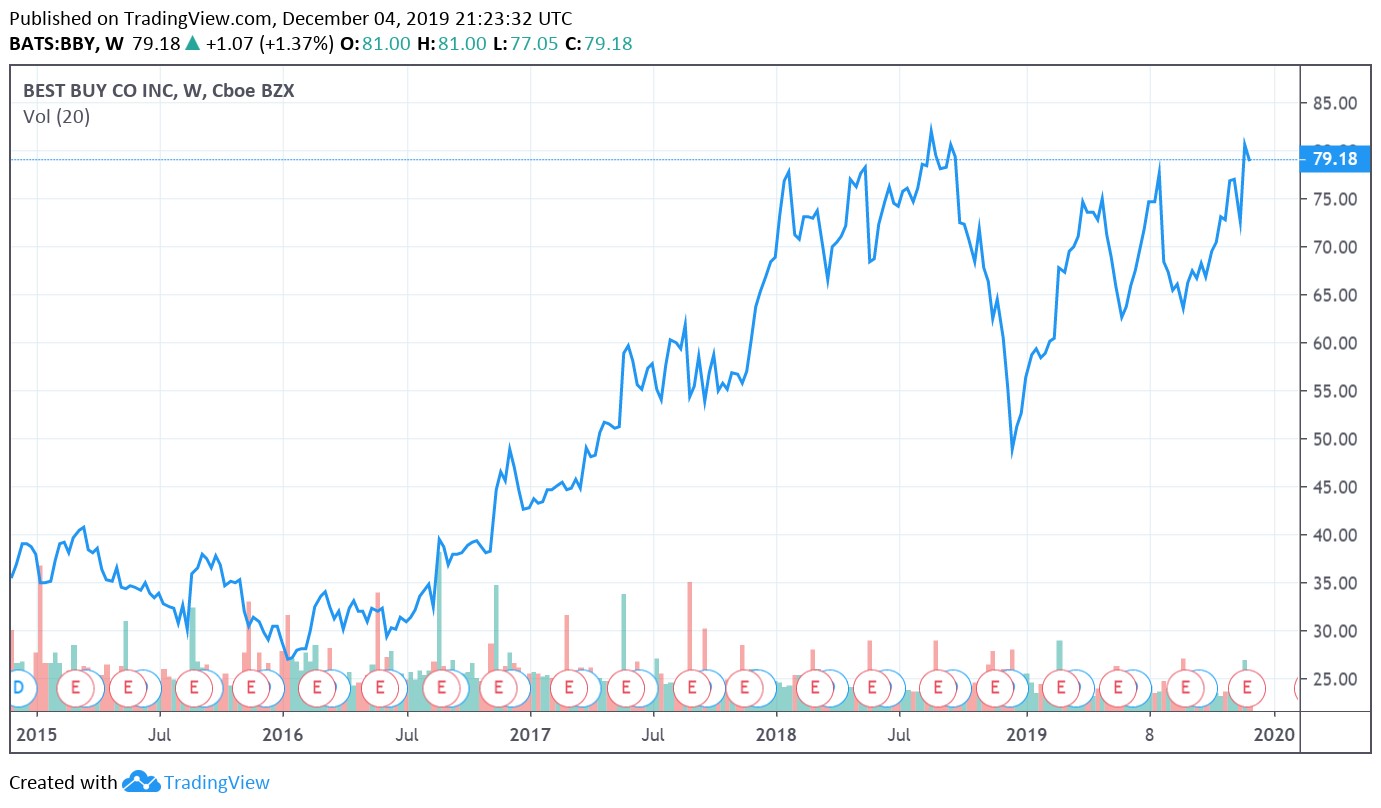
Image Shown: Best Buy Co Inc has staged an impressive rebound over the past few years. This rebound was aided by significant investments in its digital presence, recognizing the core markets Best Buy wanted to target, and ultimately comparable store sales growth.
By Callum Turcan
On November 26, Best Buy (BBY) reported third quarter earnings for its fiscal 2020 (three month period ended November 2, 2019) that beat both top- and bottom-line consensus estimates. Even better, Best Buy raised its guidance for fiscal 2020, largely on the back of stronger than expected same-store sales growth. Best Buy’s update helped send shares of BBY over our fair value estimate of $76 per share, and if this outperformance is sustained, the retailer may march towards the upper end of our fair value range estimate (which currently sits at $95 per share). Shares of BBY yield 2.5% as of this writing, and we like the firm’s dividend growth prospects. However, we caution that Best Buy remains very exposed to the US-China trade war, and we don’t include shares of BBY in our newsletter portfolios in large part due to the downside risks exogenous forces impose.
Guidance Boost
Management raised the bottom end of Best Buy’s revenue guidance for fiscal 2020 (enterprise revenue now expected at $43.2-$43.6 billion versus $43.1-$43.6 billion previously) as the company raised its forecast for enterprise same-store sales growth to 1%-2% (versus 0.7%-1.7% previously). Raising comparable sales growth estimates at this junction, in our view, is a sign of Best Buy’s confidence in the retailer’s upcoming holiday sales performance. In particular, sales of appliance, computing, and mobile phone offerings have performed quite well during the first nine months of Best Buy’s fiscal 2020. Past investments in Best Buy’s digital presence have also been key (from Best Buy’s latest quarterly report);
“Domestic online revenue of $1.40 billion increased 15.0% on a comparable basis primarily due to higher average order values. As a percentage of total Domestic revenue, online revenue increased approximately 180 basis points to 15.6% versus 13.8% last year.”
Furthermore, Best Buy is now targeting marginal/modest improvements in its adjusted (non-GAAP) operating margins and a lower (non-GAAP) effective corporate income tax rate in fiscal 2020 on a year-over-year basis. Combined, these factors enabled Best Buy to boost its full-year adjusted (non-GAAP) diluted EPS forecast to $5.81-$5.91 for fiscal 2020 versus $5.60-$5.75 previously. Best Buy’s updated outlook speaking favorably towards management’s long-term plan, dubbed ‘Building the New Blue.’
Looking Ahead
Over the long-haul, Best Buy is targeting decent revenue growth (assisted by recent acquisition activity that we’ll cover in a moment) and meaningful cost reductions. By Best Buy’s fiscal 2025, management has three key financial targets in mind as part of the firm’s Building the New Blue strategy (please note these targets were last updated on September 2019):
1) “Enterprise revenue of $50 billion, which compares to the company’s current fiscal 2020 guidance of $43.1 billion to $43.6 billion [which has since been revised upwards].”
2) “Non-GAAP operating income rate of 5.0%, which compares to the company’s current fiscal 2020 guidance of flat to slightly up [which has since been revised to “slightly up”] from fiscal 2019’s 4.6% non-GAAP operating income rate.”
3) “$1 billion of additional cost reductions and efficiencies.”
Cost reduction strategies include rationalizing Best Buy’s physical footprint and closing unprofitable/less profitable stores in the US. Rising e-commerce sales also offer opportunities for improvement.
Another aspect of management’s long-term ambitions rests on Best Buy’s acquisition of GreatCall Inc for $0.8 billion in cash that was announced back in August 2018. GreatCall’s connected health and personal emergency response services had 900,000 paying subscribers at the time the deal was announced, with annual revenues in excess of $0.3 billion. Additionally, Best Buy noted the company was profitable. Best Buy forecasts that the deal will be accretive to adjusted (non-GAAP) earnings by its fiscal 2021. Here’s how Best Buy views the GreatCall acquisition fitting into its broader strategy:
“The acquisition is a manifestation of the Best Buy 2020 strategy to enrich lives through technology by addressing key human needs. It is specifically focused on addressing the growing needs of the aging population with the help of technology products, services and solutions. The health space is a large, growing market where technology can help in particular address the needs of aging consumers, their caregivers, payers and providers. Today, there are approximately 50 million Americans over age 65, a number that is expected to increase by more than 50 percent within the next 20 years.
Best Buy currently has a growing business selling health- and wellness-related products. It also has recently been investing in health-related initiatives focused on the aging population that have included the participation of several of the nation’s leading health care providers and insurers. The acquisition of GreatCall will augment Best Buy’s existing efforts in the health space, help bring compelling solutions to more customers, and help fuel Best Buy’s further growth in the consumer and commercial markets.”
We are supportive of Best Buy’s efforts to move into less conventional markets where the company could still play a leading role in by leaning on its existing strengths. Combining the infrastructure and workforce gained from GreatCall with the existing scale and clout of Best Buy augments the growth trajectory of its healthcare-related product and most importantly service sales. Please note that at the end of November 2, 2019, Best Buy’s net debt load stood at less than $0.05 billion.
While Best Buy’s ‘Services’ segment represented only 6% of its domestic revenue streams during the third quarter of its fiscal 2020, note that comparable store sales were up 12.9% year-over-year. On the international front, Best Buy’s ‘Services’ segment represented 6% of the division’s revenue and produced 11.5% year-over-year comparable store sales growth. Over the coming quarters, we’ll get a better idea of how well Best Buy’s healthcare strategy is panning out with an eye towards (presumably) higher-margin services revenue.
Concluding Thoughts
Best Buy has been performing well of late, but we caution that the firm remains heavily exposed to the US-China trade war. International sales represent just a sliver of company-wide sales. Best Buy’s company-wide gross margins were broadly flat year-over-year during its latest earnings cycle, but we caution that the firm would have little choice but to pass on price increases to consumers should additional planned US tariffs on Chinese imports go into effect December 15. We will continue to keep a close key on the retailing space, and members interesting in reading more on the subject should check out our thoughts on Walmart Inc’s (WMT) latest earnings report here.
If you may wish to add the High Yield Dividend Newsletter to your membership, please click here.
Specialty Retailers Industry – AAN BBBY BBY GME HD LOW LL ODP SHW TSCO WSM
Food Retailing Industry – CASY COST CVS KR SYY TGT WBA WMT
Related: AMZN, RTH
———-
Valuentum members have access to our 16-page stock reports, Valuentum Buying Index ratings, Dividend Cushion ratios, fair value estimates and ranges, dividend reports and more. Not a member? Subscribe today. The first 14 days are free.
Callum Turcan does not own shares in any of the securities mentioned above. Some of the companies written about in this article may be included in Valuentum’s simulated newsletter portfolios. Contact Valuentum for more information about its editorial policies.